


June 17, 2025, 7:26 am | Read time: 4 minutes
Growing your own vegetables is an exciting endeavor. Watching a seed transform into food on our plates within weeks or months is impressive. Unfortunately, home gardening comes with its own set of challenges. myHOMEBOOK gardening expert Franka Kruse-Gering explains why young plants sometimes stop growing and remain small.
Tomatoes, cucumbers, and even bell peppers are popular vegetables for home gardening. Initially, you see two small cotyledons, and then you can observe growth spurts in the young vegetable plants. But what if the plant simply doesn’t want to grow and remains small? The fault may actually lie with us–but not necessarily.
Follow myHOMEBOOK on WhatsApp now
1. The soil doesn’t have enough nutrients
You can grow vegetables in a garden bed–but also in a pot. In both cases, it’s important that the soil provides enough nutrients; otherwise, there’s a risk that the young vegetable plants will remain small. This is especially essential for heavy feeders like tomatoes. You can mix some compost into the soil when planting. Horn shavings are also suitable as a long-term fertilizer.
If nothing helps, you should conduct a soil analysis. You can find soil analysis kits or pH test strips at well-stocked hardware stores. If the soil analysis doesn’t reveal any abnormalities, you need to continue searching for the cause of the stunted growth.
2. The vegetable plants have too much water
Regular watering is important, but it shouldn’t be too much. In my garden, I often see water standing in my pot saucers. I might have been a bit too generous. A drainage system in the pot is essential so that excess water can drain away. If the pot has drainage, water can occasionally stand in the saucer. Without drainage, the soil is always in contact with water through the holes in the pot. The roots are continuously moist, which causes them to rot and die. As a result, the vegetable plants remain small and may even die completely.
Pricking Out Plants: What Does It Involve?
How to Repot Houseplants Correctly
3. Roots are damaged during planting
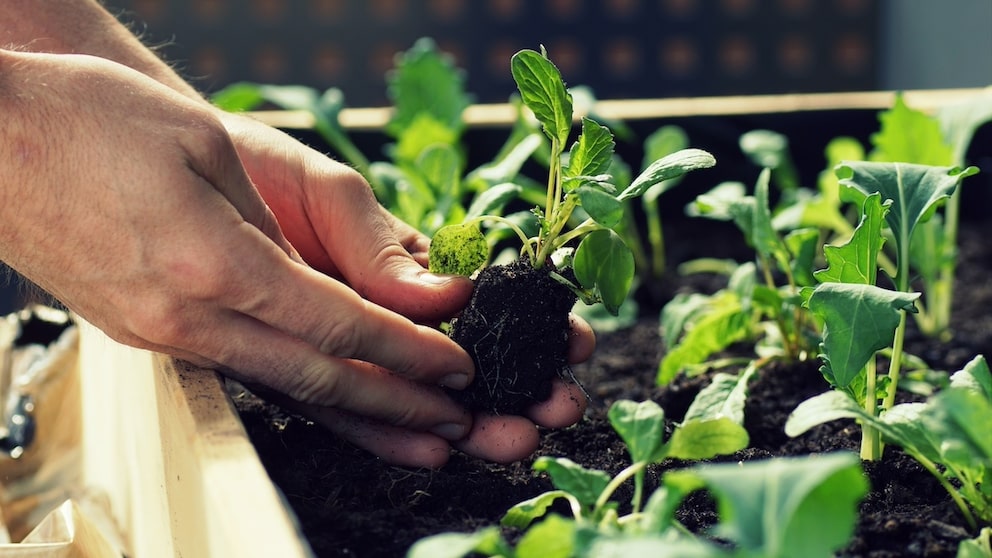
The roots of young vegetable plants are very sensitive. It’s common for them to be damaged during planting. Therefore, it’s advisable to ensure that enough soil surrounds the root ball. The hole for the plant should also be large enough in advance.
In my early days, I often found that the hole was too small, so I set the young plant aside and dug the hole larger. By constantly setting it down, the soil separates from the roots, leaving them unprotected. They also experience repeated shocks. This “root damage” takes its toll. The plant is no longer able to absorb enough nutrients and grows poorly as a result. Here’s a tip on how to determine the perfect size for a planting hole.
4. Too low temperatures
Sometimes, it’s not your fault that the young vegetable plants remain small. Nature occasionally throws a wrench in the works. However, you should wait until after the Ice Saints to plant. Only after these days in May can you almost be sure that there will be no more frost.
Of course, exceptions prove the rule. Young vegetables are very temperature-sensitive. They need warmth to grow, and sunlight is equally important. If the weather is rather mixed and it doesn’t get nice and warm or the sun doesn’t shine for more than half an hour a day, there are consequences.
Then the chances are slim that large, strong plants will develop. Under such conditions, they fall into a growth standstill. In such cases, you should support the young plants. This can be done with warming fleece or even plastic bottles that can be used as mini-greenhouses. So-called plant hats can also help protect the young vegetable plant from the cold.