

August 27, 2025, 4:57 am | Read time: 3 minutes
Whether roses, vegetables, or lawns, the type of garden soil has a decisive impact on care and success in the bed. Knowing the ground you’re planting on allows for more targeted gardening—and prevents many problems. myHOMEBOOK explains how to determine soil type without immediately involving a lab.
Why Soil Type Matters
Whether a soil is sandy, loamy, or clayey directly affects water absorption, nutrient storage, and root growth. Knowing your soil structure allows for more precise use of fertilizers and water. This not only saves time and money but also increases yields and improves plant health.
For those who want precise information, a professional analysis can be commissioned: Agricultural testing and research institutes (LUFA) offer affordable lab tests in all federal states.
Quick Overview with the Finger Test
But there’s an easier way. The German Nature Conservation Association (Nabu) recommends a simple method: the finger test. All you need is a small handful of soil and some water from a spray bottle.
Instructions for the Finger Test
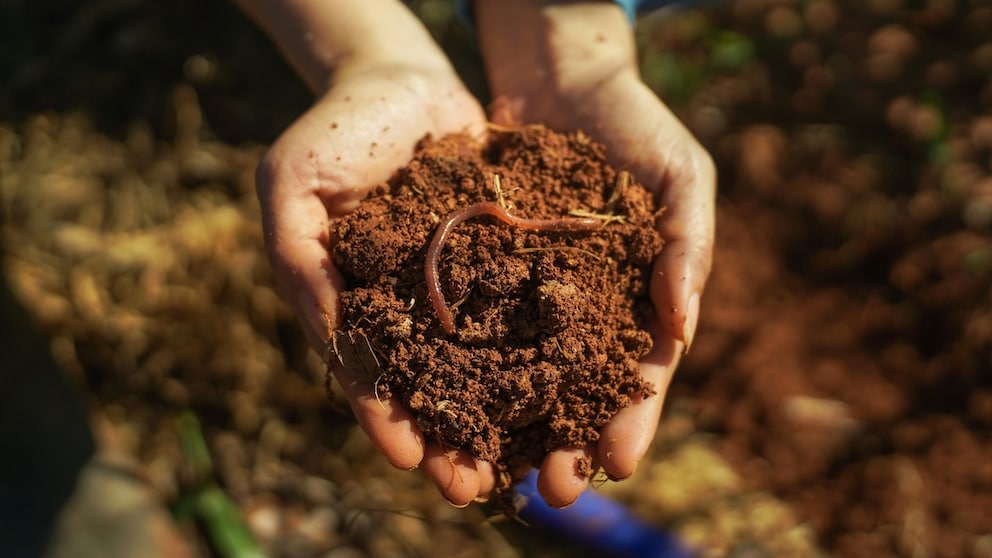
Take some soil in your hand and moisten it with the spray bottle. Then roll the soil a bit in your hand.
- Sand: The grains are visible, the soil does not stick to the hand, cannot be shaped, and falls apart.
- Silt: The surface is rough but powdery. The soil is not very moldable, hardly adheres, and feels dusty.
- Clay: Easily forms into a roll, sticks noticeably to the hand, with a smooth and shiny surface.
What the pH Level Reveals About Garden Soil

Waterlogged Lawn? Expert Explains What to Do
These Soil Types Exist–and How to Identify Them
The key to soil type is the grain size of the components. The distinctions are:
- Sandy Soil: The coarsest variant. Dries out quickly, retains little water or nutrients, and is easy to root through.
- Silt Soil: Finer structure than sand but coarser than clay. Feels powdery, not very moldable.
- Clay Soil: Very fine-grained, sticks strongly, retains water and nutrients well, but is hard to work with.
- Loam Soil: A mix of sand, silt, and clay—usually ideal for many plant types.
In gardening practice, “light” soils often refer to sandy ground, while clay or loamy soils are considered “heavy.”
Light soils allow a lot of air to reach the roots but are low in nutrients and dry out quickly. Heavy soils retain water and fertilizer better but are prone to waterlogging and are difficult to work with.
Which Plants Prefer Which Soil
Not every plant thrives in every soil. “Roses rarely like light sandy soils,” explains master gardener Oliver Fink, chairman of the Association of Garden Nurseries (GBV). However, they thrive effortlessly in loamy soils.
If the desired location in the garden cannot be avoided, the soil can be improved: “With so-called soil activators, you ‘inoculate’ the soil with soil life,” says Fink. It is also optimal to work in some humus—this creates better long-term conditions for demanding plants like roses.
With material from dpa