

November 12, 2026, 2:37 pm | Read time: 4 minutes
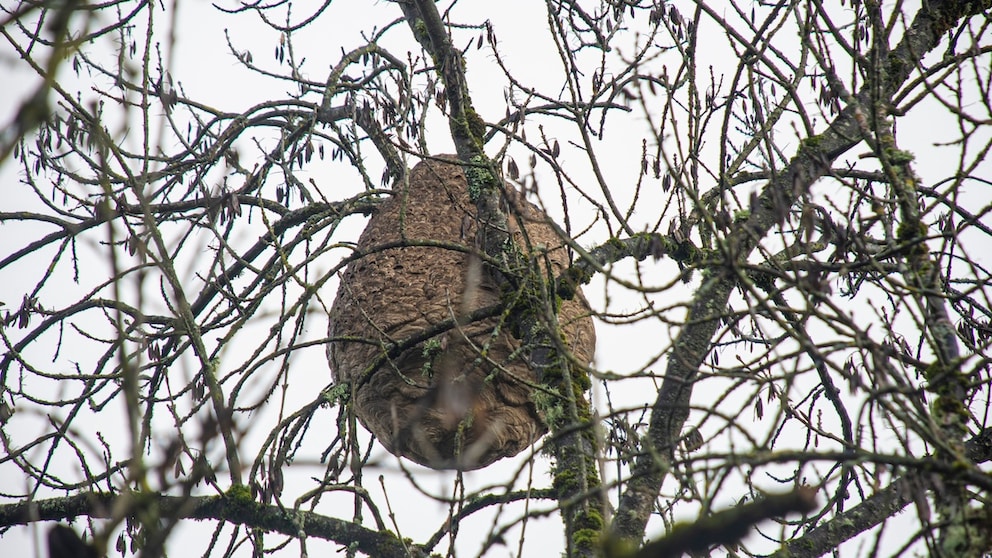
In summer, they often go unnoticed among dense foliage. However, when leaves fall from trees and shrubs in autumn and winter, surprisingly large structures sometimes come into view: the secondary nests of the invasive Asian hornet (Vespa velutina). Such a nest can also suddenly become noticeable when trimming a hedge. The key is to keep your distance and not intervene yourself.
How to Recognize a Nest of the Asian Hornet
The Asian hornet typically builds different nests within a season. In spring, a queen starts with a smaller founding or primary nest. If the colony grows and space becomes insufficient, a significantly larger secondary nest often develops in summer.
According to the State Office for Environmental Protection Saxony-Anhalt (LAU), these secondary nests are usually spherical to egg-shaped. They reach a height of about 60 to 100 centimeters, and the diameter can be up to one meter. Several thousand hornets can inhabit them.
Typically, the large nests hang high in trees. Heights of 10 to 30 meters are possible. However, they can also form on buildings or other sheltered locations, such as in hedges or on facades.
Another distinguishing feature can help: The entrance hole of a secondary nest of the Asian hornet is located on the side. Additionally, the nest is closed at the bottom. This differentiates it from nests of the native European hornet (Vespa crabro).
Also of interest: The penalty for removing a wasp nest
Hornet Nest Discovered: Keep Your Distance
If you come across a suspicious nest in the garden, you should neither open it nor remove it on your own. This is especially true if there are still animals visible. While individual Asian hornets usually pose no threat, they vigorously defend the immediate nest area. During gardening, hedge trimming, or other activities, there is a risk of being stung if people get too close to the nest.
It is also advisable to avoid attempting to remove a seemingly abandoned nest without prior inspection. Especially with high and large nests, there are additional dangers due to the necessary work at height.
First Identify and Report the Find
The first step should be to have the hornet species identified as clearly as possible. This is important because it is possible to confuse it with the native and protected European hornet.
Helpful are informative photos or videos taken from a safe distance. The NABU Naturgucker offers a dedicated reporting portal and information on identifying hornets. There, you can also find guidance on the appropriate reporting options.
Even though the Asian hornet, due to its now changed status as an established invasive species, is no longer subject to the previous EU-wide early detection and eradication obligation, reporting findings remains useful for tracking its spread. The reporting methods and measures can vary depending on the federal state.
Do Not Remove an Inhabited Nest on Your Own
If it is indeed an active nest of the Asian hornet, garden owners should seek expert help. Contacts can include the responsible nature conservation authority, local NABU groups, or beekeeping associations.
A professional assessment is advisable due to the size of many secondary nests. They can contain thousands of insects and hang at heights of 10, 20, or even 30 meters. The specific guidelines and responsibilities for dealing with the invasive species vary regionally. Therefore, it is recommended to clarify the procedure with the relevant state or nature conservation authority.
Related: When insurance covers the removal of a wasp nest

How to Attract Bumblebees to Your Garden or Balcony

The “Black Hornet” Is Actually Called the Violet Carpenter Bee
Are the Large Nests Used Again in Winter?
A large part of the hornet colony does not survive the end of the season. Workers and drones die off, while mated young queens seek protected places to overwinter. The old nest is not reoccupied by the colony the following year.
For garden owners, this does not mean that every nest discovered in late autumn or winter is automatically empty. Whether hornets still inhabit it should not be assumed solely based on the season. In case of doubt, a professional assessment is recommended before removing the nest.
How Dangerous Is the Asian Hornet?
A single Asian hornet is usually not a particular threat to humans. Caution is mainly necessary around an inhabited nest, as the insects can defend it. A sting is painful and generally comparable in effect to that of a native hornet. However, for people with an insect venom allergy, a sting can be dangerous.
The Asian hornet is particularly problematic as an invasive species. Its prey includes honeybees and other insects, which can impact biodiversity and place a burden on beekeeping. In fruit cultivation, its presence can also cause damage or yield losses.
With material from dpa