


April 1, 2026, 8:36 am | Read time: 4 minutes
To keep fruit trees healthy and productive, they need sufficient nutrients. myHOMEBOOK author and gardening expert Katharina Petzholdt explains when fertilization is advisable, which products are suitable, and how to apply them correctly.
Whether apple, pear, or cherry, fruit trees are among the most valuable plants in the garden. With some care and patience, they bear delicious fruit for years. However, each yield takes a toll on the tree. With every harvested fruit, pruned branch, and fallen leaf, it loses nutrients previously taken from the soil. Without replenishing these nutrients, not only does the harvest suffer, but also the tree’s health. Diseases and pests find it easier to attack, growth slows, and fruit quality declines. To keep fruit trees healthy and productive in the long term, regular fertilization is essential, tailored to the tree’s age, location, and season.
When Should You Fertilize Fruit Trees?
In the first year after planting, it’s best to be cautious with fertilization. On normal garden soils, no fertilization is done initially. This encourages root development, as the young tree should actively seek out water and nutrients. Only on poor soils should compost be mixed in to help the tree get started.
From the second year, the tree needs more support. The main fertilization occurs in early spring, ideally in March or April. This is when the tree begins to sprout and needs energy for new growth.
A second fertilization can take place in June after the summer solstice. At this point, the tree shifts from vegetative to generative growth. During this phase, it focuses on fruit ripening and also sets buds for the following year. Fertilizers rich in potassium and phosphorus are particularly needed now, while nitrogen should be used sparingly.
Related: Coffee Grounds as Fertilizer? For These Plants, It’s Worth It
Fertilizing Zucchini: Top Tips for a Bountiful Harvest
How to Make Old Soil Fertile Again
What Should You Use to Fertilize Fruit Trees?
Organic fertilizers are always the first choice for natural gardening. Compost, as well as well-rotted manure, horn meal, sheep wool, or plant-based liquid fertilizers, not only improve nutrient supply but also enhance soil life and structure.
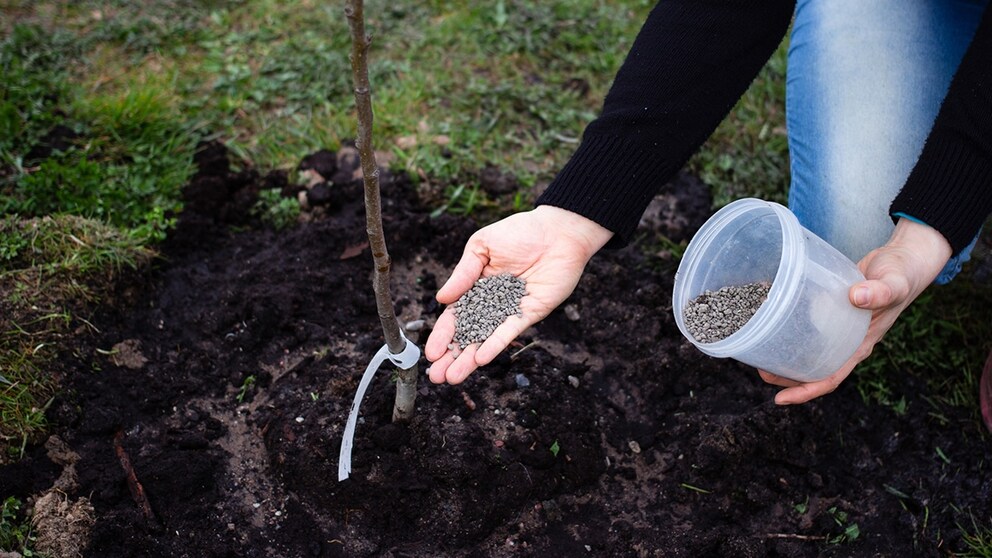
In the first few years, about one to one and a half liters of compost and around ten grams of horn meal per tree are sufficient. As the tree ages and grows, its needs increase: mature trees can effectively use four liters of compost and up to 140 grams of horn meal annually, ideally applied in late March.
If you prefer to avoid animal products, you can use so-called “vegan horn shavings.” They release nutrients slowly and can be easily combined with compost.
Mineral fertilizers are also an option. Natural variants like rock dust are suitable for targeted nutrient supplementation. Synthetic fertilizers can also be used, acting quickly, but are often unnecessary in home gardens. A balanced, organic-based fertilization is generally the more sustainable and safer choice.
How Should You Fertilize Fruit Trees?
Fertilizing on Open, Bare Ground
The so-called tree disc—the area around the trunk—should be kept free of vegetation. A diameter of about one meter is sufficient. Here, the fertilizer is evenly distributed and lightly worked into the soil. It’s crucial not to fertilize only directly at the trunk. The fine root tips, which absorb nutrients most effectively, are located at the edge of the canopy drip line, at the outer edge of the tree crown.
Fertilizing on Lawns or Vegetated Areas
If the tree is in a meadow or on a lawn, nutrient application is a bit more challenging. In such cases, deep slits can be cut into the soil at regular intervals around the outer canopy area using a spade. The fertilizer is placed in these slits, so it reaches the roots directly—without being intercepted by surrounding vegetation.