


May 15, 2026, 10:07 am | Read time: 5 minutes
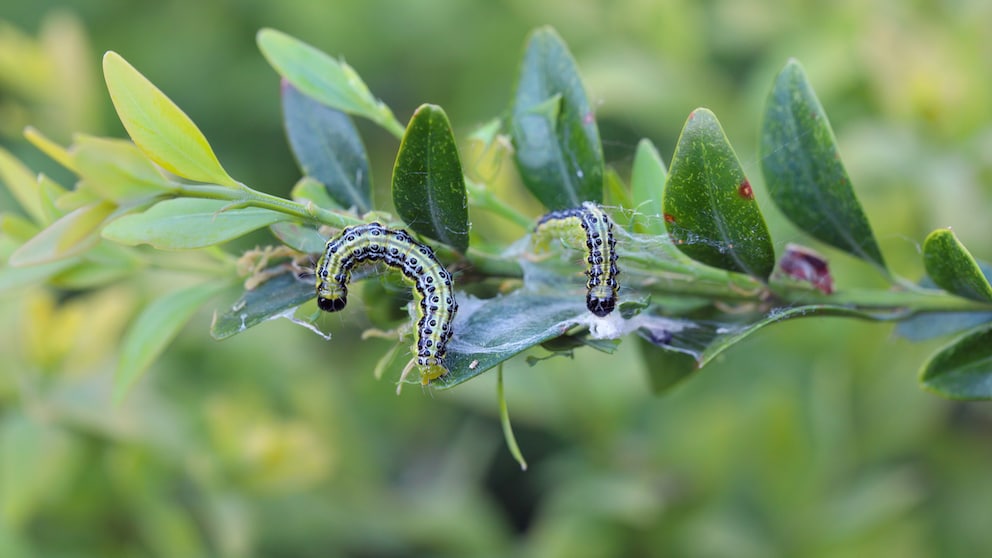
As a border plant or in a container, boxwood makes quite an impression. However, the evergreen shrub is currently being plagued by the box tree moth and its voracious caterpillars. A family that leaves no leaf behind. How to get rid of the caterpillars is explained by myHOMEBOOK in this article.
The box tree moth originally comes from Asia. Due to globalization, the moth has now also arrived in Germany. Here, the caterpillars of the small moth cause damage in many gardens. As the name suggests, boxwood is on the insects’ menu. The caterpillars, about two inches long, work from the inside out, making an infestation initially difficult to detect.
Overview
How dangerous is the box tree moth?
The box tree moth is not truly dangerous. The boxwood does not die from the infestation, explains the Agricultural Technology Center Augustenberg in Karlsruhe. Once the leaves are eaten, the caterpillars usually move on. Sometimes the bark is also nibbled. So, it’s only a cosmetic issue, but it’s still a nuisance for gardeners.
How can the box tree moth be controlled?
Biological sprays are particularly useful at two times. According to the Technology Center Augustenberg, this is in the second half of April to target the caterpillars that have overwintered on the shrubs and are now feeding. The second spraying should occur in the first half of July to target the first generation of offspring.
It’s important to spray only when you see the caterpillars feeding on the leaves. Earlier, the spray won’t reach them as they are still in their winter cocoons made of spun leaves. Additionally, the pesticide must reach all the foliage, including the interior of the boxwood. The German Nature Conservation Association (Nabu) advises against using chemical agents to combat the box tree moth. The poison also harms other insects and nature. According to Nabu, more and more native birds are developing a taste for the insect. Those who make their garden bird-friendly can rely on the hungry beaks of tits and sparrows to get rid of the box tree moth.
Additionally, an early pruning of the boxwoods and collecting the larvae in April can help, as well as another pruning in September to remove the offspring that will overwinter again. The Bavarian Garden Academy also recommends spraying with a strong jet of water.
Related: Japanese holly–a good alternative to boxwood
Controlling the box tree moth–what methods help?
Experts from the Technology Center Augustenberg recommend products based on the spores of the bacterium Bacillus thuringiensis subsp. kurstaki. It works exclusively against caterpillars that consume the spores and is therefore considered harmless to, for example, ladybugs and pets.
Do I need to dispose of cut green waste separately?
It depends on the timing. If there are mature larvae, they can still develop on the cut branches. This is possible from the end of May to mid-August. In that case, the clippings should be bagged and disposed of with regular trash or left in the sun for a few days before composting.
How successful is it to control the box tree moth?
Experts believe that the box tree moth can no longer be eradicated in Germany and must therefore be controlled anew each year. However, the plants themselves will recover and sprout again. The experts from the Technology Center conclude: Controlling the box tree moth is generally “possible with relatively little effort” and can be integrated into annual gardening with two control dates.
Also interesting: Successfully combating leaf miners in the garden–here’s how
However, the defoliation bothers many gardeners. For a while, their boxwood doesn’t look nice and will repeatedly lose mass. Many gardening professionals now advise switching to other plants. This is also due to a second problem that boxwoods increasingly face. A fungus called Cylindrocladium buxicola turns the leaves brown, which later fall off. This is also known as dieback.

Dense, Fast-Growing, Evergreen – 14 Popular Hedge Species for the Garden
The Secret Behind the Trash Bag Trick Against the Box Tree Moth
What can be done against the fungus?
If detected early, the plant can be pruned back vigorously. However, in most cases, removal is necessary–both of the affected and neighboring boxwoods, even if they still appear healthy, the experts explain. Fungicides do not help; they only provide preventive protection.
Also interesting: How to combat fungi on gooseberries and currants
What are good alternatives to boxwood?
Evergreen conifers are the recommendation of the Federal Association of Horticulture and Landscaping (BGL). Many species and varieties have similar growth habits. Additionally, they can be easily shaped like boxwood through pruning. Good plants for privacy screens include juniper (Juniperus), yew (Taxus), or false cypress (Chamaecyparis). The experts from Augustenberg also mention holly and barberry (Berberis buxifolia) as evergreens.
In specialty stores, new cultivars are deliberately marketed as boxwood replacements, including the yew variety ‘Renkes Kleiner Grüner’ (Taxus baccata) and the rhododendron called Bloombux (Rhododendron hirsutum x micranthum), which is especially popular for border plantings.
with material from dpa