



November 11, 2026, 12:37 pm | Read time: 5 minutes
A small plant in a large pot. That sounds like room to grow, but it can backfire. More space in the pot doesn’t always mean better growth for the plant. Why the right pot size is crucial for plants and when it’s time to repot is explained by myHOMEBOOK.
Plant roots don’t care about centimeters. They want two things simultaneously: water and air. Both are in the soil, but they share the space. Where water is, there’s no air. The more soil in the pot, the more water it can store. If the plant doesn’t use it quickly enough, the soil stays wet for a long time, and air becomes scarce. The pot size depends on how much water the plant uses. Beate Kollatz, an ornamental plant cultivation expert at the Saxon State Office for Environment, Agriculture and Geology in Dresden-Pillnitz, summarizes it this way: “The decisive factor is not the pot size, but the substrate moisture!”
Does a Pot That’s Too Large Harm the Plant?
A pot that’s too large doesn’t inherently harm the plant. It just tempts you to overwater. “A small plant doesn’t evaporate much water. A large substrate volume can store a lot of water,” the expert explains. If you water again before the large soil mass has dried out, the roots sit in water like a sponge that no one squeezes. They lack oxygen and start to rot.
Problems can also arise the other way around. If a large pot is only supplied with small amounts of water from the saucer, the water struggles to reach the roots at the top. The plant is thirsty in the giant pot.
Also interesting: How to Repot Houseplants Correctly
How to Recognize a Pot That’s Too Small
Three signs reveal a pot that’s too small. Roots grow out of the drainage hole, the root ball consists almost entirely of roots with barely visible soil, and the plant hardly grows anymore. “If all these statements apply, you should repot,” says the expert. It’s obvious that a pot that’s too small is harmful. Where there’s little soil, there’s a lack of storage for water and nutrients, and the plant dries out faster and starves.
Rule of Thumb: How Much Larger Can the New Pot Be?
The rule of thumb is a range. The new pot can have a diameter two to five centimeters larger. The expert considers a fixed number unnecessary: “You don’t have to stick to an exact value. Plants are living beings and can’t be forced into a tight corset.”
With regular repotting, about two centimeters more is sufficient. If the last repotting was a long time ago and there’s hardly any soil left in the root ball, it can be about five. Growth also plays a role: Fast and lush-growing plants get the larger pot, and slanted walls create a different volume than vertical ones.
Centimeters are most misleading with small pots. Kollatz calculates: “If I repot from a 6-cm pot to an 8-cm pot, the pot volume almost doubles.” With an 11-cm pot, just five centimeters more, it would be almost five times as much. In a large container, such an increase doesn’t matter, but in a small pot, it multiplies the soil and with it the water that remains.
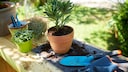
What to Consider When Repotting Potted Plants
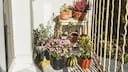
4 Common Mistakes in Caring for Potted Plants
The Type of Plant Determines the Space Needed
How much soil a plant needs depends on its type. Drought-tolerant species like cacti or the bulb plant amaryllis grow well in smaller pots as long as other conditions are right. For others, it’s the opposite, explains Kollatz: “Plants that need more water (such as hydrangeas) should also have enough soil in the pot to store this water. And plants like monstera or philodendron, which have strong roots, also need more space.” For all pots, it’s essential to have a drainage hole for excess water to escape.
Container Plants Outdoors: Here, the Sky Waters Too
The same logic applies to container plants outdoors as to potted plants indoors, but outside, the weather plays a role. Here, plants are often placed in a slightly larger pot to prevent them from toppling over in the wind. The rain waters them uninvited. If you water again after a shower, the pot quickly becomes too wet. In high summer, it’s the opposite. A large plant in the sun evaporates a lot and empties its pot quickly. Then, a lot of soil is no longer a risk but a reserve.
A pot is suitable if the soil can dry out between waterings.
Good to Know: Clay Pots
Unglazed clay is porous. It absorbs water and releases it through the wall. Therefore, the substrate in a clay pot dries out faster than in a plastic pot, and a new pot initially draws moisture from the fresh soil. It should be soaked for a while before planting, and shorter watering intervals should be expected with clay pots.