


July 30, 2026, 4:27 am | Read time: 7 minutes
A container garden can become a disaster during hot and dry summers. Whether it does is often determined before the first watering. Find out why and what well-functioning container gardens look like here on myHOMEBOOK.
There are plants for which a hot August is the best time of the year. Thyme and rosemary smell more intense when the sun is blazing, and houseleek and stonecrop stand relaxed where a hydrangea would have long wilted. A container garden that gathers the right species has half won the summer.
But only half. Because under all pots, whether on a balcony, terrace, or courtyard pavement, the same thing is missing: soil. In regular beds, roots draw water and nutrients from deeper, cooler layers. In a pot, the plant’s world ends at the container wall after 30 centimeters, with heated stone below. The heat periods that charge it are becoming longer and more intense with the climate crisis. Every measure against heat, therefore, builds buffers where the pot provides none. How to achieve this, myHOMEBOOK asked garden designer Annette Lepple, author of the book “My Garden Grows in a Pot.”
Follow myHOMEBOOK on WhatsApp now
Why a Large Container Is More Effective Than the Right Material
The most effective buffer is volume. “Large containers retain moisture longer than small ones,” says Lepple. The temperature in the root zone fluctuates more slowly with larger amounts of soil, and the water supply lasts throughout the day. Lepple’s planting recommendations start at 40 liters. If it’s significantly less, both plant and gardener suffer, just at different ends: one from too little water, the other from carrying too much.
While volume has the greatest impact, the material is not insignificant. In southern exposures, the garden designer advises against dark and metallic containers. The difference can be felt by hand: touch the sunny side of a dark container on a summer afternoon and then the shaded side of the same pot. On one side, the roots are grilled; on the other, the heat is bearable.
With clay, advantages and disadvantages are close together. The thick wall dampens the temperature, and the unglazed clay constantly releases some moisture through its pores. It cools like a damp cloth on the forehead, but this is paid for with the water you wanted to save. Lepple’s verdict is still clear: “High-quality, frost-resistant clay pots always work.” Those who want to avoid evaporation loss should opt for glazed ware, where the closed surface retains moisture in the pot. If clay cannot be placed on the balcony for static reasons, opt for light containers made of fiberglass or other plastic and compensate for the thinner wall with volume.
Peat-Free Soil That Retains Moisture
The next buffer is in the substrate, as many container garden plantings fail in summer due to the soil. Commercial potting soil often contains peat, which, once dried out, hardly absorbs water, causing the watering to run unused downwards. The root ball remains bone dry, and the liters rush into the gutter. There’s also the ecological cost: peat extraction destroys bogs, which store large amounts of carbon even in small areas.
Lepple recommends a different base: “Clay-rich, peat-free substrates are ideal.” They retain moisture longer and better supply plants with nutrients.
Her mixing tip for those with their own garden:
- one-third mature compost
- two-thirds garden soil
- some bark humus
- an organic nitrogen fertilizer like horn shavings
Those without their own garden should use a peat-free substrate for Mediterranean plants and enrich it with some compost.
For root aeration and storage capacity, additives like coconut fibers, lava granulate, sheep wool pellets, or vermiculite are used. Succulents, on the other hand, thrive effortlessly in nutrient-poor, gravelly-sandy soil.
Also interesting: The trend for hobby gardeners with limited space
Saving Water with Mulch
Mulch is the jack-of-all-trades in gardening–even in container gardens in summer. “Mulching conserves moisture, suppresses weeds, and promotes soil health,” explains garden designer Lepple.
The suitable material depends on the planting. For shrubs and perennials, organic material like compost, grass clippings, or chippings is suitable. Mediterranean herbs and succulents prefer fine gravel or grit. They would take offense to moist chippings at the stem base and might rot away.
Also interesting: Which bark mulch alternatives suit which plants
Drought Artists and Thirsty Classics
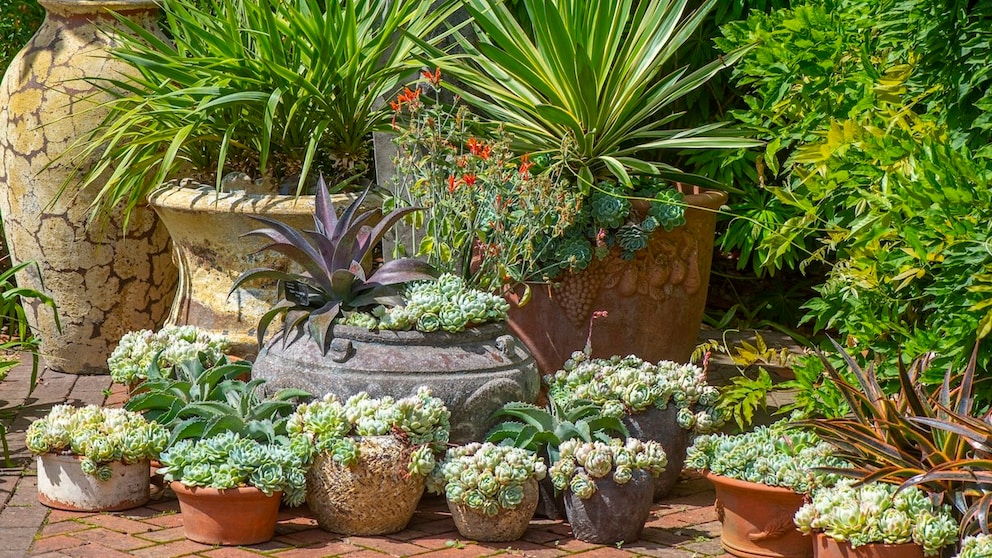
The smartest measures are just smoke and mirrors if the plant in the container garden is in a location it would never choose itself–especially in summer. Annette Lepple’s candidates for hot southern exposures: “Species from the Mediterranean region like lavender, oregano, rosemary, rockrose, thyme, some of which can be used in the kitchen. But also succulents like houseleek, stonecrop, and ice plant are in their element there. Mediterranean herbs and succulents can be beautifully combined. The latter can be attractively arranged in shallow bowls.” All these species are highly favored by insects.
Those who prefer less southern options can be guided by steppe flora. “Flax, thistles, blue fescue, globe allium, feather grass, and steppe or spurge enchant with their wild charm for weeks,” says Lepple.
Lepple also recommends oleander and lantana, two classics in container gardens. However, with a caveat, as they require significantly more water. Good to know: Oleander is highly toxic to humans and animals in all parts.
The Advantage of Perennial Species
Nearly all the species Lepple recommends are perennial. This is the same buffer again, this time calculated over time. An annual planted in May must first develop its root system while the heat is already rolling in. A lavender that has been in the same pot for the second season has long rooted through the substrate and reaches the moisture even in the lower centimeters.
The price for this is a winter plan. A container, unlike a bed, stands in the cold from all sides and freezes through faster. Frost-hardy varieties are therefore only half the battle. Additional measures include moving pots to the house wall, placing them on wood or Styrofoam, and wrapping them in burlap if necessary. Oleander and lantana overwinter best frost-free indoors. However, oleander can withstand short frost periods unscathed. Lantana sometimes sheds all its leaves in the winter quarters but sprouts again after a spring pruning.
What to Consider When Repotting Potted Plants
4 Common Mistakes in Caring for Potted Plants
Two Plant Combinations by Annette Lepple to Recreate
- “Mediterranean Aroma and Fragrance Oasis”: Edible herbs and fragrant subshrubs, pot size: 50 liters. Species: Rosemary Salvia rosmarinus ‘Arp’ (syn. Rosmarinus officinalis), ornamental oregano Origanum laevigatum ‘Herrenhausen’, thyme Thymus vulgaris ‘Orange Spice’.
- “Steppe Design: Structure and Movement”: Delicate grasses and architectural perennials, pot size: 50 liters. Species: Perennial flax Linum perenne, blue fescue Festuca glauca, spurge Euphorbia myrsinites. Additionally, as a bulb: globe allium Allium sphaerocephalon, planted among the perennials in autumn. Note: The sap of spurge irritates skin and eyes. It’s better to wear gloves when pruning.
The Added Value of the Watering Can
Regarding watering technique, the expert prefers good old manual labor, even though an automatic system can bridge longer absences and a moisture meter helps with assessment. “In my opinion, nothing beats individual watering with a can,” she says. Because those who stand in front of their pots daily, preferably in the cool morning hours, are most likely to notice where water replenishment is urgently needed and where the watering can can pass by.