


June 22, 2026, 3:23 pm | Read time: 4 minutes
Garden enthusiasts now have many options for watering their plants and lawns. myHOMEBOOK spoke with an expert about which of the various irrigation systems on the market is best suited for one’s own garden.
“Anyone planning a garden today should definitely consider a suitable irrigation system,” emphasizes Torsten Brämer. Since 2014, he has been running “Wir sind Garten”, the largest German-speaking garden community online.
Overhead Irrigation Not a Good Solution
Many people still think of watering flowers, beds, and lawns with a watering can and hose. “Many garden enthusiasts have now realized: These methods are not only laborious but also an ecological disaster,” explains garden expert Torsten Brämer. “Especially with large-scale watering by hose, the moisture evaporates on the surface. Sustainable irrigation works differently today.”
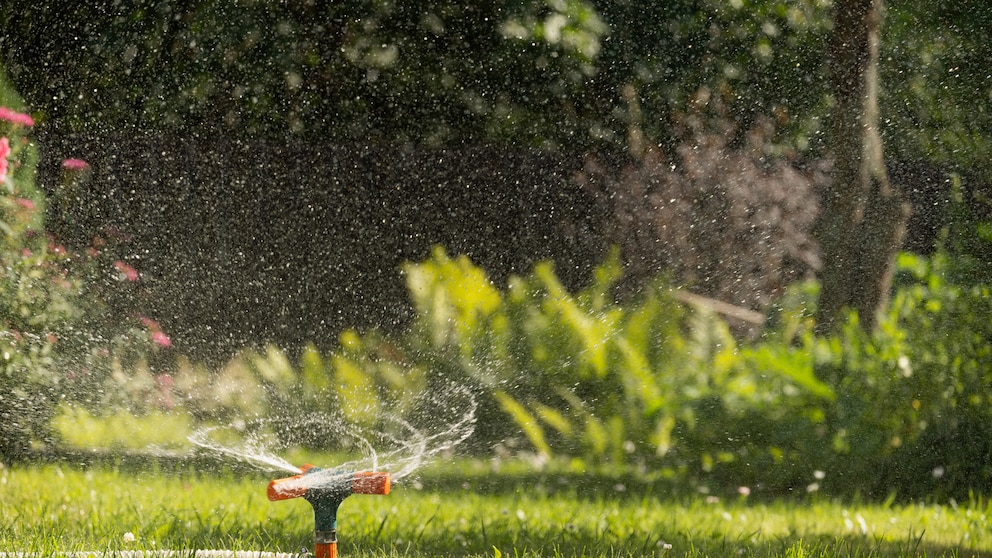
That’s why Brämer also advises against traditional lawn sprinklers. “Like with a hose, overhead irrigation works. The water not only evaporates unused but also hits the surrounding plants. The droplets on the leaves then create an excellent entry point for pests of all kinds,” explains Torsten Brämer, recommending switching to other irrigation systems in the garden.
If you’re not around to water the lawn on hot summer days, don’t worry about the first brown spots. “Grass is a steppe plant and can handle being without water. Even if the green turns to brown on summer days, it doesn’t matter. The lawn will recover on its own with the next rain,” explains Torsten Brämer from the garden community “Wir sind Garten.”
Drip Irrigation: Regular and Economical
In recent years, the so-called drip irrigation has become increasingly popular for watering beds and flowers. Hoses laid on the ground provide targeted and regular watering. Due to the holes in the hoses, it works in a drip manner. This not only reduces water consumption but also ensures the water reaches the plant directly and doesn’t evaporate ineffectively.
“There are now systems in all shapes and sizes, from small solar-powered modules for the balcony to large installations for gardens with several hundred square meters,” says garden expert Torsten Brämer. The small irrigation systems for the balcony are perfectly adequate when a long weekend calls and there’s no watering hand available during absence.
Irrigation systems for larger gardens and beds now come with many smart additional features. For example, such systems have sensors that measure soil moisture or react to rainfall. If the soil is moist enough or it starts to rain, the automatic irrigation stops.

Does Gardening with AI Work? What AI Planning Apps Can Really Do

How Often Should You Clean a Rain Barrel and Cistern?
Smart Irrigation Systems
The devices perform different functions. Homematic IP provides a watering computer as a base. This can be integrated between an outdoor faucet and a hose. Behind it is a drip irrigation system. This is then controlled by the intermediate computer, allowing various watering scenarios to be set up via an app or automatic watering plans to be created.
MIYO offers a comprehensive solution. The smart system provides multiple interfaces, allowing several irrigation systems to be connected and controlled. The control is also done via a smartphone app. Sensors provide information on the moisture level at any time. Spontaneous plan changes can be made remotely with a few clicks.
The Micro-Drip-System from Gardena works similarly comfortably. Here, too, small hoses in the bed ensure constant, appropriate watering. The entire control is via an app, allowing changes to be made at any time and, for example, to respond to special weather conditions.
The Effort for Setup Is Worth It
“Regardless of the manufacturer, all systems that rely on drip irrigation are superior to traditional methods like hoses or watering cans,” emphasizes Torsten Brämer, founder of the online garden community “Wir sind Garten.” “It’s important to note that most of these systems are not winterproof. Therefore, the hoses should be removed at the start of the cold season.” A manageable effort, as bed maintenance is reduced to a minimum during the summer period due to automatic, regular watering.
However, setting up such a system requires time. This time is well invested if the system is properly integrated into one’s own bed. Hand watering becomes almost unnecessary. At the same time, such an irrigation system reduces water consumption due to the smart additional features.
The costs are certainly not to be underestimated. Depending on the system, one-time costs range from 50 to 300 euros. Larger systems can also cost 500 euros or more. However, the expense is justified, as such irrigation systems, when properly set up, work better than hand watering.