

July 30, 2026, 11:14 am | Read time: 4 minutes
They form massive colonies, spread across several states, and can even cause damage to buildings and technical infrastructure. Anyone who discovers the giant gland ant should take notice, as experts say this invasive species poses a challenge to nature and residential areas.
How to Identify the Giant Gland Ant
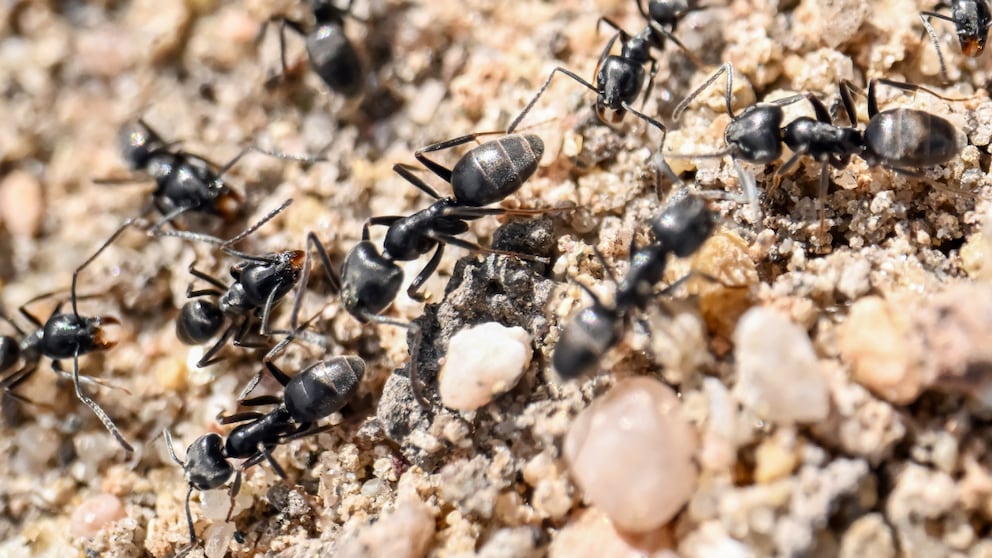
The giant gland ant (Tapinoma magnum) is particularly noticeable due to its black color and massive presence. The ants live in so-called supercolonies, which is why many ants are often observed at the same time.
An important identifying feature is the varying size of the workers within the same colony. According to the German Environment Agency (UBA), the ants range from two to five millimeters in size. In contrast, native ant species usually have workers of uniform size.
The Stuttgart Museum of Natural History recommends luring the ants with some sugar syrup onto a white sheet of paper and placing a measuring tape next to them. This makes it easier to determine their size.
Also noticeable are wide, sometimes multi-lane ant trails. In contrast, the native black garden ant, which the invasive species resembles visually, usually creates single-lane paths. Sand and soil are often thrown out at the entrances of the nests.
If the colony is disturbed, the ants react aggressively and swarm out of their nests in large numbers. According to the Stuttgart Museum of Natural History, they also emit a characteristic odor when irritated, described as lemony, rancid, or reminiscent of acetone.
Another distinguishing feature: The giant gland ant remains active even at cooler temperatures and can still be on the move at about three degrees Celsius. Many native species, including the black garden ant, do not exhibit this behavior.
Anyone who wants to have their suspicion checked can send photos and videos to the Tapinoma Research Project. This is a collaboration between the natural history museums in Stuttgart and Karlsruhe.
The Damage the Invasive Ant Species Can Cause
In general, ants perform important tasks in the ecosystem and are not usually considered a threat to homes or gardens. However, there is concern that the giant gland ant may displace native species.
There are also potential damages in residential areas. The ants build their nests underground, creating extensive systems of interconnected colonies. This can undermine foundations, walkways, and slabs.
In their search for food or warmth, the insects also invade buildings. According to the UBA, they can damage facades and even cause problems with electrical systems.
According to the German Environment Agency, the ants do not pose a direct health threat to humans. However, their strong mandibles and the secreted substance can cause skin irritation.
Insect Spray Doesn’t Work Against Pharaoh Ants—It Actually Promotes Their Reproduction
Underestimated Suffering–The Dark Side of Bumblebee Breeding for Tomato Cultivation
What to Do in Case of Suspicion or Infestation
The German Environment Agency recommends reporting any suspected cases and existing occurrences immediately to the responsible city or municipality. In most cases, the public order office is the point of contact.
For successful control, a coordinated approach is crucial. Authorities, property owners, residents, and pest controllers should work closely together.
The necessary measures depend on the extent of the infestation. In addition to insecticides, thermal methods such as hot water or hot foam are sometimes used. However, these methods often only push back the colonies. Therefore, chemical control should only be carried out by professional companies.
Why Mediterranean Plants Play a Role
The large gland ant originally comes from the Mediterranean region. It was first detected in Germany in 2009—at that time in a nursery in Ingelheim am Rhein.
According to the UBA, the species enters Germany almost exclusively via plants and soil. Therefore, horticultural businesses, garden centers, and private individuals with large Mediterranean plants should regularly check their plant stocks.
With material from dpa