


May 6, 2026, 2:28 pm | Read time: 3 minutes
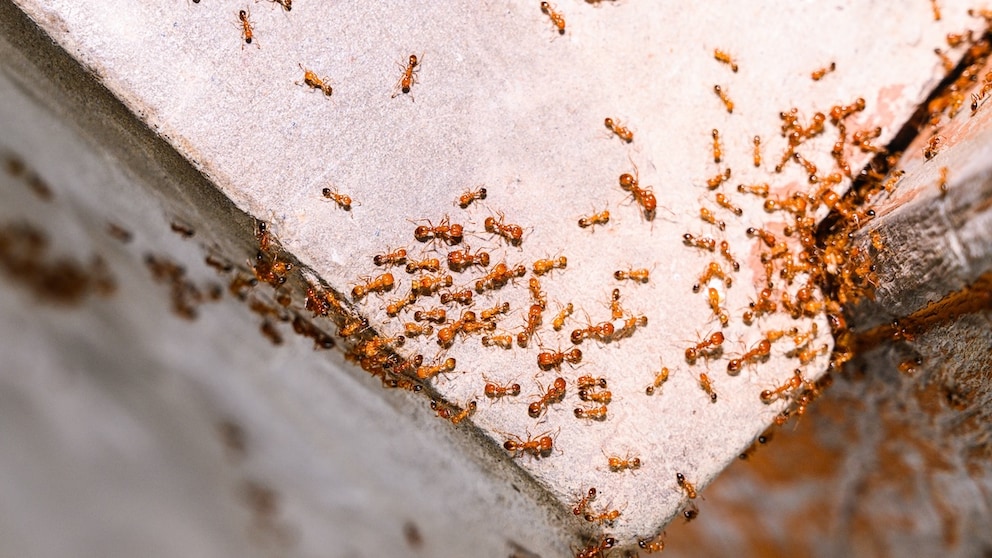
Small ants in the kitchen or bathroom? Many people quickly reach for insect spray in such cases. However, with the Pharaoh ant, that’s exactly the wrong approach—and it can even worsen the problem. myHOMEBOOK asked the Berlin Pest Control Association and received some surprising answers.
Living in Hiding–and Only Indoors
The Pharaoh ant is fundamentally different from most native ant species, explains the managing director of the Berlin Pest Control Association when asked by myHOMEBOOK. “You won’t find Pharaoh ants in the garden. They are indoors and need a lot of warmth.” Instead of building nests outside, they live exclusively indoors—hidden in walls, behind baseboards, or under floors. A constant temperature, like that in heated buildings, is crucial.
Contrary to what many believe, they are not dependent on warm summers. “Pharaoh ants are not necessarily most active in the summer, but in the winter when the heating is on,” the expert explains. However, this does not mean they only appear seasonally. Rather, they are present year-round—but often become more visible in the colder months because indoor conditions are particularly stable then.
Why Insect Spray Worsens the Problem
When people spot individual ants, they want to get rid of them as quickly as possible. But this is where the problem lies. “It’s not possible to combat Pharaoh ants with sprays or store-bought baits,” the pest controller explains. The reason is that the visible ants are just a small part of a much larger system.
“Pharaoh ants are in the masonry, where you can’t reach them.” The actual nest is hidden, often deep within the building. Spray only reaches the workers searching for food. The colony’s reaction is disastrous for those affected: “If you spray or poison the workers, more are produced.” Instead of reducing the infestation, it is further fueled—in the worst case, the colony even splits and spreads.
According to the expert, the ants have a special ability: Through the exchange of mouth secretions, which is passed within the colony, the queen receives chemical signals about the state of the colony. If the number of workers decreases, this signal changes—prompting the queen to produce more ants.
This Ant Is Spreading in Germany–and Can Damage Houses
Does This Home Remedy Help With an Ant Infestation?
Many Queens, Many Nests
A key reason for the persistence of the Pharaoh ant is its unusual organization. “Pharaoh ants can quickly have about 100 queens, each located elsewhere.” Unlike many other species, there is not a single central nest but numerous subcolonies connected to each other.
This structure makes control particularly difficult. If one area is disturbed, new colonies often form in other parts of the building. This is precisely why simple measures like sprays or unsuitable baits almost always fail.
Even Pros Reach Their Limits
Controlling the Pharaoh ant is considered challenging—even for professionals. “Pest controllers can combat them if they know what they’re doing. I estimate that only about 30 percent of pest controllers can do this—if not fewer.” The success rate strongly depends on experience and specialization.
Additionally, there is the risk of confusion with other species. “Confusion with the Argentine ant is possible, and you really need an expert here.” For laypeople, distinguishing between them is difficult, especially since the ants are extremely small.