


November 22, 2026, 5:05 am | Read time: 4 minutes
Frost cracks primarily affect young trees with thin bark. Here on myHOMEBOOK, we explain how to prevent them and what to do if the trunk has already split.
A beautiful day in February, four degrees below zero in the morning, and the sun blazing at noon: For us, it’s an ideal winter day for a walk. For young trees, the same day can be a trial. If the bark can’t withstand the weather conditions, so-called frost cracks can occur.
How Frost Cracks Occur in Trees
The cause of frost cracks lies in a temperature imbalance within the trunk. The winter sun warms the side facing it, while the shaded side remains icy cold. The temperature difference, which can be 10 degrees or more, creates strong tensions in the bark. If they are too strong, the bark tears, usually vertically along the trunk–sometimes accompanied by a loud crack. Frost cracks mainly occur at the end of winter from February onward.
These cracks are more than just cosmetic issues: Pathogens such as fungi and bacteria can enter through the injuries. Severe infections can significantly damage the tree and even lead to its death.
Which Trees Are Particularly at Risk
Young trees are particularly at risk. Their bark is thin and smooth, lacking a well-insulated and protective outer layer. The location also plays a role: Where a trunk receives a lot of direct sunlight, the temperature difference between the sunny and shaded sides is especially large. Fruit trees such as apple, pear, plum, cherry, or peach are often affected, as well as young maples, lindens, and chestnuts. Older trees with thicker bark usually fare better in winter.

Why Trees Are Painted White

Many Garden Owners Overlook Heat Damage to Trees
Preventing Frost Cracks: Whitewash and Other Protective Measures
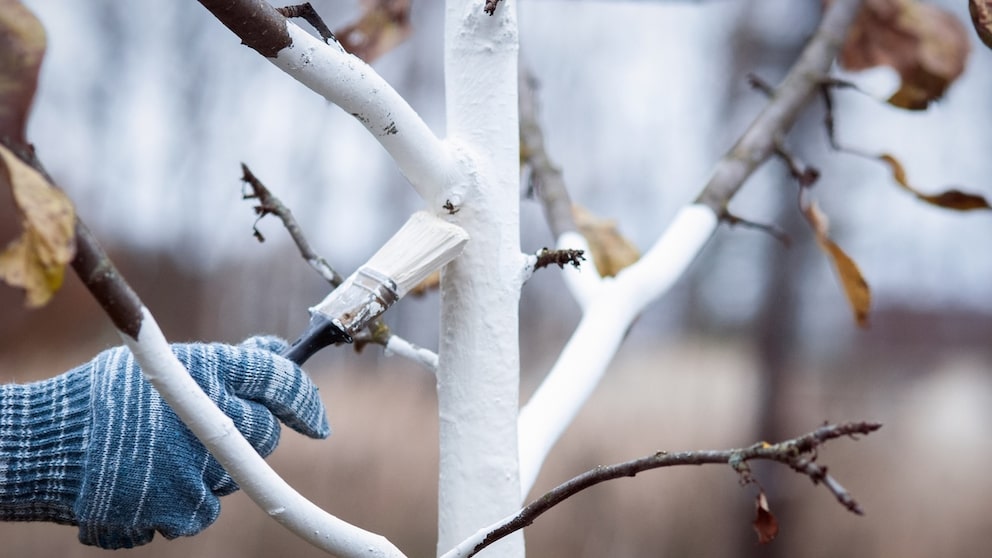
The most well-known method is whitewashing. It looks like decoration and craftwork but serves as sun protection: Like a white shirt, the light color reflects the light, so the bark warms up less. It is applied in November or December from the base of the trunk to the lowest branches. If the winter is particularly long and harsh, the coating can be renewed in March.
The coating comes in several variants. The simplest is a ready-made tree coating from a garden supply store. You can also mix your own clay coating from clay and horsetail broth or a lime coating from lime, water, and wallpaper paste without additives. Brush the trunk free of loose bark pieces beforehand, especially gently with young trees.
Instead of coating the trunks, you can also protect them with mats made of reed, straw, or jute, which are wrapped around the trunk as a collar. Plastic sheeting, on the other hand, is not suitable because condensation forms underneath. Another option is boards attached to the south side of the trunk. They act like a sunshade for the trunk.
Treating Frost Cracks: Can the Tree Be Saved?
If you discover a longitudinal crack in the trunk in winter or spring, don’t despair immediately. The tree can gradually heal smaller injuries on its own: It forms new tissue that gradually closes the wound from the edges. First, take a close look at the damage and keep an eye on it in the following weeks.
Experts are divided on whether to seal the wound with wound wax. Some guides recommend it, but many arborists advise against it because moisture can accumulate under the sealant, promoting the development of pathogens. For larger or deeper cracks, it is advisable to consult a professional tree care service.

My Sloe with a Crack
“I am familiar with frost cracks from my own garden. A grafted sloe split apart in its first winter. I only noticed it in the spring. The crack was large, the wood was exposed, but I was lucky: The shrub continued to develop normally.”