


September 23, 2026, 4:49 am | Read time: 5 minutes
Anyone who occasionally works in the garden will sooner or later come across the term “pH value.” What this value is all about, and why your blueberries or rhododendrons will thank you for understanding it, can be found here on myHOMEBOOK.
You’ve fertilized and watered, yet your blueberries have developed yellow leaves, grown poorly, and eventually died. The reason could be the pH value in the garden soil. This value is an invisible factor that plays a crucial role in the success or failure of your garden.
Follow myHOMEBOOK on WhatsApp now
What the pH Value Reveals
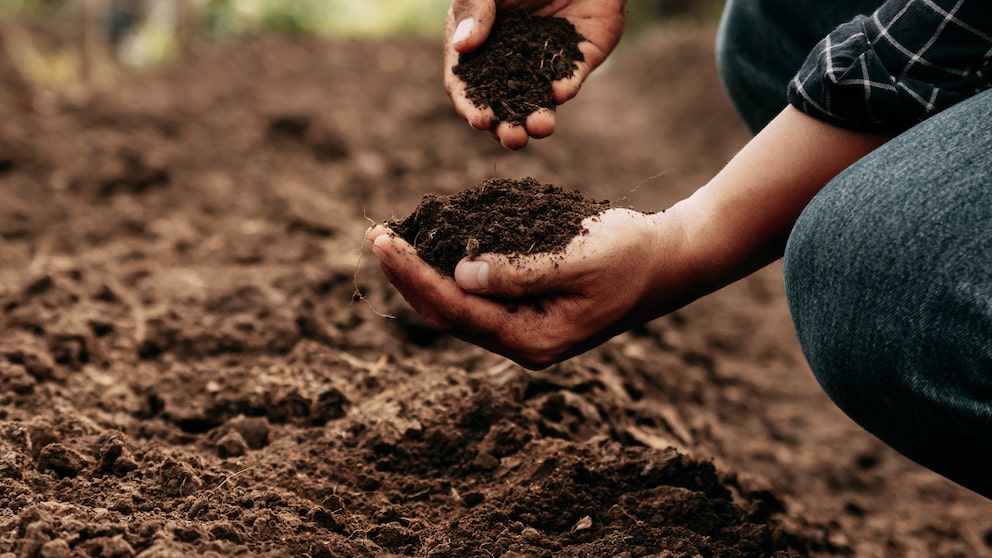
The pH value in garden soil indicates how acidic or alkaline the chemical environment in the soil is. It is measured on a scale from 0 to 14. The midpoint at 7 is considered neutral. Below 7, the soil is acidic; above it, alkaline. Most garden plants prefer slightly acidic to neutral conditions. You can easily find out where your garden soil stands on this scale: A test strip from a garden center provides a rough indication in minutes. For more precise values, you can have a soil sample analyzed in a lab.
What pH Actually Means: The letters pH stand for “potentia Hydrogenii”–the power of hydrogen. It refers to the activity of hydrogen ions (H⁺) in the soil solution: The more of them present, the more acidic the soil, and the lower the number.
Why the pH Value Is So Important
Roots do not simply absorb nutrients; they need them in dissolved form. Whether a nutrient is dissolved or remains bound in the soil is influenced by the pH value. With an unfavorable value, some nutrients remain blocked, even though the soil actually contains them. The plants are essentially at a set table but cannot access it. An incorrect pH value can thus cause deficiencies where there should be none.
Plants for Soils with Low or High pH Values
For most flower and vegetable plants, a soil that is slightly acidic to neutral is sufficient. Blueberries, on the other hand, require a lower pH value and thus a significantly more acidic soil; otherwise, their leaves turn yellow and they struggle. Rhododendrons, azaleas, and camellias also belong to this group. They all originally come from regions with distinctly acidic soil and have difficulty with ordinary garden soil. At the other end of the scale are lilacs, boxwood, and Mediterranean herbs like thyme, rosemary, and lavender: They prefer a higher pH value and thus a more alkaline soil, but they also do well in neutral garden soil.
Also interesting: Which herbs should not be planted next to each other
Can the pH Value in Garden Soil Change on Its Own?
Even though it doesn’t happen overnight, the pH value in garden soil can shift. Rain absorbs carbon dioxide from the air as it falls, becoming slightly acidic. In the soil itself, several factors contribute: Needle litter from pines or spruces has an acidic effect, as do certain fertilizers. Over long periods, this gradually lowers the pH value.
Tap water, which is often high in lime, has the opposite effect. Watering with this hard water over the years slowly raises the pH value in the bed. A single watering can has no effect, but over time, it can be enough to put sensitive plants like blueberries in distress.
That’s why a soil test every few years is advisable, as today’s value may not be the same as five years ago.
How Effective Is Hydrangea Soil Really?
Which Plant Needs Which Specific Soil?
pH Value Too Low? Liming Helps
The optimal pH value for most garden plants depends, among other things, on the soil type: Sandy soils are optimal between 5.0 and 6.5, loamy soils between 5.5 and 7.0, and clay soils between 6.0 and 7.5. If the value of a soil sample falls below this range–becoming too acidic–carbonated lime can be lightly worked into the soil in early spring about every three years: about 150 grams per square meter on light, sandy soils and 250 grams on heavy ones. Regularly applying compost often raises the pH value sufficiently, making liming unnecessary. An exception is bog plants like blueberries, rhododendrons, and heathers: Because they need acidic soil, you should avoid lime or regular compost with them.
Also interesting: What does liming the soil do?
pH Value Too High? Not Always a Problem
If the soil’s pH value is above the optimal range, it’s not automatically problematic. If the plants are growing satisfactorily, there’s no need for action. Only if they visibly struggle might it be worthwhile to acidify the soil.
To do this, first avoid lime and compost, as both can further increase the pH value. Over several years, the pH value can naturally lower itself again. It can be done a bit faster with needle compost or bark mulch, which can additionally slightly acidify the soil.