


August 15, 2025, 2:59 pm | Read time: 4 minutes
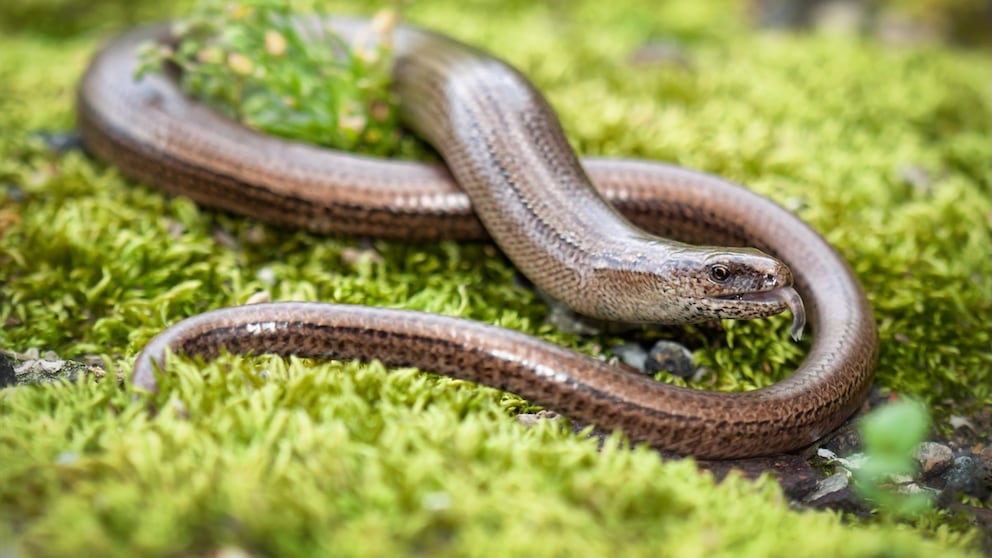
Discovering what seems to be a snake in the garden often causes alarm–but it’s often a slow worm. Its shimmering, snake-like body can be misleading. Here’s how to distinguish slow worms from snakes and what to do if you encounter them in your garden.
Not Poisonous, Not Blind, and Not a Snake
The slow worm (Anguis fragilis) is a lizard, even though it looks like a snake at first glance. It has movable eyelids, rudimentary limb bones, and a stiffer slithering motion. Its name is misleading, as it is not blind. According to the German Nature Conservation Association (NABU), the name comes from the Old High German word “plintslicho,” meaning “dazzling creeper”–a nod to its metallic sheen.
Despite its length of up to 50 centimeters, it is completely harmless. It doesn’t bite and has no venom. In threatening situations, like many lizards, it can shed its tail. The twitching, discarded tail distracts predators while the animal escapes. The tail regrows but remains shorter.
How to Distinguish a Slow Worm from a Snake
Although its shiny, elongated body resembles a snake, there are several clear differences. Slow worms have movable eyelids that they can close, whereas snakes have a fixed, transparent eye covering. Additionally, slow worms have tiny, rudimentary remnants of pelvic and shoulder bones, which are not visible externally but can be detected in the skeleton.
Their movement also appears stiffer and less fluid than that of snakes. Another characteristic: slow worms can shed their tails when threatened, while snakes cannot.
Also interesting: 8 Poisonous Animals You Might Encounter in the Garden
What to Do If You Find a Slow Worm in Your Garden
Slow worms pose no threat, so there’s no need to panic if you encounter one in your garden. If you want to help the slow worm, the Bavarian State Association for Bird and Nature Conservation (LBV) suggests creating a suitable retreat in the garden with simple means. Wood or stone piles, dry walls, hay accumulations, and compost sites offer ideal hiding places for the reptiles. An additional water source improves the conditions. The presence of slow worms is not only a sign of a functioning ecosystem but also beneficial in combating snail infestations.
Making Your Garden Slow Worm-Friendly
To make your garden welcoming for slow worms, in addition to retreats and a water source, consider the following:
- Create a compost heap: serves as a warm retreat and attracts snails and worms as food
- Leave weed corners: don’t maintain every area perfectly, allowing insects and small animals to find habitat
- Avoid chemicals: refrain from using pesticides, slug pellets, and artificial fertilizers to protect the food supply
- Set up a water source: small ponds, water bowls, or moist areas create a favorable microclimate
- Don’t mow meadow areas too often: tall grass provides cover and habitat for prey animals
- Combine sunny and shady spots: slow worms need both, warmth for heating up and cool retreats
- Keep cats and dogs away: secure access to retreats where possible
Slow Worms Are Useful Helpers in the Garden
Slow worms prefer to live in natural gardens, forests, meadows, and wastelands. They are especially common in compost heaps, under stones, or in leaves. Their diet consists largely of slugs and earthworms, according to BUND Hessen. This helps regulate pests naturally, which is an advantage for any gardener. Hairless caterpillars, butterfly larvae, spiders, and woodlice are also occasionally on their menu. They hunt at dusk and during wet weather, even during the day.
Tigerschnegel: Why This Slug Is Good for Your Garden

Turn Off Robotic Lawn Mowers at Night
Threats from Humans and Various Animals
Although the slow worm is widespread in many parts of Europe, it is on the watch list or considered endangered in several states. The greatest threat is humans: habitat loss due to intensive agriculture, the use of pesticides and slug pellets, and careless killing out of ignorance reduce their population. Dogs, cats, chickens, and numerous wild animals are also among their natural enemies.
Read also: What to Do If You Discover a Snake in Your Garden
Reproduction and Lifestyle of the Slow Worm
Slow worms lead a rather hidden life and are mainly active at dusk. The mating season begins between April and June when temperatures are consistently milder. Unlike many reptiles, slow worms do not lay eggs but give birth to live young. The females carry the fertilized eggs in their bodies until the young hatch after about three months.
A litter usually consists of six to twelve, rarely up to 26 young, which are already completely independent. Slow worms can live surprisingly long: under favorable conditions, they reach an age of 20 to 30 years.