


October 15, 2025, 3:09 pm | Read time: 4 minutes
The time for lounging in the backyard pool is definitely over. Now, with the cooler days, the question arises: dismantle or leave it up? The answer is complicated and depends on the type of pool, as myHOMEBOOK discovered for this article.
Inflatable Ring Pools
So-called Quick-Up pools, Fast-Set pools, or simply pools with an inflatable ring must be dismantled and stored in a dry place. The inflatable ring is the weak point in freezing temperatures. The pool cover suffers under the weight of snow and ice. Additionally, the ring can burst if the frozen water expands. This can happen quickly, as the outer cover already suffers from UV radiation in the summer, making the material brittle over time. Therefore, an inflatable ring pool must be dismantled at the end of the swimming season.
Steel Frame Pools
Frame pools or pools with a steel frame construction are also not suitable for winter. Due to low temperatures, all components are under enormous pressure: steel contracts, water expands. This situation causes pressure on the pool’s outer walls. The result: rods bend and seams can tear. Therefore, steel frame pools should also be dismantled and stored in a dry place for the winter.
Steel Wall Pools
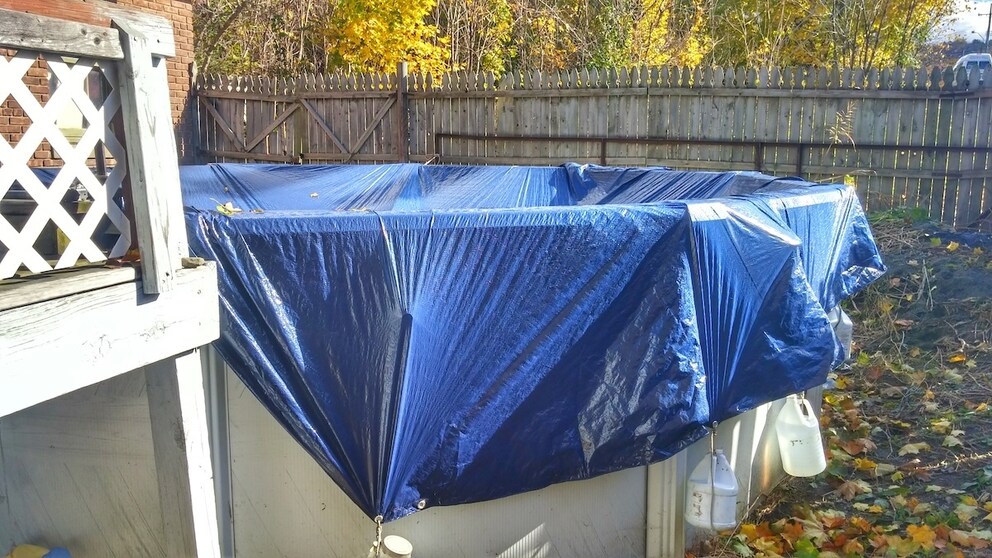
Pools with a continuous steel wall are top-tier among mobile swimming pools and withstand winter conditions. With proper preparations after the swimming season, a steel wall pool can generally endure snow and ice in the backyard.
Related: How to Winterize Your Garden
The Best Pools for Your Garden: An Overview
How to Protect Your Backyard Pool From Frost and Ice
Winterizing a Mobile Pool
Before deciding to leave a steel wall pool up year-round, check with the manufacturer to ensure your model is truly winter-proof. Only then should you begin preparations to winterize the mobile pool.
Important measures for winter include:
- Thoroughly clean the pool. The filter pump should run for 1 to 2 days.
- Then, check and adjust the water values according to the manufacturer’s instructions.
- Next, completely drain and frost-proof all technology, pipes, and built-in parts.
- It is also advisable to drain about one-third of the water, with below the jets being a good guideline. Note: If the jets remain underwater, they must be sealed with special plugs. This also applies to all other pool openings.
- Finally, backwash the filter to clean the filter sand and keep it ready for spring.
- Then add a suitable winter protection agent to the pool water according to the dosage instructions and cover the water surface with a tarp.
For extra security, consider purchasing so-called ice pressure pads. These plastic pads float on the water surface and reduce the pressure that would otherwise be exerted on the outer wall during ice formation. A single pad is available from 7 euros upwards in stores. Depending on the size and shape of the mobile pool, a few ice pressure pads are enough to form a diagonal row or a cross. In regions with particularly cold winters, this is a worthwhile investment.
Winter-Proof Pool Saves Money
A winter-proof pool in the garden may cost more initially. However, this can be recouped in the long run through saved water costs. A simple calculation example:
A rectangular steel wall pool measuring 6 by 4 meters with a water depth of 1 meter holds 24,000 liters or 24.00 cubic meters of water. At an assumed water price of 4 euros per cubic meter, filling it costs nearly 100 euros.
Of course, the effort to winterize the mobile pool also involves time and costs. But this is negligible compared to the wear and tear on components from constant assembly and disassembly, which can lead to costly replacements due to numerous minor damages over time.