

November 23, 2026, 6:11 pm | Read time: 5 minutes
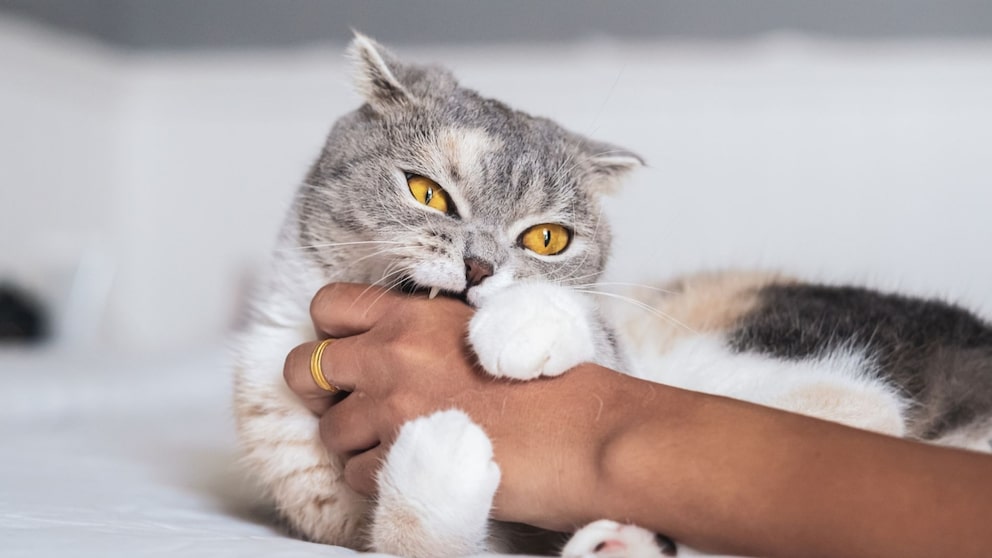
Just moments ago, the cat was purring contentedly while being petted, and suddenly it bites the hand. Does the bite mean it’s had enough, wants to play, or perhaps even shows affection? Cat behavior expert and pet editor Saskia Schneider explains the reasons behind the sudden change and the signals owners can use to recognize their cat’s mood.
Follow myHOMEBOOK on WhatsApp now
Reason 1: The person doesn’t notice the signals
Cats communicate with each other almost exclusively through body language. For humans, this is not always easy to interpret. However, those who pet attentively can quickly recognize when their cat no longer wants to be petted.
It’s important to keep an eye on the tail and ears. If a cat twitches or flicks its tail, it can mean that it is irritated or annoyed. In any case, it is dissatisfied with the situation. Sometimes the ears also start to twitch. More often, the cat will lay one ear back. Both can be signs that the animal is nervous or feels disturbed.
If you notice ear or tail twitching–sometimes only the tip of the tail moves–you should stop petting. It’s worth paying close attention, as with some cats, a slight twitch can be the only warning before a bite.
Also interesting: Can the landlord terminate the lease without notice if my cat urinates in the hallway?
Reason 2: The cat is overstimulated
If you pet the cat for a long time or in places that are uncomfortable for it, it can lead to what’s known as overstimulation. Similar to sensory overload, the petting becomes too much for the cat at that moment, and it bites. Signs of this include twitching skin over the back, dilated pupils, or laid-back ears.
Sometimes the cat also suddenly turns its head and stares at the hand while being petted. At this point, it’s best to stop cuddling or choose a spot that is less uncomfortable for the animal.
The reaction to overstimulation can also be very abrupt, almost explosive. The cat may bite harder. Therefore, it’s important to know when your own cat has had enough and which areas it finds uncomfortable to be petted. It’s also best to inform petting visitors or housemates.
Reason 3: The cat wants to play
Especially young cats quickly switch from a cuddly mood to a playful one. But adult cats also show this mood change. Often they try to entice their human to play by gently grasping and licking or nibbling on their hand. Generally, they are quite gentle. However, younger kittens may not yet fully gauge their strength when playfully biting.
A sure sign that the cat’s biting during petting is play is the absence of hissing or growling. Still, it’s important to remember that play behavior trains hunting skills, which ultimately includes biting prey to death. Therefore, it’s best not to play with hands and switch to a toy instead.
Reason 4: Redirected aggression
Cats can also bite if they see something that frightens them or stresses them out. For example, the animals may react aggressively if they see a strange cat through the window in their territory. This can make some animals so enraged that the aggression “redirects.” Experts refer to this as “redirected aggression.”
In this case, the aggressive behavior is no longer directed at the actual trigger–the strange cat in the garden–but at the person who happens to be nearby. Often, we are unaware of the actual cause, and it seems as if the cat bites us out of nowhere.

The Hamster Is Suddenly Dead? These Are Possible Causes

5 Tips to Make Your Garden Cat-Proof
Reason 5: Love bites
Another reason cats bite while being petted is the so-called love bites. These gentle bites usually occur during relaxed cuddling moments and are often accompanied by purring. They are an expression of a close bond and possibly a remnant of cats’ social grooming behavior.
It’s important to distinguish love bites from defensive bites, which occur with overstimulation or discomfort and are accompanied by body signals like tail flicking or ear twitching. The right approach is to interpret the cat’s signals and accept its affection without overwhelming it.
Also interesting: With these 5 tips, your garden will be cat-proof
How should I react if the cat bites while being petted?
If the cat bites while being petted, don’t hold it against her. Never yell at or become violent with the cat. This can severely damage the relationship and lead to significant insecurity in the cat.
The best approach is to observe your pet closely and notice the cat’s signals early. If you don’t stop petting before the cat bites, you should end the interaction immediately after the bite. Cats can transmit diseases when they bite, including previously unknown pathogens. Learn more in this FITBOOK article: After a bite! Cats could transmit previously unknown pathogens.
Once the play with the cat is over, let the animal decide what it wants to do next. Some will immediately leave the situation and retreat for a while. Others want to stay close to their human; they just don’t want to be petted anymore. As owners, we should respect that–even if it’s sometimes difficult.