


April 8, 2026, 3:16 pm | Read time: 4 minutes
Tidying expert Marie Kondo has sparked a global tidying trend with her KonMari Method. Her approach goes far beyond traditional decluttering: It’s not just about creating order, but about building a conscious relationship with one’s belongings. She became well-known through her book “The Life-Changing Magic of Tidying Up” and her Netflix series, where she helps people restructure their homes—and often their lives.
What Sparks Joy?
At the heart of Marie Kondo’s method is a simple yet powerful question: “Does this item make me happy?” (originally: “Does it spark joy?”). Instead of rushing through drawers and cabinets, the focus is on consciously holding each item, truly perceiving it, and pausing briefly. What does it evoke? A little spark? A good feeling? Or rather indifference? Only the things that elicit that certain sparkle, that honest “Yes, this is good for me,” are allowed to stay. Everything else is sorted out—not carelessly, but with gratitude for its past use.
Tidying by Categories Instead of Rooms
A key difference from conventional tidying strategies: Marie Kondo recommends tidying by category, not room by room. The order is predetermined.
- Clothing
- Books
- Papers
- Komono (miscellaneous items, such as kitchen utensils or cosmetics)
- Sentimental items
This structure helps make decisions more consistently and gradually progress from simple to more emotionally challenging items.
How to Apply the Method Practically
The implementation begins deliberately radical, and that’s where its impact lies. Instead of tidying up a little here and there, everything from a category is gathered in one place: truly everything. What lies before you is often a surprisingly large pile. One that honestly shows how much has accumulated over time. And this moment is crucial: It creates awareness.
Now, each item is taken in hand, briefly felt, and then decided upon. It’s important to decide intuitively and not overanalyze.
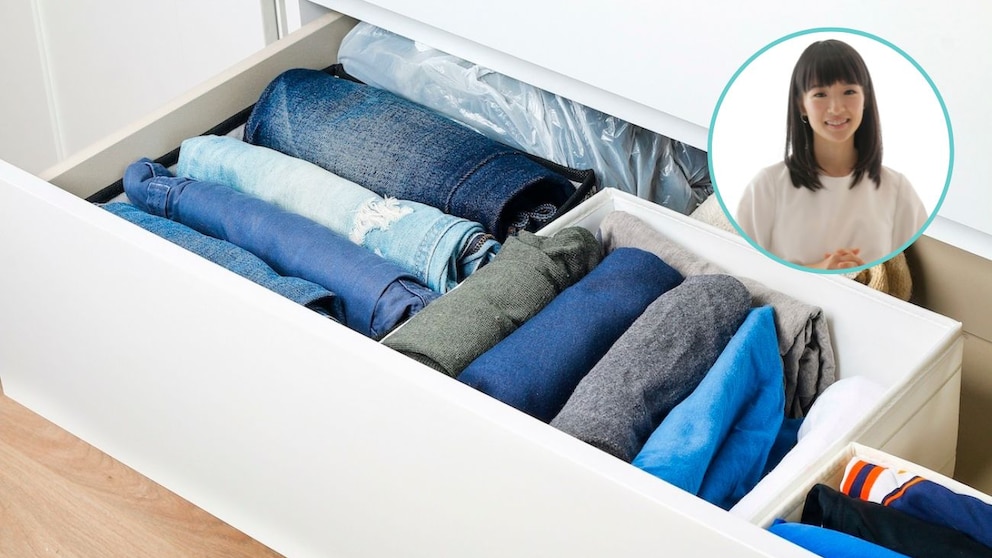
Everything that is allowed to stay is then given a fixed, appreciative place. And here, too, the special approach is evident: It’s not just about storing, but about conscious organizing. Marie Kondo’s famous folding technique plays a central role. Clothes are not stacked but folded so they stand upright in drawers or baskets. This has an almost meditative quality and, above all, a practical effect: You can see at a glance what you own, and nothing gets forgotten in the back corners of the closet.

Why the Method Is So Special
The KonMari Method combines minimalism with mindfulness. It forces us to consciously decide what we truly need and what we don’t. It’s less about renunciation and more about appreciation: for the things that stay and for those that can go.
Another difference: It’s not a permanent process but a one-time, intensive tidying project. Those who follow through consistently should never have to do a major tidying again, only maintain order.

How to Best Sort and Organize Your Wardrobe

Finally, Organize Your Closet! 8 Clever Tips and Tricks
A Global Trend with Lasting Impact
For years, the method has captivated people worldwide. This is not only due to its simplicity but also its emotional impact. Many report that not only has their home changed, but also their sense of life: more clarity, less stress, and more conscious consumption.
Especially in a time of abundance and constant sensory overload, the Marie Kondo Method offers a kind of counter-movement. It reminds us that less is often more and that a tidy home can also contribute to a tidy mind.
Order as a Life Philosophy
The Marie Kondo Method is more than a tidying trend; it’s an attitude. Those who embrace it will quickly realize that it’s not just about closets and drawers, but about life priorities. And perhaps that’s exactly why it continues to inspire so many people today.