


November 16, 2026, 10:23 am | Read time: 5 minutes
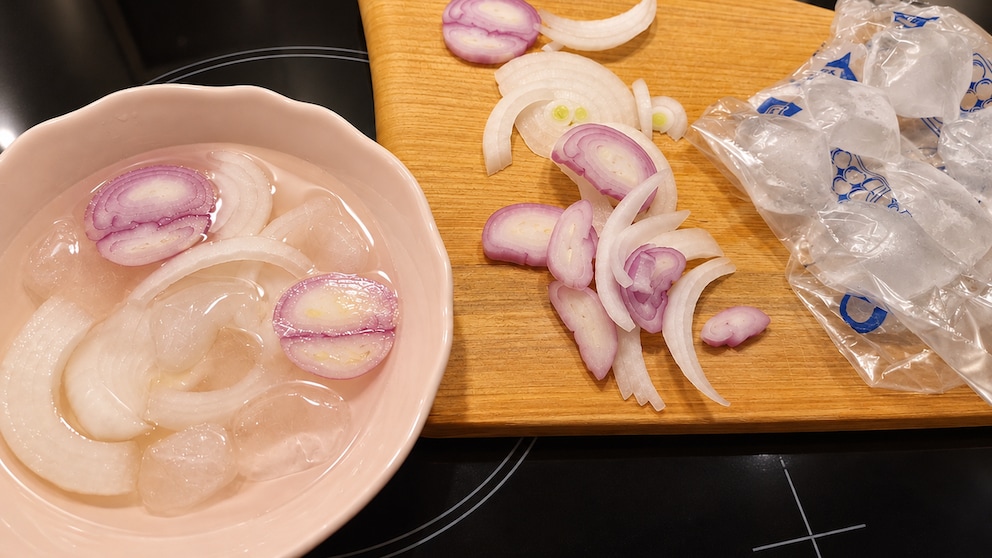
On social media, a seemingly simple kitchen trick often appears: sliced onions are placed in a bowl of ice water for a few minutes before further processing. But what is this supposed to achieve? And does the cold water actually affect taste and texture? myHOMEBOOK asked an expert.
What the Ice Water Is Supposed to Do to the Onions
There is indeed a plausible effect behind the ice water trick. “The goal of this ‘life hack’ is to wash out some of the irritating and pungent sulfur compounds with cold (ice) water,” explains Astrid Donalies from the Federal Center for Nutrition (BZfE). This is intended to make raw onions milder and possibly more digestible for sensitive individuals.
However, the water not only changes the perceived sharpness. “Some of the specific aroma is also lost,” says the expert. The result is milder onions that taste less dominant. At the same time, the onion pieces are supposed to remain nice and crisp.
Why Onions Taste Less Sharp as a Result
The fact that a cut onion suddenly smells and tastes much sharper is due to processes that are only set in motion by chopping. Donalies explains: “The sharpness comes from the interaction of the sulfur-containing amino acid alliin and the enzyme alliinase, which together create sharpness through a chemical reaction when the onion is cut.”
During subsequent soaking, components are rinsed off the cut surfaces. According to the expert, the enzyme is also washed away at the cut surfaces, so the reaction is limited. Additionally, the low temperature: cold slows down enzyme activity.
The ice water thus addresses several points. In the end, the sliced onions taste less sharp, but they also lose some of their characteristic aroma.
Related: How to Pickle Onions in a Few Steps
Why Onions Become Crunchier in Water
The water also affects the texture. This is due to a process called osmosis. Simply put, water can move through the semi-permeable membranes of plant cells. When you place the onion pieces in water, water flows into the cells.
“The influx of water creates pressure, and the cell walls are ‘stretched,’ giving the plant tissue firmness,” explains Donalies. As a result, the onion pieces can appear plumper and crunchier.
This effect can be particularly interesting when raw onion rings or strips are to be used for a burger or salad.
Does It Have to Be Ice Water?
Cold tap water can also have an effect. However, if you specifically want to slow down enzymatic processes, you benefit from particularly low temperatures, according to the expert.
“Cold ensures that enzyme activity is significantly slowed down,” she explains. A similar principle is known in the kitchen from shocking blanched vegetables with ice water. Her conclusion is therefore clear: “The colder, the more effective!”
Also interesting: How to Easily Make Onion Juice
How Long Should Onions Be in Ice Water?
In this case, more is not necessarily better. According to Donalies, kitchen professionals recommend not leaving the sliced onions in the water for more than about 10 to 15 minutes. However, how quickly the texture changes can also depend on the condition and age of the respective onion.
If the pieces stay in the water too long, they can become mushy, according to Donalies. Therefore, they should not only be removed from the water in time but also dried thoroughly. “It’s important to dry the onion pieces thoroughly afterward, preferably with a fresh, clean kitchen towel or on paper towels.”
This is especially important if the onions are to be placed in hot oil afterward, as adhering water can cause significant splattering. In a salad, excess water can dilute the dressing.

With This Trick, Onions Are Easier to Peel

Can You Freeze Onions?
The Trick Also Has a Downside
Washing onions doesn’t only remove substances responsible for sharpness and aroma. Other water-soluble components can also partially transfer into the water. According to Donalies, these include B vitamins, vitamin C, and potassium.
However, the exact extent of the losses cannot be quantified across the board. Factors include the duration of the water bath and the size of the onion pieces. The finer an onion is cut, the larger its surface area, and the more points there are for substances to escape.
However, this shouldn’t be dramatized. No one needs to fear a nutrient deficiency from this kitchen trick, the expert clarifies.
When to Skip the Ice Water Trick
Whether the trick is worthwhile ultimately depends on what happens to the onion afterward. For braised dishes, stews, or soups, Donalies personally would skip the soaking. After all, the onion is to be further processed here and is meant to add flavor to the dish.
Even for salads or burgers, she doesn’t see the hack as strictly necessary. If you want to consciously use the typical onion aroma and ingredients there, you can choose another solution. “Therefore, I would personally cut them into very fine cubes with a very sharp knife rather than soak them,” says Donalies.
The ice water trick does work in principle, but it is especially useful when raw onions are to taste milder and still remain crunchy. However, if you want the typical onion flavor, you can skip the water bath.