

November 2, 2026, 1:12 pm | Read time: 3 minutes
Freshly pressed juices can be made from a variety of fruits and vegetables. But if you want to juice regularly, you’ll quickly face the question: slow juicer or traditional juicer? Both devices extract juice from fruits and vegetables, but they differ in function, speed, handling, and results. So, which device is suitable for whom?
How Does a Traditional Juicer Work?
A traditional juicer typically operates using centrifugal technology. Fruits and vegetables are first fed into the device through an opening. A rapidly rotating grater then chops the ingredients. The resulting pulp is then pressed against a fine-mesh sieve by centrifugal force. The liquid passes through the openings into a collection container, while pulp and other solid components remain as residue.
The biggest advantage of this technique is speed. The high rotation speed allows for the processing of larger quantities of fruits and vegetables in a short time. Many ingredients require little chopping, which facilitates the processing of larger amounts. This is particularly practical for the regular preparation of large juice quantities.
However, the rapid rotation also has drawbacks: It introduces air into the juice, which can create foam. Additionally, ingredients and juice can warm up during processing. How much this affects the nutrients depends on the device and the foods used.
How Does a Slow Juicer Work?
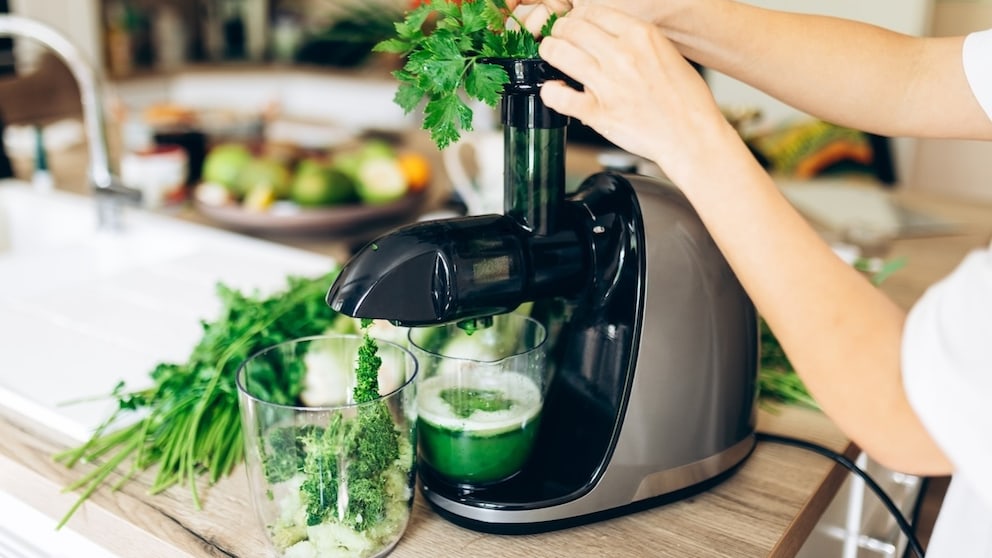
A slow juicer uses a slowly rotating auger. This draws in the ingredients, crushes them, and presses them against a sieve, gradually extracting juice from the plant material. The result is often a more homogeneous juice with less foam. The consistency can also vary: Depending on the ingredients and sieve structure, the juice can be either fine or somewhat thick. Since the auger works continuously, preparation usually takes longer than with a traditional juicer.
Also interesting: From your own harvest! Easily make apple juice yourself

Tips for Finding the Ideal Juicer

From Your Own Harvest: How to Easily Make Your Own Apple Juice
Cleaning and Maintenance
Another important factor in the purchasing decision is the cleaning effort. Especially with regular use, the cleaning effort plays a crucial role.
With a traditional centrifugal juicer, the sieve and grater must be thoroughly cleaned. Pulp residues and fibers can get stuck in the fine openings. Depending on the design, the sieve can be rinsed relatively easily or may require a brush.
A slow juicer also consists of several individual parts that should be cleaned after each use. These include the auger, sieve, and juice chamber. Fibrous ingredients, in particular, can leave residues that are difficult to remove after a long period.
Which device is easier to clean cannot be said in general terms. The number of parts, the accessibility of components, and the ability to clean individual components in the dishwasher are decisive. Those who want to use the juicer frequently should definitely consider this aspect.
In general, for both types, cleaning should be done as soon as possible after use to avoid dried fruit and vegetable residues.
Which Juicer Is Right for Whom?
Which device is the better choice mainly depends on personal habits. Centrifugal juicers are often cheaper and process larger quantities in a short time. Slow juicers vary in price depending on the model and take longer, but they can offer advantages with leafy greens and herbs and often operate more quietly.
If you primarily want to quickly make juice from apples, carrots, or cucumbers, a traditional centrifugal juicer is usually a good choice. If you regularly process leafy greens, prefer less foam, and don’t mind the longer preparation time, a slow juicer might be more suitable.