


October 20, 2026, 4:14 am | Read time: 3 minutes
Tea lights are a staple in many households. However, numerous tricks and tips circulate around these small candles. One of them: Some people wrap aluminum foil around a tea light. What seems unusual at first glance has a specific reason. myHOMEBOOK tried it out and asked the German Firefighters Association if this trick poses any safety risks.
Why do some people wrap aluminum foil around a tea light?
On the internet, you often come across a trick where aluminum foil is wrapped around a tea light. The idea behind it: The heat emitted by the candle should be more concentrated or reflected back into the room. Whether this actually creates a noticeable effect is disputed, as confirmed by Frieder Kircher, head of the Committee for Fire Safety Education, Fire Safety Awareness, and Self-Help at the German Firefighters Association, in response to a myHOMEBOOK inquiry. In addition to possible heat reflection, users also hope for better light output, as the aluminum foil is supposed to reflect part of the candlelight.
Also interesting: Heating an entire room with a tea light stove? Expert has a clear opinion

7 Tips to Reduce Fire Risk at Home

Is putting reflective foil behind the heater worthwhile?
myHOMEBOOK editor tried it out
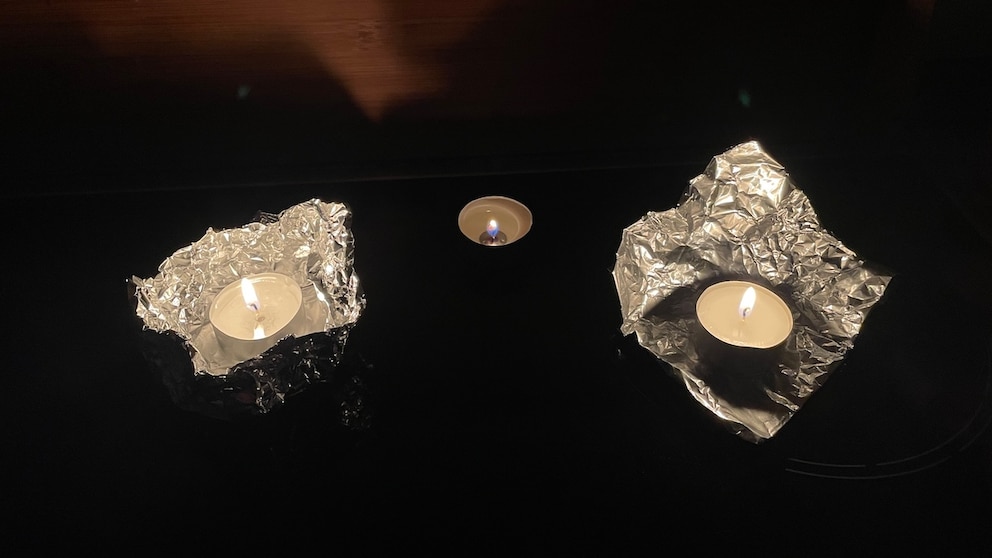
To verify the effect, two different setups were used in a self-test. In one, the aluminum foil was placed around the tea light at the same height on all sides. In the other, the foil was only raised behind the tea light to reflect the light forward and observe any potential impact on heat emission.
Here’s what we found
Regarding heat development, a slight difference was observed after about 30 minutes. In direct comparison, the tea lights wrapped in aluminum foil were slightly warmer than the identical tea light without foil. However, the effect was relatively minor and is unlikely to be noticeably perceptible in everyday life.
The effect on light was more pronounced. The reflective surface of the aluminum foil bounced back some of the candlelight, making the immediate surroundings appear slightly brighter. The most effective method was when the aluminum foil was only raised behind the tea light. It reflected the light more directly forward and provided better illumination compared to the foil that was the same height all around. Although the tea light did not transform into a strong light source, there was a visibly better illumination compared to the untreated tea light.
Is there a safety risk?
Frieder Kircher does not expect an increased fire or safety risk with this application. The prerequisite, however, is that the construction remains open at the top. “The heat can escape upwards, but the air warmed by the reflections also rises if the top is open,” explains the fire safety expert. A dangerous heat build-up is therefore not expected. Additionally, aluminum foil itself is not flammable. Nevertheless, one should not forgo precautions: Kircher recommends always placing tea lights on a non-flammable surface and never leaving them unattended.