


April 5, 2026, 10:56 am | Read time: 4 minutes
Spring cleaning doesn’t always have to be a strenuous marathon; it can even be fun. Some methods from Japan have shown myHOMEBOOK author Daniela Matsuzaki that you don’t have to do everything in one day. Instead, small, regular steps help simplify the process and make it much more relaxed.
The 5-Minute Rule
The 5-Minute Rule is easy to integrate into daily life and has become a regular routine. It helps me keep my home tidy and thus makes spring cleaning easier. For this, I make a small list of things that need to be cleaned once a week, such as emptying the dishwasher or quickly wiping down the fridge. I try to do something different every day, so the tasks automatically repeat throughout the week, making the home appear tidier.
This approach is often associated with the Japanese principle of Kaizen—the idea that continuous improvement can occur through small steps. It’s also about not procrastinating but simply starting.
Also interesting: What We Can Learn from the Japanese About Home Design
Not Everything at Once During Spring Cleaning
Sometimes when tidying up, you can’t see the forest for the trees. Then it helps to break it down into individual trees. In Japan, people consistently separate the important from the unimportant. Everything that isn’t absolutely necessary is put away or sorted out, leaving room only for practical or beautiful items. Because many things in Japan are systematic, every item gets a designated place. This is called Seiton, which means order through a fixed place.
It also helps to tackle individual rooms or focus on specific areas, either room by room or by theme. Especially things I tend to procrastinate on or corners that easily get overlooked in daily life can be approached much more easily this way. Sometimes I have a plan, sometimes I just tackle it when I feel like it—and if I don’t finish everything in one day, I mentally check it off and continue the next day. I don’t put pressure on myself. This makes spring cleaning much easier for me.
Don’t Throw Everything Away
In a YouTube video, I recently saw a Japanese YouTuber doing a kitchen reset. She didn’t just clean the kitchen but really took care of every single item. I was particularly impressed that she sanded her wooden utensils, like cutting boards or cooking spoons, with sandpaper and then treated them with some cooking oil, making them look like new again. This method is not only sustainable but also shows that you don’t have to throw away everything that seems old during spring cleaning. Sanding the surface also removes germs and deeply cleans the wood.
Also interesting: 5 Things Often Forgotten When Cleaning the Kitchen

7 Household Items You Shouldn’t Buy Used

How the myHOMEBOOK Editorial Team Motivates Itself for Spring Cleaning
Containers and Storage
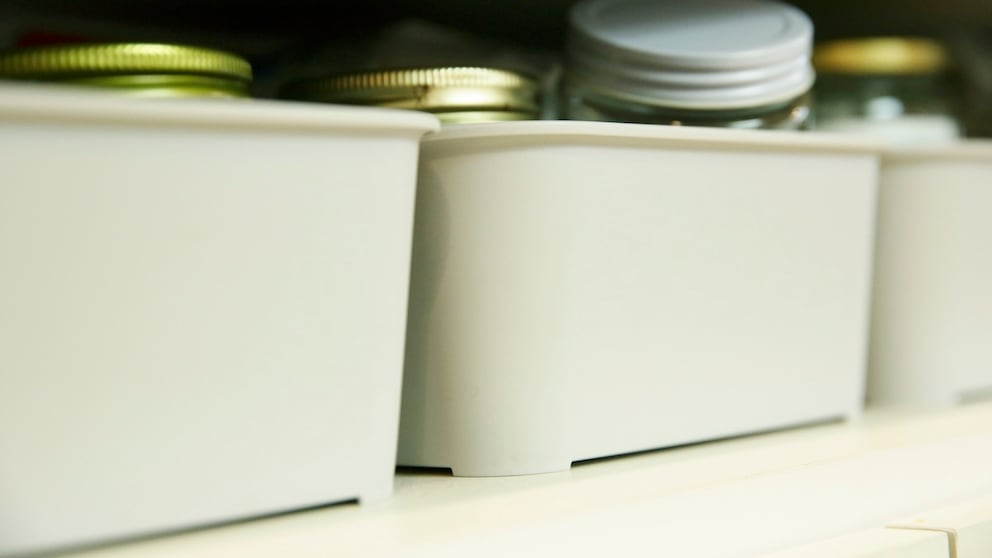
I used to think storage boxes were totally old-fashioned. I let spices or foods like rice or pasta just coexist side by side. However, in Japan, I saw that they have completely different systems. Storage is fun there and simultaneously makes everyday life easier. I wondered why this is and found out that space is often limited in Japan, leading to extremely well-thought-out, space-saving, and versatile solutions. Since then, I’ve been visiting Muji stores more often, even though I used to be rather skeptical of all the boxes and containers.
Especially in the kitchen or bathroom, it looks much calmer when spices, small towels, or cosmetics are neatly stored in containers. What I also find very practical about this: Everything is much easier to clean because you can simply remove the boxes and clean the surface without much effort.
Waste Nothing
Mottainai means in Japan not to waste resources. My husband told me that he learned in kindergarten to eat even the last grain of rice on the plate and not to waste anything. Especially during spring cleaning, I notice how well you can put Mottainai into practice. Before something ends up at the recycling center, I ask myself if I can still use it somehow.
An old toothbrush, for example, can be used as a small brush to get into tight spaces, and towels or old T-shirts that are worn out can be used as cleaning rags. What we often simply call upcycling is something that has been quite natural in Japan for generations.

My Insight
“What I learned from the Japanese about spring cleaning is that you can make it easier if you don’t try to do everything at once.”