


February 19, 2026, 10:07 am | Read time: 4 minutes
For many of us, rice is a staple on our plates—whether as creamy risotto, fluffy basmati rice, or a spicy bowl base. But before the rice hits the pot, a small, often overlooked step is worth considering: washing. While some see this step as unnecessary, others swear by it. But what’s really behind it? Why might it be beneficial to thoroughly rinse rice before cooking—and what happens if you don’t?
What Happens During Rice Cultivation and Processing
Rice typically grows in flooded fields. This unique cultivation method ensures good yields but also has a peculiarity: Under these low-oxygen conditions, naturally occurring arsenic in the soil is chemically altered, making it more accessible to the plant. As a result, rice can absorb higher amounts of inorganic arsenic compared to other grains. The Federal Institute for Risk Assessment (BfR) points out: “Investigations by state monitoring authorities have shown that rice and rice-based products, such as rice cakes, rice snacks, and rice flakes for rice porridge, can have relatively high levels of inorganic arsenic.”
Inorganic arsenic is considered a health concern and accumulates mainly in the outer layers of the rice grain. There are also residues from processing and transport. After harvest, rice is hulled, polished, and packaged. During this process, excess starch can adhere to the surface. Additionally, fine particles or dust can settle. All of this is hardly visible to the naked eye but can be partially removed by simple washing. Health-relevant residues in rice traded in the EU are generally strictly controlled.
The Benefits of Washing Rice
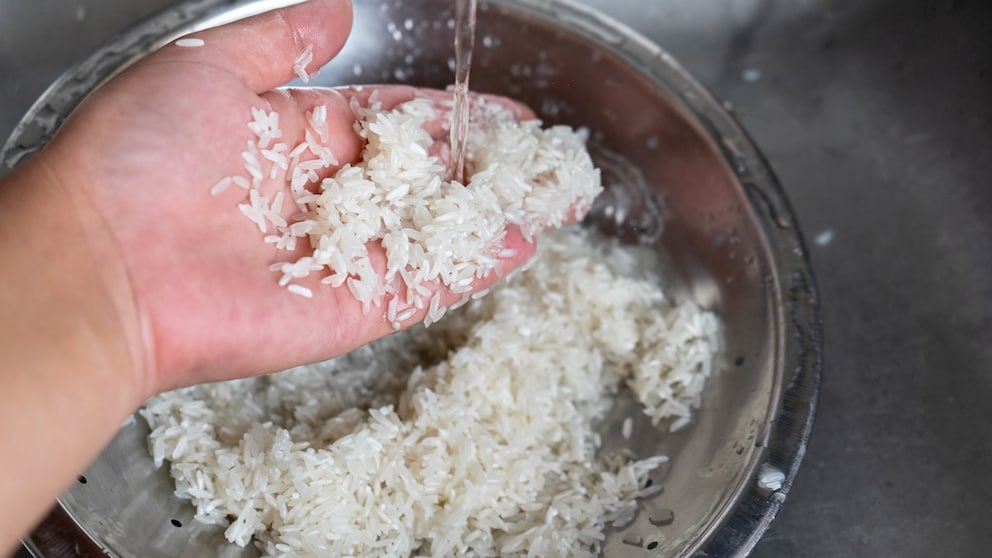
Rinsing under cold water removes excess starch that forms during polishing. This keeps the rice fluffier and less sticky when cooked. This effect is particularly noticeable with long-grain varieties like basmati or jasmine rice. However, the content of inorganic arsenic is only slightly affected by this.
Studies show that the content of inorganic arsenic can be reduced during rice preparation through certain cooking methods. A study by Signes-Pastor and colleagues (2016) published in the journal Food Chemistry found that cooking in plenty of water followed by draining can significantly reduce the concentration of inorganic arsenic. The BfR also notes that water-soluble arsenic partially transfers into the cooking water.
Why Using Plenty of Water Can Be Beneficial
Authorities point out that cooking in plenty of water followed by draining can reduce the content of inorganic arsenic. This method is especially recommended for people who regularly consume larger amounts of rice. This way, the intake of inorganic arsenic can be reduced, even if the substance cannot be completely removed.
Don’t throw out rice water after cooking

8 Uses for Pasta Water – Don’t Throw It out
There Are Exceptions
Not every type of rice and not every preparation method requires washing before cooking. Boil-in-bag rice, for example, is usually already industrially pre-cleaned. The grains are washed before packaging and cooked in the bag in plenty of water. Additional rinsing is generally not intended or necessary here. However, this does not have a decisive impact on the original arsenic content.
In certain dishes, washing may even be undesirable. For risotto or rice pudding, the surface starch is deliberately used to achieve the typical creamy consistency. Washing it off beforehand could result in a less creamy outcome.
Risotto and Rice Pudding–Does the Arsenic Stay in the Dish?
For risotto and rice pudding, the rice is usually not washed and is prepared using the absorption method. The liquid remains entirely in the dish. Water-soluble substances like some of the inorganic arsenic are therefore not drained with the cooking water. The actual exposure depends on the variety, origin, and amount consumed.
Info: The Federal Office of Consumer Protection and Food Safety makes it clear: What matters is not a single portion, but how much and how often you eat it over a longer period. According to the agency, health problems from occasional consumption of rice dishes are unlikely.
Another exception can be fortified rice, to which vitamins and minerals have been added. Intensive washing can partially remove these nutrients. Ultimately, whether washing is sensible depends on the type of rice and the desired dish.