

November 26, 2026, 1:53 pm | Read time: 4 minutes
The heating season has just begun, and some might notice that their home isn’t quite ready for winter. An often underestimated weak point is uninsulated heating pipes in unheated areas like the basement. With them, you not only lose heat but also money. myHOMEBOOK consulted the Consumer Center NRW and explains how you can easily insulate heating pipes yourself.
Follow myHOMEBOOK on WhatsApp now
Why Should You Insulate the Pipes?
Especially in fall and winter, uninsulated heating pipes can become a cost trap. Christian Handwerk, an expert in energy-efficient building and building physics from the Consumer Center NRW, knows this well. “Assuming the basement has a typical temperature of 50 to 57 degrees Fahrenheit throughout the year and the total length of the heating and hot water circuit in the basement is 49 feet (including both directions), over 300 kilowatt-hours can be lost annually. At an assumed energy price of 14 cents per kilowatt-hour net, this costs 50 to 60 euros per year.”
Not only for warmth but also for saving money, it’s important to keep the pipes in the house well insulated. According to the expert, this can also be done easily by oneself.
Did you know? According to the Building Energy Act, all pipes in German households must be insulated. However, Christian Handwerk estimates that this is definitely not the case in all homes. “We could imagine that in 30 percent of households, the pipes are not insulated.”
Insulating Heating Pipes Yourself–How to Proceed?
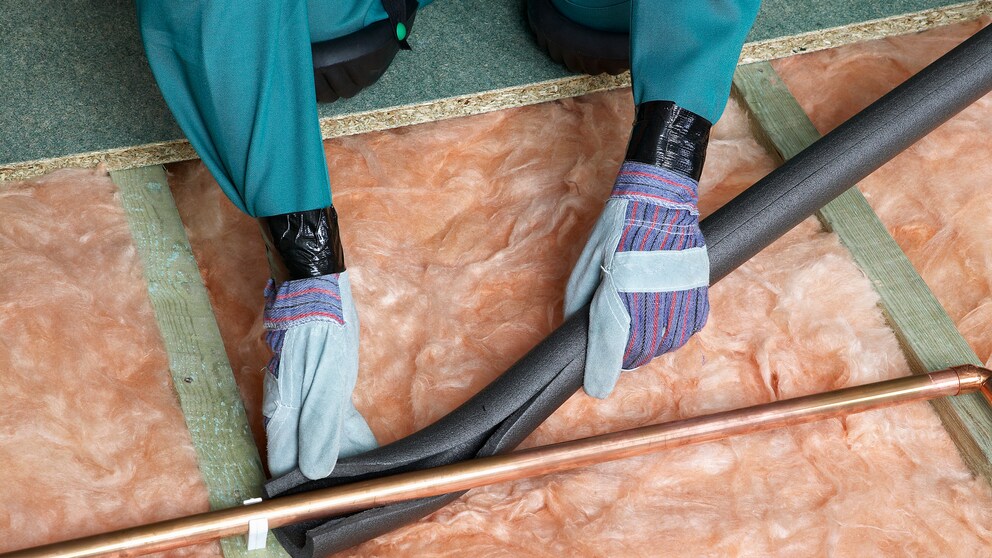
If you discover uninsulated pipes at home, you can easily insulate them yourself. However, you must first determine which ones belong to the heating and hot water circuit and also run through unheated areas (often in the basement). Suitable insulation sleeves for these pipes can be purchased at hardware stores. It’s also important to use the right universal adhesive for the insulation. It must withstand heat but not allow it to pass through. Using the wrong adhesive risks the insulation material dissolving.
“The thickness of the pipe insulation must at least match the diameter of the respective pipe, as stated in the law,” explains Christian Handwerk.
Also interesting: Turning down the heating saves money, but …
How to Proceed with Insulation?
- Cut the sleeves to the desired lengths and cut the bends of the pipe lines at an angle so that they fit well together and the insulation layer is closed at the corners
- Also, don’t forget the fittings that are part of the piping system (there are prefabricated sleeves for these as well)
The following video from the Consumer Center NRW shows the insulation process step by step.

How Effective Is Insulation for the Climate and Your Wallet?
Why You Should Insulate Your Basement Ceiling
Extra Tip: Insulating Radiator Niches
In older buildings, especially those from the 1960s and 1970s, the niches for radiators in living rooms may still be uninsulated. According to calculations by the Consumer Center NRW, up to 15 euros per square meter of heating costs can be unnecessarily incurred annually.
Insulation boards and mats are a solution; they are applied airtight to the wall. An aluminum coating is added to help save even more.
What If You Don’t Want to Insulate Pipes Yourself?
Although the Building Energy Act stipulates that all pipes in houses must be insulated, this is not always the case. So what if tenants discover uninsulated pipes in the house and don’t want to insulate them themselves? Then it’s important to inform the property owners.
“Building owners are at least obliged to act at that point. This is stated in the Building Modernization Act. This energy retrofit is also not particularly expensive, which consumers could additionally point out to emphasize the sensibility of implementation,” explains Christian Handwerk.
With material from dpa