


December 27, 2022, 5:11 am | Read time: 6 minutes
If your home isn’t getting warm and your feet stay cold, you should take a look at the basement ceiling. If it’s not insulated, the floor remains significantly colder. However, with the right insulation, you can combat the cold.
It’s unfortunate that potential heat bridges in the house are often only discovered during the winter months. Cold air flows through the window, or energy is lost through the building envelope. Good insulation is essential in every room. Especially in times of energy scarcity, you should explore all options to save energy and heating costs. An insulated basement ceiling can contribute to a cozy home. However, there are some points to consider when insulating the basement ceiling.
Table of Contents
- Why is an insulated basement ceiling important?
- What insulation is suitable for the basement ceiling?
- Ecological insulation materials for the basement ceiling
- How to insulate a basement ceiling?
- Do you need a building permit for basement ceiling insulation?
- Step-by-step basement ceiling insulation–important tips
Why is an insulated basement ceiling important?
If the rooms don’t get warm and your feet stay cold, it’s usually due to poor thermal insulation. If you’re not lucky enough to have the heating room directly under the living room, it can naturally get cold from below. In that case, it’s important to retrofit and insulate the basement ceiling with suitable insulation. This can efficiently save on energy costs.
With a well-insulated basement ceiling, the rooms on the ground floor don’t cool down as quickly. Good insulation can also save on heating costs and reduce heat loss in the home. Therefore, it’s usually worth insulating the basement ceiling.
What insulation is suitable for the basement ceiling?
In the basement, almost any insulation material can be used. However, since the basement often has slightly higher humidity, you should opt for high-quality insulation materials. You shouldn’t skimp on insulation materials for the basement ceiling. Therefore, simple expanded polystyrene, also known as EPS, is not recommended. Extruded polystyrene (XPS) would be a better alternative.
The reason for this lies in the better processing of the material. Extruded polystyrene is more closed, homogeneous, harder, and firmer. Good insulation materials are crucial here because the insulation must not absorb and retain moisture.
Also interesting: Pollutants in construction and renovation–what to consider?
Ecological insulation materials for the basement ceiling
If you want to insulate the basement ceiling with ecological materials, you can use various environmentally friendly insulation materials. If the basement has a lower height, sustainable fine plaster coatings are recommended. These are made from mineral surface plaster, are usually thinner, and don’t take up much space. They are also suitable for allergy sufferers.
In addition, cellulose is considered an ecological insulation material and is suitable for insulating the basement ceiling. Cellulose insulation materials are made from recycled paper. If you want to insulate the basement ceiling with cellulose, you can also spray it on.
Cellulose insulation is especially suitable for older buildings where not every wall is straight. Curves and other special constructions can be filled more easily. If the insulation needs to be sprayed on, you should hire a professional company. Did you know that cellulose is also a good heat storage material? Even at high temperatures, you can benefit from it, as cellulose insulation also offers good heat protection.
Note: If special fire protection is required, insulation materials made of mineral wool are advisable. In this case, you should definitely consider expert advice.
How to insulate a basement ceiling?
You can also insulate a basement ceiling yourself. However, it depends on the condition of the basement ceiling and the associated effort. If the basement is small and manageable, such a project can be done alone. Especially if the ceiling insulation should only be done from below. However, if there are several small pipes below the basement ceiling, you should hire a construction company. Unforeseen complications and a lack of expert material knowledge could complicate the insulation of the basement ceiling.
In addition, existing water pipes must be properly enclosed and insulated. For insulating water pipes, you can use pipe casings. Here you can learn how to proceed with pipe insulation.
What to Keep in Mind When Building a House in Winter

What exactly is a cold conservatory?
Do you need a building permit for basement ceiling insulation?
If the basement ceiling needs to be insulated from both below and above, the effort might be too great for you. Doors, radiators, windows, parapets, etc., must be rebuilt during a floor construction. In this case, you shouldn’t tackle the project alone. Additionally, a building permit might be necessary for the comprehensive project if the structure changes. It’s better to secure yourself beforehand to clear any potential obstacles. Call the local building authority or talk to a construction company or architect about it. Only then should you begin the renovation of the basement ceiling.
Also interesting: Where the most heat is lost in a house
Step-by-step basement ceiling insulation–important tips
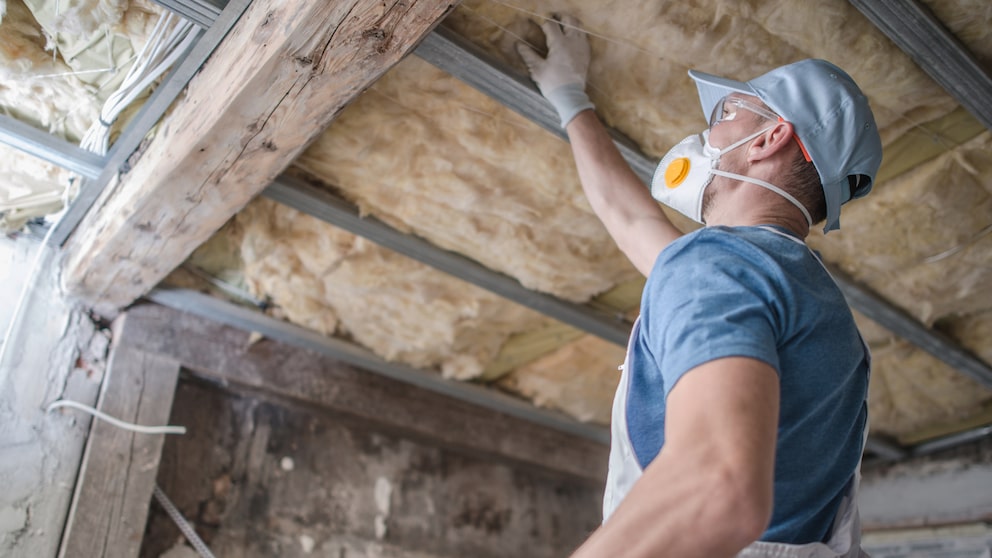
If none of the above conditions apply, you can carry out the renovation yourself. The suitable insulation materials should be at least 8 centimeters thick. Only at this thickness can heating costs be minimized. Make sure the basement ceiling is clean and free of dust and dirt.
Additionally, the basement ceiling should be load-bearing before insulation. If unevenness needs to be concealed, this should be done a few days before applying the basement ceiling insulation. The filler used for this must be dry before applying the insulation. The insulation boards for the basement ceiling should not be attached beforehand. Also, ensure a gap-free installation of the insulation boards. If moisture is visible on the ceiling, it should be clarified by an expert before attaching the ceiling panels. Further tips:
- Ensure all necessary materials and tools are available. A tape measure, pencil, level, utility knife, drill, filler, spatula, and a mortar bucket are necessary for the project.
- Wear appropriate work clothing and safety goggles.
- Cover the basement floor with a tarp or old newspaper.
- Ensure all unevenness is concealed. If necessary, use filler to help.
- The basement ceiling should be free of dust and dirt.
- Apply adhesive to the basement ceiling. Light panels can be glued. Heavy panels must be fastened with dowels and screws. Depending on the material of the floor slab, appropriate drilling should be done. Special drills are needed for a concrete slab.
- Ensure an offset installation of the insulation materials on the ceiling.
- The first row is aligned with a line (which you have already drawn), and the second row should be installed offset.
- If the insulation boards are glued, they should be installed gap-free.
- Press each individual board to the ceiling with a float after gluing.
- Now the insulated basement ceiling can be clad or painted, depending on its condition.