


November 26, 2025, 1:55 pm | Read time: 2 minutes
Whether it’s a chisel, ax, or pruning shears–dull tools not only make work harder but also increase the risk of injury. Why this is the case and how to easily sharpen dull blades with a whetstone is explained by myHOMEBOOK editor-in-chief Felix Mildner on “Easy DIY.”
Sharpening Tools with a Whetstone
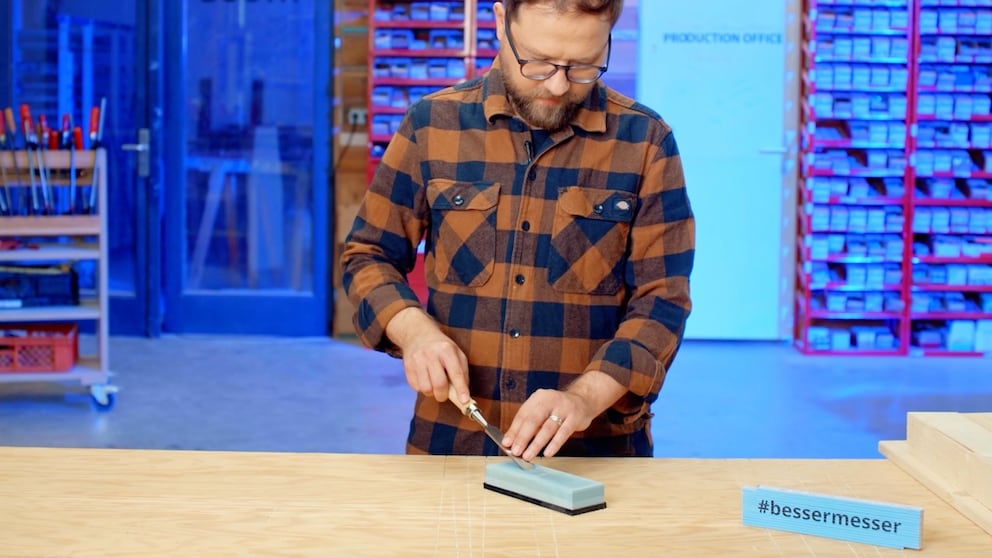
For our guide, a chisel for woodworking was used. However, other tools with a similar edge–such as an ax or pruning shears–can be sharpened in a similar way.
First, the whetstone–also called a water stone–is prepared. It’s best to soak the stone in water until no more bubbles rise. Then the whetstone is properly saturated.

How to Properly Store Garden Tools for Winter

Sanding with a Cordless Drill? This Tool Makes It Possible
From Coarse to Fine Grit
To start, the flat back of the chisel, known as the mirror side, is ground flat on the whetstone. Next is the bevel, or the slanted edge. This is moved in even strokes at a constant angle of about 15 to 25 degrees across the entire surface of the whetstone. This step should be repeated until a noticeable burr forms on the edge.
When sharpening, the grit of the whetstone is crucial. Many stones have two sides–one coarse and one fine. The rule is: start with the coarse side, then finish with the fine side. In general, the higher the grit number, the finer the abrasive. This also applies to sandpaper.
Finishing and Polishing
If you want to achieve an especially fine sharpness, you can add another step after sharpening: polishing. For this, either use an especially fine stone or apply polishing paste to a leather strip and use it to polish both the bevel and the mirror side.

Is the Tool Sharp Again? Here’s How to Test It
“With a little practice, dull tools can easily be restored to a sharp state–all without expensive sharpening devices. To test the sharpness, you can try carefully ‘shaving’ a few hairs off your forearm with the chisel. Alternatively, you can effortlessly cut a sheet of paper with a sharp tool.”