


June 14, 2023, 1:27 pm | Read time: 3 minutes
For years, insect decline has been a major issue, but there are ways to counteract it. A wildflower meadow could be highly beneficial to insects and birds alike. An experiment from England yielded surprising results.
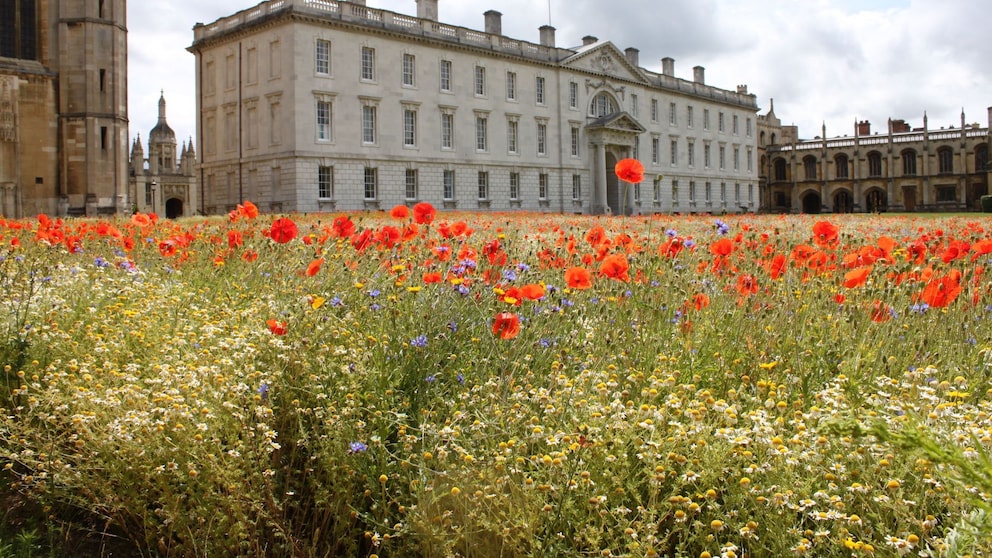
The University of Cambridge in England had a perfect “English lawn.” However, in 2020, King’s College decided to conduct an experiment. Part of the lawn was left unmowed to let it grow naturally, with some plants even being sown. This created a wildflower meadow with poppies, daisies, and cornflowers. The developments were monitored, and the current results surprised even the researchers. Wildflower meadow or lawn–which is better?
Wildflower Meadow Instead of Lawn–Study with Surprising Results
In the few years the study has been ongoing, remarkable changes have occurred on the area, which is only the size of half a football field. The study’s leader, Dr. Cicely Marshall, found that the wildflower meadow is not only a beautiful sight but also promotes biodiversity and is more resilient than the usual lawn.
Related: How environmentally (un)friendly Germans are when it comes to their lawns
The wildflower meadow provides a habitat for three times more plant, spider, and beetle species than the rest of the lawn, the researchers explain in the journal “Ecological Solutions and Evidence.” Additionally, the number of invertebrates is 25 times higher than on the lawn. Moreover, bats were recorded three times more frequently on the wildflower meadow, with 14 species being protected.
These Plants Are the Best “Bee Magnets,” According to Scientists

How Environmentally (Un)Friendly Germans Are When It Comes to Their Lawns
The Wildflower Meadow Has Not Only Positively Affected Biodiversity
The study showed that the meadow saves an estimated 1.36 tons of carbon emissions per hectare per year compared to the lawn. This is due to less mowing and fertilizing. Additionally, the wildflower meadow offers another climate benefit. It can reflect 25 percent more sunlight than the lawn, helping to counteract the so-called “urban heat island effect.”
Note: The urban heat island effect refers to significantly higher air temperatures observed near the ground in urban areas compared to rural regions.
The wildflower meadow is also less susceptible to drought. According to the University’s website, most of the beautiful lawns would have dried up last summer. The wildflower meadow took care of itself, as the deep-rooted wildflowers can still access water during dry periods.
Another positive effect from this study is that the flowering meadow offers greater aesthetic, educational, and psychological benefits than the lawn. This is based on surveys among students and staff.
A wildflower meadow can also save costs. A lawn needs regular mowing. These costs are eliminated when a wildflower meadow is planted instead of a lawn. Researchers predict the university could save approximately 760 euros per hectare annually.
The University Is Enthusiastic
The question of whether a wildflower meadow is better than a lawn is no longer asked in Cambridge. Researchers were surprised at how quickly nature reclaimed the area. The introduction of the meadow has been a complete success, according to a university press release. A wildflower meadow instead of a lawn has a positive impact on biodiversity, climate, costs, and well-being. With an “overwhelming majority,” the Cambridge community has decided to plant more wildflower meadows instead of lawns in the future, the press release states.