


July 18, 2023, 3:22 pm | Read time: 3 minutes
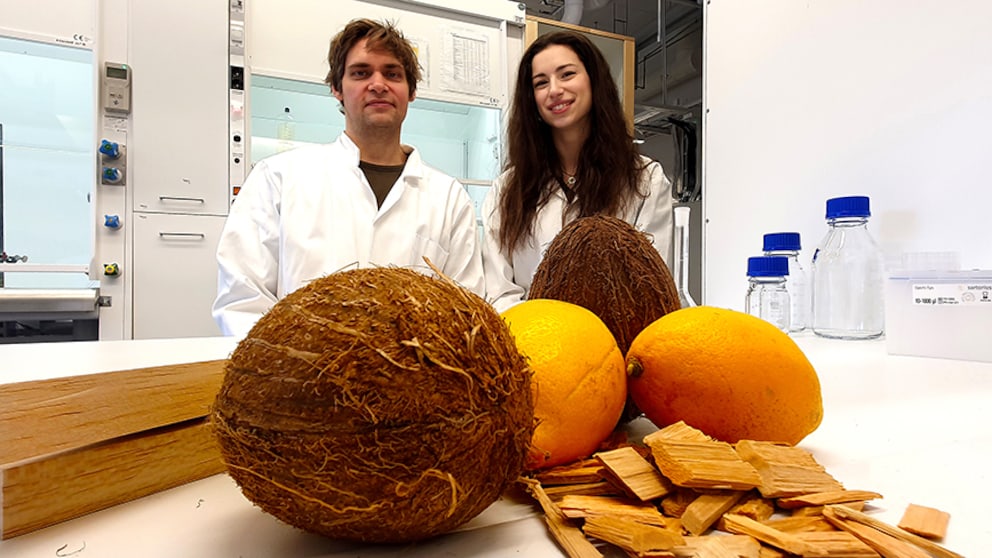
New, innovative construction and insulation materials are constantly being developed. Recently, a research team from Stockholm succeeded in creating insulation made from lemon, coconut, and wood. Find out what the new insulation can do and how it is intended to be used here.
Due to the advancing climate change, a transformation in the construction sector is urgently needed, prompting continuous research into innovative building materials worldwide. Recently, a research team from Sweden developed a new insulation material made from lemon, coconut, and wood. This purely biological building material is designed to insulate buildings so that living spaces are optimally air-conditioned.
How does the new insulation made from lemon peels, coconut flesh, and wood work?
It is a milestone in the research history of the Royal Institute of Technology in Stockholm. With the development of this novel insulation, entirely new standards could be set in the field of building insulation, significantly contributing to environmental protection in the future. The sustainable building material is based on birch wood, from which lignin (bio-polymers) has been removed, which normally holds the individual fibers together. This process makes the wood brittle and similar in transparency to frosted glass.
Subsequently, the open wood pores are filled with limonene acrylate, a substance derived from lemon peels and coconut flesh. When limonene acrylate is heated, the material liquefies and can store heat. As the temperature drops, crystallization occurs, and the heat is released again. This effect is intended to save valuable energy in buildings in the future. According to current research, 100 kilograms of the material can reduce heating and cooling energy consumption by approximately 2.5 kWh per day.

Also interesting: 6 ecological insulation materials compared

5 Common Misconceptions About Building Insulation

What Makes a Swedish House So Special
Insulating Interior Spaces
Even though the material still needs to prove itself as a viable, reliable building material for the future, it could soon represent a groundbreaking step within the construction industry. The vision of the Swedish research team is to use the new insulation in the form of milky construction panels for insulating interior spaces soon. Once the material goes into mass production, it could gradually replace gypsum boards.
Equipping greenhouses is also expected to be possible in the medium term, as the translucent material can create ideal conditions for plants. Since the panels can partially absorb and store infrared rays, the plants inside are protected from overheating due to incoming sunlight. As the night cools, the stored heat is released accordingly. Facades could also be insulated with the material in the future. However, according to the Swedish research team, more research is still needed in this area.
The Country Needs New Building Materials
In terms of sustainability, there is still significant potential in the construction sector. After all, the industry is responsible for nearly 40 percent of global greenhouse gases. To save substantial amounts of energy, it is essential to construct buildings based on ecological construction and insulation materials in the future. Numerous research labs worldwide are already developing suitable alternatives. For some time now, seagrass has been successfully used for insulating buildings.
Currently in development is insulation made from mushrooms, specifically their root systems (mycelium). In combination with wood chips, grain residues, and other materials, this composite is also expected to eventually replace the more problematic Styrofoam. Hemp is also emerging as a sustainable, innovative building material. The market already offers mortar, building blocks, and insulation made from this rapidly renewable natural product.