


June 2, 2026, 7:46 am | Read time: 3 minutes
The monstera is one of the most popular houseplants. Its large, perforated leaves are impressive and give any room a touch of the jungle. To ensure the plant grows vigorously and lives long, it should be properly cared for. myHOMEBOOK explains which care mistakes can weaken the monstera.
1. Mistake: Overwatering
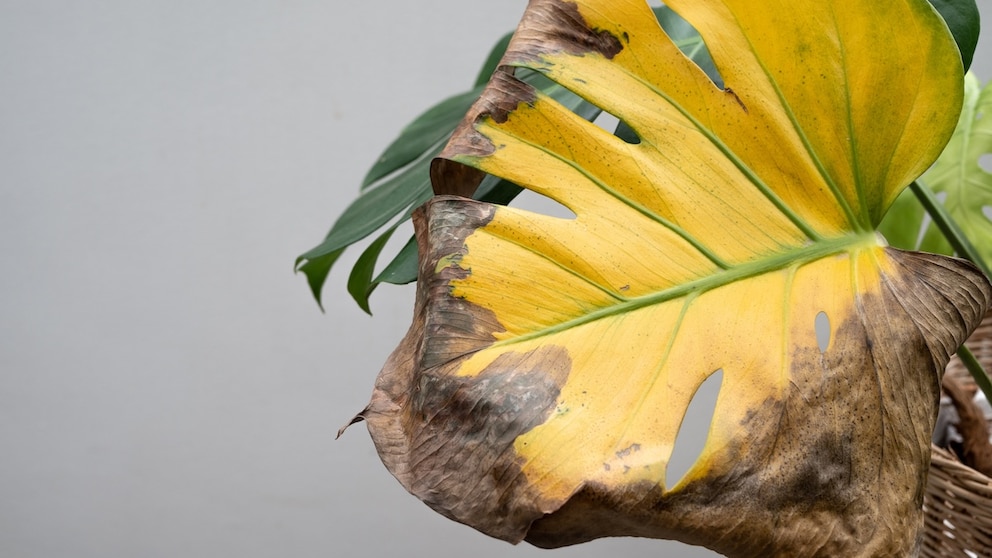
If a monstera’s leaves droop, it’s usually a warning signal. If yellow spots also appear and a musty, rotten smell spreads, it often indicates waterlogging. This is a typical problem with potted plants. It occurs when excess watering cannot drain and collects in the pot. Most plants cannot tolerate constantly wet roots: they begin to rot, and the monstera can die in the worst case.
To avoid this care mistake, the plant should be watered less rather than more. The Swiss cheese plant copes much better with short dry spells than with constantly wet soil. Therefore, it’s recommended to do the finger test before watering. If the soil still feels moist, you should wait before watering again. If you’re unsure, it’s better to leave the watering can aside.
2. Mistake: The Wrong Location
If a monstera develops long, thin shoots, shows brown, dry spots, or discolored leaf edges, the cause is often the wrong location. The tropical houseplant does not tolerate direct sunlight well. Its leaves can literally burn. But a spot that’s too dark is also not good for it. Dry heating air, drafts, or low temperatures are equally problematic.
The monstera feels most comfortable in a bright location with plenty of indirect light. An ideal spot is a protected place without direct midday sun, preferably not right next to a heater.
3. Mistake: Lack of Support
In Germany, the monstera is primarily known as a decorative houseplant. However, in its tropical homeland, it grows up trees in the rainforest. It is a climbing plant. Therefore, its long, strong shoots need support to grow stably. A suitable support should not be missing in the pot. So-called moss poles, which the aerial roots can easily cling to, are particularly popular.
Rubber Plant Losing Leaves? Here’s Why It Might Be Happening
Propagating Monstera: An Overview of 3 Methods
4. Mistake: Forgetting to Dust
The large leaves are the hallmark of the monstera. Their characteristic cuts and holes make the houseplant so popular. Variegated specimens, whose green leaves have white patterns or discolorations, are particularly decorative. But the leaves are not just eye-catching: the plant uses their large surface area for photosynthesis and gas exchange. Both are vital for its growth.
However, dust quickly accumulates on the large leaves. A common care mistake is not removing it regularly. The dust layer can impair photosynthesis and harm the plant. Therefore, the leaves should be gently wiped with a soft cloth or duster regularly.
5. Mistake: Humidity Is Too Low
The monstera originally comes from tropical rainforests, where high temperatures and humidity prevail year-round. In living spaces, however, humidity is usually only between 40 and 60 percent, partly to prevent mold growth. For the monstera, this is often too dry. It feels most comfortable with a humidity of about 60 to 80 percent. Especially in winter, dry heating air can lead to brown leaf and shoot tips.
If you want to care for a healthy monstera, you should avoid this common care mistake. Often, it helps to regularly spray the leaves with low-lime water to increase the humidity around the plant.