


November 10, 2025, 11:04 am | Read time: 4 minutes
Cabbage had a real image problem for a long time. It was considered a stodgy post-war vegetable, more for filling than for enjoyment. However, perceptions have changed. Today, it is seen as a healthy trend vegetable and has many fans in home gardens again. Here are a few interesting facts about cabbage that many might not be aware of.
1. One Species, Many Forms
White cabbage, red cabbage, pointed cabbage, savoy cabbage, kale, palm cabbage, Brussels sprouts, broccoli, cauliflower, Romanesco, and kohlrabi differ so much in appearance that one would hardly suspect they belong to the same botanical species. In fact, they all belong to the same species, Brassica oleracea. Their diversity in form arose because plants with a particular trait, such as a dense head or a lot of leaf mass, were continually propagated.
Good to know: The genus Brassica includes not only the forms of Brassica oleracea presented here but also other species. These include, for example, Brassica rapa, which includes pak choi, Chinese cabbage, and various Asian salads, or Brassica napus, which includes rapeseed and rutabaga.
Related: 9 Popular Cabbage Varieties Compared
2. Breeding from Leaf to Flower
Historically, breeding progressed in stages. Initially, loose leaf forms, similar to the original wild cabbage, were the focus. From these, variants with particularly pronounced leaf mass, like kale, developed, and later cabbage forms with compact heads, such as white cabbage and red cabbage. Later, other plant parts became the focus of breeders: the thickened stem in kohlrabi, and the still-closed flower heads in broccoli and cauliflower.
3. From the Coast to the Garden
The origin of all today’s cabbage varieties lies on the coasts of Western Europe. There, wild cabbage (Brassica oleracea var. oleracea) grows on rocky, calcareous cliffs in windy locations. It is a perennial plant with robust growth, blue-gray leaves, and remarkable tolerance to salt and wind. This hardy wild form is considered the “mother” of all modern cultivated cabbage varieties. In its natural habitat, wild cabbage is relatively inconspicuous. Yet its resilience and adaptability made it ideal for breeding numerous cultivated forms.
4. Cabbage as an Edible Ornamental Plant
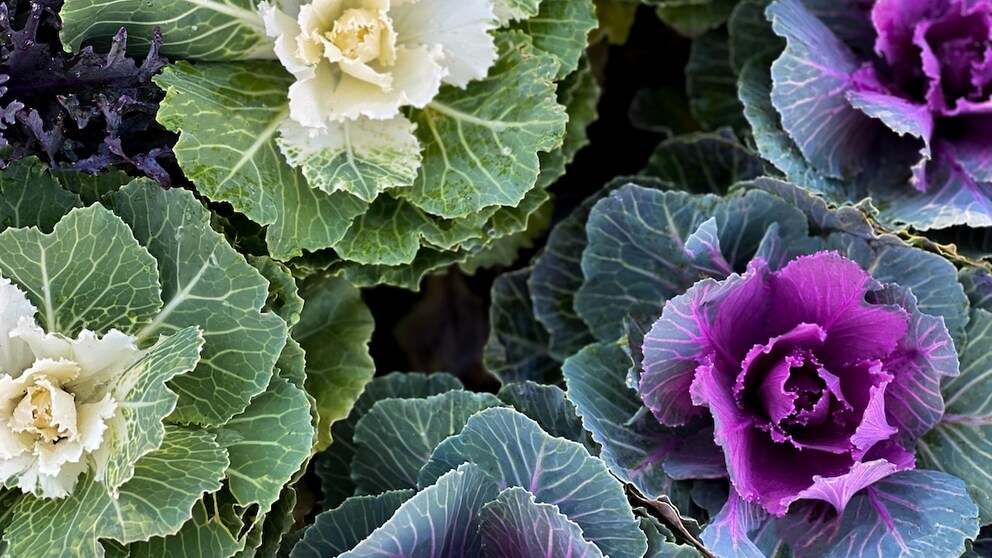
Those who see cabbage only as a utility vegetable overlook its visual appeal. Palm cabbage, with its deep green, upright leaves, almost resembles exotic perennials. Purple kale shines in the winter garden when many other plants have long lost their colors. And Romanesco, with its spiral structure, showcases fractal geometry at its finest. Particularly colorful is ornamental cabbage, which remains attractive with its pink, white, or purple rosettes well into winter.
5. The Secret Behind Cabbage’s Distinct Flavor
Cabbage’s characteristic taste is no accident. When cut and chewed, its glucosinolates transform into aromatic mustard oils, giving it a mild to peppery flavor depending on the variety. These substances protect the plant and are also beneficial to humans, as they are secondary plant compounds that promote health. Even in ancient times, cabbage was valued as a medicinal plant, used to relieve stomach issues or applied externally for inflammation. In winter, it also served as an important vitamin source, especially in the form of sauerkraut.

9 Popular Types of Cabbage Compared
Pak choi – how to grow Asian cabbage in the garden
6. Cabbage Sends Signals
Cabbage plants protect themselves with a chemical defense system based on sulfur-containing glucosinolates. When their leaves are damaged, pungent mustard oils are produced, deterring many herbivores. However, some of these scent compounds are already present in small amounts in undamaged leaves, giving cabbage part of its distinctive smell.
For specialized insects like the cabbage white butterfly, this scent is an important identifying feature. It helps them find suitable host plants. Herbs like sage or thyme planted among cabbage can help reduce infestations because their strong scent masks the cabbage smell, making it harder for the butterflies to navigate.
7. Cabbage Blooms in the Second Year
Cabbage is actually biennial, but it usually ends up on the plate just a few months after sowing. However, if allowed to grow, most varieties will produce a multitude of pretty, small yellow flowers in the second year, which are popular with insects.