


June 10, 2023, 12:41 pm | Read time: 5 minutes
The common comfrey is primarily known as an ancient medicinal plant. However, this vigorous and easy-to-care-for perennial has much more to offer. It serves as a haven for insects and can be processed into fertilizer. Learn how to cultivate and care for this versatile plant here.
The common comfrey (Symphytum officinale) goes by many names such as comfrey, medicinal comfrey, bonewort, woundwort, honey flower, or all-heal. Many of these names hint at the plant’s healing properties. But common comfrey can do much more. It is popular with both insects and gardeners. Insects are particularly drawn to its nectar. Gardeners appreciate the plant as mulch material and for making fertilizer. In the wild, this native plant is mainly found along streams, in floodplain and swamp forests, as well as at the edges of paths and forests.

Planting Common Comfrey
Sowing outdoors should be done early in the year, ideally between February and April, as temperatures may become too high for germination afterward. Alternatively, sowing can be done in the fall. Since comfrey is a light germinator, the seeds should only be covered with a very fine layer of soil.
What Does Common Comfrey Look Like?
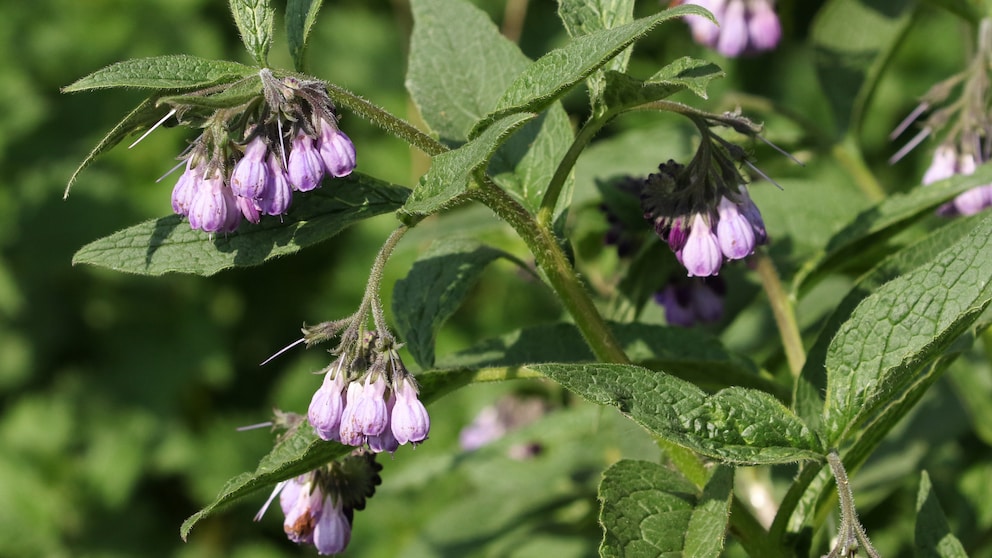
Common comfrey is a perennial, herbaceous plant that reaches a height of 50 to about 80 centimeters. It has bristly-haired stems and leaves that die back above ground in winter and sprout again in spring. The bell-shaped flowers appear from May to August, depending on the variety, and are white, violet, purple, blue, or pink. They are a popular food source, especially for bumblebees and other long-tongued insects.
Location and Soil Requirements
When it comes to location, comfrey is not particularly picky. It thrives best in semi-shaded areas but also does well in light shade. With adequate water supply, sunny locations are also an option. The soil should be deep, moist, humus-rich, and nutrient-rich. Heavy clay soils are not a problem for comfrey, but dry sandy soils are.
Comfrey is well-suited as an underplanting for trees and shrubs. It is also ideal for planting along the edge of a garden pond or near a compost heap. Terrace and balcony gardeners need not forgo comfrey, as the plant also thrives in containers.
Variety Tip
Particularly popular is “Moulin Rouge,” a variety that displays its purple-red flowers from May to July.
Caring for Common Comfrey
Comfrey is an uncomplicated perennial that requires little attention. With the following tips for optimal care, your comfrey will thrive.
Watering
Thanks to its deep taproot, comfrey can generally supply itself with water. Only during extended dry periods should it be watered thoroughly on occasion.
Fertilization
If comfrey is growing in a suitable location, fertilizer is unnecessary in the first few years. Only after several years might a dose of mature compost in the spring be beneficial, especially if the plant has been frequently harvested.
Pruning
Common comfrey does not necessarily need pruning. However, it can be cut back to ten centimeters above the ground in the fall after flowering. Alternatively, the old leaves can be removed in spring to make room for new growth.
Propagation
Comfrey can be propagated in two ways. The simpler method is propagation through rooted runners, which comfrey produces abundantly. In spring or fall, a piece of the root is cut off and replanted at the desired location. Propagation by sowing is also possible.
Repotting
If comfrey is grown in a container rather than a garden bed, it should be rejuvenated by division every two to three years.
Overwintering
Comfrey is completely frost-hardy and can survive the winter without protection.
Toxicity
Like borage, comfrey contains liver-toxic and carcinogenic pyrrolizidine alkaloids. Young leaves, flowers, and the root are sometimes still used in cooking today, but consumption of the plant is increasingly discouraged.
Diseases and Pests
Diseases and pests are not a major issue for comfrey. Occasionally, powdery mildew and rust may occur. If the plant is affected, the affected parts should be cut off and disposed of.
Planting and caring for the tasty culinary herb borage in the garden

Planting and care tips for the common viper’s bugloss
Harvest
Fresh leaves can be harvested as needed throughout the season. If leaves are to be dried, it is best to harvest them just before the flowering period. Those wishing to harvest parts of the root, which can also be used fresh or dried, should wait until the plant is at least two years old. The harvest time for root pieces is in the fall.
Uses of Common Comfrey
Comfrey has various uses, especially in medicine and gardening. Due to the toxic pyrrolizidine alkaloids, its use in cooking is increasingly discouraged. Common comfrey is an important plant for the external treatment of muscle and bone injuries. Comfrey roots, and sometimes leaves, are primarily used for making ointments and creams.
Among gardeners, comfrey is particularly valued for its nitrogen- and potassium-rich leaves. They make excellent mulch material and can be processed into liquid manure to be used as fertilizer and to strengthen plants. Another gardening benefit lies in the plant’s special hormones, which promote the rooting of cuttings.