


June 11, 2026, 12:28 pm | Read time: 4 minutes
Perlite, vermiculite, and zeolite are among the most popular soil additives in gardening and are often offered together. Although all three materials can improve the soil, they differ significantly in their effects. myHOMEBOOK gardening expert Katharina Petzold explains the differences and shows when each additive is the best choice.
Perlite: The White “Volcanic Popcorn”
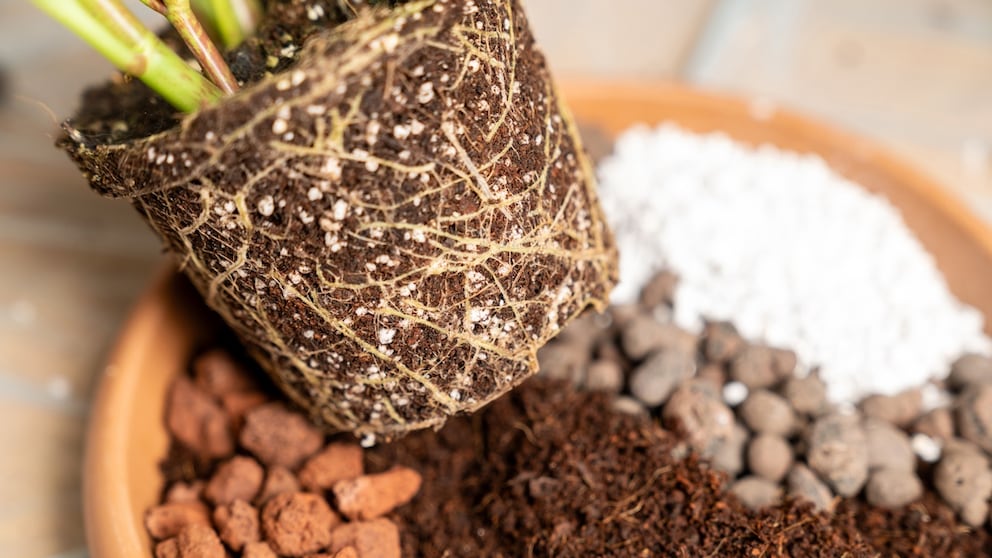
Perlite is hard to miss in the substrate: The small, snow-white beads that look like crumbled Styrofoam are made from natural volcanic glass, which is “popped” at around 900 °C. The crystal water trapped in the stone expands explosively, causing the material to swell to fifteen to twenty times its volume.
The Effect
In plant care, this substance acts as a true aerator, serving as a mechanical support skeleton for the soil. Since the granules are shape-stable, oxygen pockets remain permanently. This is vital for popular houseplants like Monstera or Ficus, whose roots can quickly suffocate in compact substrate. Perlite provides the necessary breathing space, thus preventing dangerous root rot.
Tips for Use
For standard houseplants, about 30 percent perlite keeps the soil loose, while for cacti, a proportion of up to 50 percent protects against waterlogging. In propagation, 20 percent is usually enough to pave the way for young roots. Only use products explicitly labeled as garden perlite, as construction variants are unsuitable for plants.
Vermiculite: The Shimmering Water Sponge
Vermiculite is also one of the “expansion products,” but it is based on a natural layer silicate. Under extreme heat, it unfolds accordion-like into small, gold-brown shimmering flakes, which are permeated by countless cavities.
The Effect
This structure acts as a highly effective reservoir, retaining moisture like a magnet and releasing it in a controlled manner during dry periods. Unlike perlite, vermiculite also scores as a chemical mediator: It stores nutrients and thus improves plant nutrition. Its slightly alkaline pH value also acts as a buffer in the substrate.
Tips for Use
Vermiculite shines especially in propagation with a mix of 60 percent soil and 40 percent mineral, and its sterility makes it ideal for covering seeds. For thirsty container plants, it significantly extends watering intervals as a mix partner.
Zeolite: The Intelligent “Nutrient Battery”
Unlike perlite and vermiculite, zeolite is not an expansion product but a massive rock of volcanic origin. Visually, it resembles fine, light gray gravel or flour and functions in the soil as a highly complex reservoir. With an internal surface area of up to several hundred square meters per gram, this mineral offers enormous capacity to bind substances.
The Effect
You can think of zeolite as a parking lot for fertilizer. It binds nutrients like potassium or magnesium in its cavities. When the nutrient level in the soil drops, the mineral automatically releases the stored supply. This prevents expensive fertilizer from being washed out of the pot or bed unused during watering. Particularly nutrient-hungry crops like tomatoes or lush balcony flowers benefit from this depot effect, while the enormous water storage capacity simultaneously extends watering intervals.
Tips for Use
The optimal dosage depends on the specific application and varies by supplier, so it’s advisable to check the package instructions. Since zeolite has a pH value of over 8, it raises the soil environment. For plants that need acidic soil—such as rhododendrons, blueberries, and hydrangeas—zeolite is not suitable. The structure should also match the project: While fine flour enhances compost or improves heavy beds, coarse granules stabilize the water balance in pots and containers.

Which Tricks Really Keep Plants Moist Longer in Summer

Which Plant Needs Which Specific Soil?
Pot, Container, or Bed: Where Each Material Excels
In a houseplant pot, it depends on the plant’s needs: While perlite ensures permanent root aeration, vermiculite is the specialist for moisture-loving species and propagation. In outdoor containers on a balcony or terrace, heat is the biggest challenge. Here, a mix of water storage (vermiculite) and nutrient battery (zeolite) saves plants from rapid drying out.
A garden bed has different requirements. Here, the heavy zeolite works best: As a massive volcanic rock, it remains stable in the soil and is hardly washed out. It improves the soil over the years as a permanent nutrient and water reservoir.
Dust Hazard: Caution When Mixing!
Since perlite, zeolite, and vermiculite can create dust when poured, it is advisable for health reasons to wear a dust mask and ideally work outdoors.