


November 24, 2026, 2:03 pm | Read time: 6 minutes
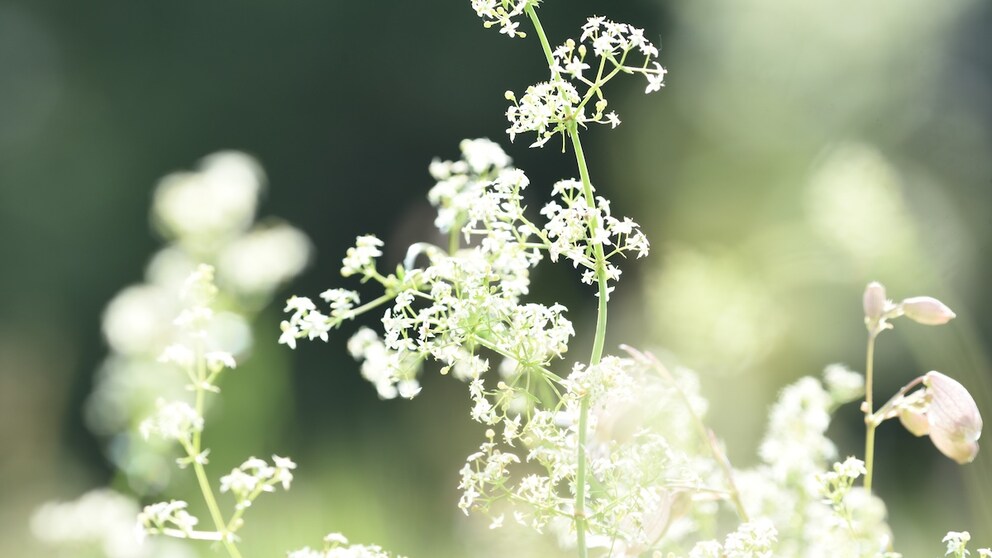
The meadow bedstraw (Galium mollugo) belongs to the Rubiaceae family and is commonly found in Central Europe. Its range extends from Europe to Siberia and also occurs in North Africa. The wild plant primarily grows in nutrient-rich meadows and pastures, as well as at forest edges and roadsides, preferring light locations. Galium mollugo is closely related to the white bedstraw (Galium album). Both are grouped into the species complex Galium mollugo agg. and can be easily confused with each other.
Overview
Planting Meadow Bedstraw
Meadow bedstraw can be planted as a pre-grown perennial or grown from seeds. Suitable planting times are March to May and September to October. A spacing of 40 to 50 centimeters between individual plants is recommended, allowing about four to six plants per square meter. The seeds are sown about 0.2 centimeters deep and germinate within approximately two to three weeks. When planting, ensure there is enough space, as meadow bedstraw forms underground runners and can spread more extensively in the bed over time.
Location and Soil
A sunny to partially shaded location provides good growing conditions for meadow bedstraw. In nature, it also grows in meadows, at forest edges, in clearings, and along roadsides. The wild perennial prefers fresh, nutrient-rich, and well-drained soil, with loamy or humus-rich soils being particularly suitable. The pH value can range between six and eight. The plant does not tolerate waterlogging. Once established, it can also withstand temporarily drier periods.
Follow myHOMEBOOK on WhatsApp now
Appearance and Growth
Meadow bedstraw grows as a perennial herbaceous plant and reaches a height of about 30 to 100 centimeters. It is characterized by a distinctly square stem, with narrow leaves growing in whorls. Typically, six to nine leaves are arranged in a circle at the same height around the stem. From May to July, Galium mollugo bears numerous small, white flowers that form loose flower clusters. The individual flowers measure about two to three millimeters and each has four corolla lobes. Underground, the plant forms long runners, which allow it to spread. In winter, the above-ground parts of the plant die off.
Also interesting: What plants can do despite having neither a brain nor a nervous system
Caring for Meadow Bedstraw
Meadow bedstraw is considered robust and requires little care in a suitable location. A fresh soil provides good growing conditions. If the plant spreads too much, it can be selectively contained.
Important Watering Tips
Meadow bedstraw thrives best in fresh and adequately moist soil. After planting and during prolonged dry spells, the wild perennial needs regular watering. At the same time, the soil should drain excess moisture well, as the plant does not tolerate waterlogging. Once well-established, meadow bedstraw can also withstand temporarily drier periods.
Fertilization
Meadow bedstraw naturally prefers nutrient-rich soils and therefore does not require additional fertilization in a suitable location. Too many nutrients can even have the opposite effect and promote more extensive spreading. Thus, meadow bedstraw can temporarily appear more frequently on agriculturally used meadows after intensive fertilization with slurry. In the garden, a naturally nutrient-rich soil is sufficient.
Does the Plant Need Pruning?
Meadow bedstraw generally does not require regular pruning, as its above-ground parts die off naturally in winter. However, pruning is advisable if the perennial spreads too much in the garden or if a more compact growth is desired. If self-seeding is desired, some faded shoots should be left standing.
Winter Hardiness
The perennial is winter-hardy and survives the cold season outdoors without special protection. As winter approaches, the above-ground parts of the plant die off, while meadow bedstraw persists underground. In spring, the plant sprouts anew.
Propagation
Meadow bedstraw can be easily propagated by sowing or division. Larger stands can be divided, and the resulting plant parts can be planted in a new location. For sowing, the seeds are placed about 0.2 centimeters deep in the soil and germinate after approximately two to three weeks. Often, the wild perennial propagates itself: It forms underground runners and can also self-seed.
Also interesting: How to plant the medicinal herb valerian in the garden
Diseases and Pests
Meadow bedstraw is considered a robust plant, with diseases and pests playing only a minor role. However, the following problems can occur:
- Leaf spot disease: A fungal infection can cause brown spots on the leaves. No treatment is necessary for minor infestations. For more severe occurrences, affected plant parts should be removed to prevent further spread.
- Leaf beetles: The beetles can nibble on leaves and flowers, leaving small holes. For light infestations, beetles, larvae, and eggs can be removed by hand.
- Water deficiency: Wilting leaves may indicate overly dry soil. The plant should then be watered slowly and thoroughly so that the water reaches the roots.
Toxicity
Meadow bedstraw is considered non-toxic and is generally edible. No toxic plant parts are known. The wild perennial is also considered non-toxic for dogs and cats.
Alternatives
Within the genus of bedstraws, there are several species that look similar and can be easily confused. The white bedstraw (Galium album) is particularly closely related. The real bedstraw (Galium verum) can be more easily distinguished, as it has yellow instead of white flowers. The cleavers (Galium aparine) is also a related species. Its plant parts, equipped with hooks, easily cling to clothing or animal fur.

Common boneset – planting and care tips for the wild perennial
Planting and Caring for Mint in the Garden or on the Balcony
Harvest and Use
From spring to late summer, meadow bedstraw provides various usable plant parts. It starts with young leaves and shoots, which can be used raw or cooked for salads, pesto, soups, and sauces. Later, the white flowers can be used to decorate dishes and flavor drinks. In August and September, the seeds ripen, which can be roasted as a coffee substitute. The roots were also used in the past for dyeing textiles.
Bee Friendliness
For numerous insects, meadow bedstraw is an important food source. Its small white flowers are pollinated by bumblebees, among others. At the same time, the wild perennial serves as a food plant for the caterpillars of numerous butterfly species, including the hummingbird hawk-moth (Macroglossum stellatarum).