


June 3, 2026, 8:00 am | Read time: 5 minutes
Rhubarb (Rheum rhabarbarum) is not only a classic in the kitchen but also a low-maintenance and long-lasting garden plant. Whether for pies, compote, or syrup, this tangy stem vegetable impresses with its versatility. With proper care, rhubarb provides steadily growing yields for years—and all with minimal effort. It’s impressive, large leaves and the reddish stems of some varieties also make it a visual highlight.
Rhubarb belongs to the knotweed family (Polygonaceae) and originally comes from Asia, where it was used as a medicinal plant thousands of years ago. It only made its way to Europe in the 18th century and has since become a popular vegetable. Rhubarb is a perennial plant and thrives particularly well in temperate climates. With the right care, it can grow in one location for over ten years.
Planting Rhubarb
Rhubarb is ideally planted as a rootstock (rhizome) in the fall, as the plant can root well over the winter. Alternatively, planting in spring is possible, but harvesting will only be possible the following year. Before planting, the soil should be deeply loosened and enriched with compost or horn shavings. The rootstock should be placed shallowly in the ground so that the overwintering buds are just barely covered with soil. After planting, rhubarb should be generously watered.
Location and Soil
A sunny to partially shaded location is ideal for rhubarb. The soil should be rich in humus, nutrients, and well-drained. It’s important that the soil remains evenly moist without causing waterlogging. Heavy soils can be improved by mixing in compost or sand. Each plant needs about one square meter of space to grow without disturbance.
Appearance and Growth
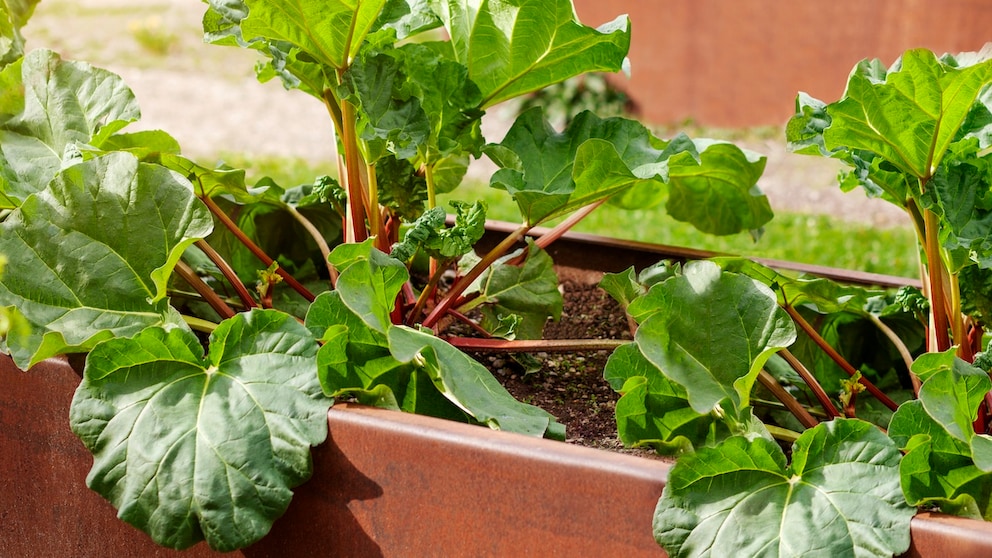
Rhubarb is an impressive perennial with large, green leaves growing on long, sturdy leaf stalks. The stalks vary in color from green to deep red, depending on the variety. The plant can reach a height of up to 1.5 meters, especially during the flowering period when decorative, panicle-shaped flower clusters develop. The roots form a thick, fleshy rhizome that allows the plant to grow vigorously for many years.
Varieties
- ‘Holsteiner Blut’: This classic variety is characterized by thick, red stalks and a mild aroma.
- ‘Vierländer Blut’: Also with red stalks, it has a tangy taste and high yield.
- ‘Goliath’: Especially long and thick stalks, ideal for processing.
- ‘Timperley Early’: An early-ripening variety that is well-suited for “forcing.”
- ‘Frambozen Rood’: Sweet in taste, with deep red stalks.
Caring for Rhubarb
Rhubarb is undemanding and suitable for beginners. Regular watering and occasional fertilizing promote its growth.
Proper Watering for Rhubarb
Rhubarb needs a lot of water, especially during the growing season in spring and summer. Water regularly to keep the soil evenly moist without causing waterlogging. Particularly during dry spells, the soil should not dry out.
Which Fertilizer to Use
Fertilizing in early spring with compost, horn shavings, or organic complete fertilizer provides the plant with the necessary nutrients. After harvesting in June, an additional nitrogen application, such as horn meal, can promote growth.
Does Rhubarb Need Pruning?
Flowering shoots should be removed as they unnecessarily drain the plant’s energy. It is also advisable to regularly remove dead or damaged leaves to prevent diseases.
Winter Hardiness
Rhubarb is extremely winter-hardy and can withstand temperatures down to minus 25 degrees. Additional winter protection is not necessary.
Propagation
Rhubarb can be propagated by dividing the rootstock in fall or early spring. To do this, the plant is dug up and the rhizome is divided into pieces, each with at least one bud. The pieces are then planted at their new location.
Diseases and Pests
Rhubarb is largely robust. However, some problems can occur:
- Leaf Spot Disease: This is a fungal infection that causes brown spots on the leaves. Remove affected foliage and promote good air circulation.
- Root Rot: Caused by waterlogging. Ensure well-drained soil.
- Slugs: These can damage young shoots. Slug fences or hand-picking can help.
Toxicity
Rhubarb leaves contain high amounts of oxalic acid and are toxic. Consumption can lead to poisoning symptoms. The leaf stalks, however, are safe and edible when cooked or baked.
Alternatives
- Sorrel (Rumex acetosa): Similar tangy taste, suitable for salads.
- Gunnera manicata (Giant Rhubarb): Visually impressive, but not edible.
- Swiss Chard (Beta vulgaris subsp. vulgaris): Suitable for similar culinary uses.
How to Properly Store Rhubarb to Keep It Fresh Longer
Fertilizing Zucchini: Top Tips for a Bountiful Harvest
Harvesting and Use
Rhubarb is harvested between April and June. The stalks should be twisted off the plant and never cut to avoid rot. Cutting can also promote pathogens. The leaves can then be used as mulch or for compost. Rhubarb is suitable for pies, compote, jam, and syrup. The stalks can be frozen, either peeled or unpeeled.
Bee Friendliness
Rhubarb flowers are popular with insects and provide a good food source, but should be removed for growth reasons.

My “Faux Pas” at the Supermarket
“I know rhubarb as compote, in pies, as jam, and in other sweet dishes. With its slightly tangy taste, often mellowed with a bit of sugar, rhubarb always belonged to the fruit category for me. But at the supermarket checkout, I was taught otherwise. When I tried to self-checkout in the produce section, I searched the terminal’s fruit list in vain for rhubarb. I called over an employee, who also couldn’t find it. Then he asked if I was looking in the right category. I paused and switched to vegetables. And indeed! There I found rhubarb between carrots and beets. Who would have thought? Certainly not me, and I must admit I had no idea that rhubarb is not a fruit but a vegetable.”