


March 30, 2026, 8:55 am | Read time: 5 minutes
Celery, also known as stalk celery or blanched celery, is one of the most versatile vegetable plants and is primarily valued for its crunchy leaf stalks. Unlike other forms of celery, the focus here is not on the bulb but on the above-ground part of the plant. Its mild-spicy flavor makes it suitable for both raw and cooked use. However, some special considerations are necessary for cultivation, as the plant has high demands for water and nutrients. Those who understand these can successfully grow stalk celery and use it in various ways.
Stalk celery (Apium graveolens var. dulce) belongs to the Apiaceae family, characterized by its distinctive umbrella-shaped flower clusters. It originally descends from wild celery, which grows in the Mediterranean region and along European Atlantic coasts. There, it inhabits nutrient-rich, moist, and often salty soils. Celery was used as a medicinal plant as early as ancient times. Today, stalk celery is widespread worldwide and is an important vegetable, especially in the U.S. and the Mediterranean region.
Planting Stalk Celery
Stalk celery is grown from seeds due to its long development time. Sowing takes place from February or March at temperatures of about 60 to 68 °F. As a light germinator, the seeds only need to be lightly pressed. They germinate after about two to three weeks. After around six to eight weeks, the young plants can be planted outdoors from mid-May, once there is no longer a risk of frost. It’s important not to plant them deeper than they were in the seedling pot.
Location and Soil
Stalk celery prefers sunny to partially shaded locations. The soil should be deep, humus-rich, and nutrient-rich, as it is a heavy feeder, meaning a plant with high nutrient needs. Clayey, well-water-retaining soils are particularly suitable. Consistent moisture is crucial, as dryness leads to quality loss. Lime and slightly salty soils are well tolerated, but waterlogging should be avoided.
Appearance and Growth
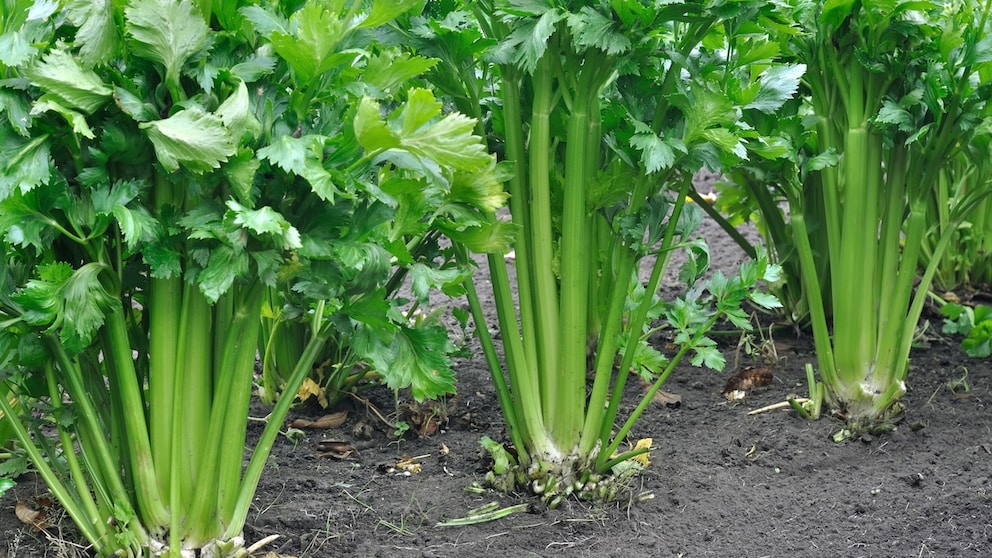
Stalk celery is a herbaceous plant that can grow up to one meter tall. Characteristic are the fleshy, thickened leaf stalks that grow from the center of the plant and can reach up to 60 centimeters long. The stalks are usually green to light green, and in certain cultivation methods, they can also be yellowish (blanched celery). The leaves are feathery and dark green. Unlike other forms of celery, stalk celery forms only a small, inconspicuous bulb.
Varieties
There are various cultivations of stalk celery with different characteristics:
- ‘Tall Utah’: High-yielding variety with a mild taste
- ‘Spartacus’: Self-blanching variety with tender, light stalks
- ‘Darklet’: Early variety with rapid development
- ‘Conga’: Fast-growing, suitable for spring and summer cultivation
- ‘Tango’: Resistant and suitable for longer growing periods
Some varieties are self-blanching, while others need to be lightened before harvest by depriving them of light.
Caring for Stalk Celery
Stalk celery is labor-intensive and more suitable for experienced gardeners, as it requires continuous water and nutrients.
How to Water Stalk Celery Properly
The water requirement is high. The soil should always be kept evenly moist. Especially during warm periods, regular watering is necessary, as dryness leads to fibrous and more intensely flavored stalks. Waterlogging should be avoided.
How to Fertilize Celery
As a heavy feeder, stalk celery requires an intensive nutrient supply. Before planting, compost is worked into the soil. During the growth phase, additional fertilization is advisable, such as with nitrogen- and potassium-rich fertilizers or organic alternatives like nettle manure. However, over-fertilization with nitrogen can affect the taste.
Does Stalk Celery Need Pruning?
A classic pruning is not necessary. For harvesting, individual outer stalks can be cut while the plant continues to grow. Alternatively, the entire plant can be harvested.
Winter Hardiness
Stalk celery is sensitive to frost and does not tolerate sub-zero temperatures. Therefore, harvesting should occur before the first frost.
Propagation
Propagation is done through seeds. Due to the long development time, pre-cultivation is necessary. After germination, the young plants are thinned out (pricked) to allow them to develop strongly.
Diseases and Pests
Stalk celery can be affected by various problems:
- Septoria leaf spot disease: brown spots with black dots; prevention through good ventilation
- Celery mosaic virus: yellowish discolorations and growth disturbances; transmission by aphids
- Celery fly: larvae damage the leaf stalks
- Carrot fly: affects roots and causes feeding tunnels
- Aphids and slugs: weaken the plant through feeding
Toxicity
Stalk celery is edible and a popular vegetable, but it can cause allergic reactions such as skin irritations or gastrointestinal issues in sensitive individuals.
Alternatives
Similar vegetable plants with comparable uses include:
- Fennel (Foeniculum vulgare)
- Parsley (Petroselinum crispum)
- Carrot (Daucus carota)
- Parsnip (Pastinaca sativa)
Pak choi – how to grow Asian cabbage in the garden
How to Grow Lettuce in Your Garden
Harvest and Use
Stalk celery can be harvested gradually from summer by cutting individual stalks. The complete harvest occurs at the latest before the first frost. The stalks can be used raw as a snack or salad ingredient, but they are also suitable for soups, stews, and sauces. Additionally, it is a component of vegetable juices. It should be stored cool.
Bee Friendliness
Since stalk celery is usually harvested before flowering, it plays only a minor role for bees in the garden.