

October 19, 2026, 2:34 pm | Read time: 4 minutes
Between delicate pink and vibrant purple lies one of the most extraordinary native orchids. The monkey orchid captivates with its bizarre flower shapes, loves sunny, calcareous locations, and is extremely rare in Germany. It has been named the Orchid of the Year for 2027.
The Orchid of the Year 2027 was chosen by the Working Group for Native Orchids (AHO). The selection highlights the lifestyle of this orchid and draws attention to the protection of its endangered habitats.
Appearance and Special Features
The monkey orchid belongs to the orchid family and is a perennial, herbaceous plant. Depending on the location, it typically reaches a height of about 8 to 18 inches. Its elongated, usually unspotted leaves form a ground-level rosette, from which the flower stalk rises in spring.
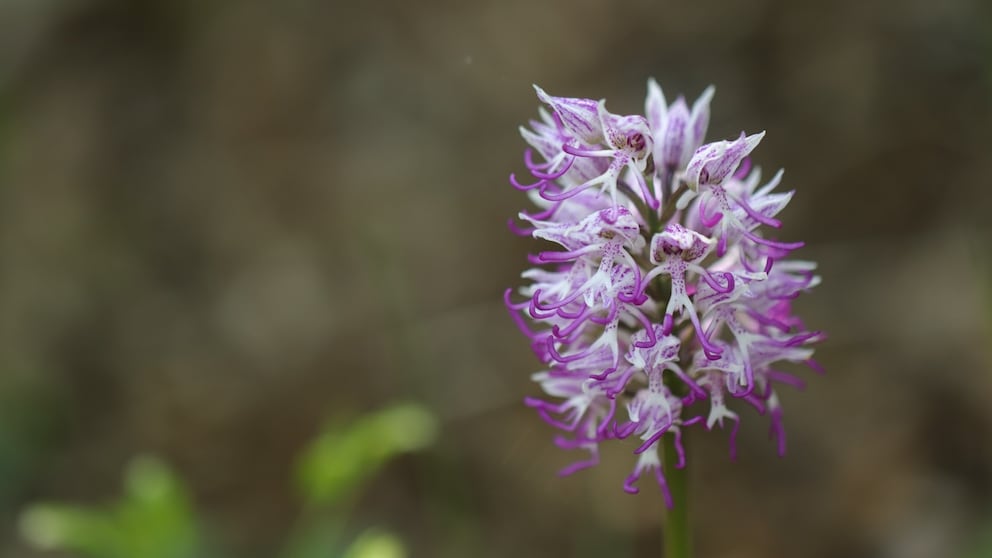
Particularly striking is the dense, egg-shaped flower cluster. The individual flowers display a color play of white-pink, delicate violet, and vibrant purple. While the upper petals, together with the sepals, form a kind of helmet, the three-part lip is especially eye-catching. Its narrow side lobes and deeply notched middle section resemble, with a bit of imagination, the arms and legs of a small monkey. This shape gave the species its German name. The second part of the scientific species name, simia, also refers to the monkey.
Another peculiarity is revealed during blooming: Unlike many other plants, the flowers of the monkey orchid typically open from top to bottom. This changes the appearance of the flower spike over the course of the blooming period.
Between April and May, the monkey orchid blooms in many places. Depending on the weather, altitude, and regional climate, the blooming period can shift. Especially in spring, it’s worth paying attention to the special plant life of the calcareous grasslands during walks through suitable protected areas.
Where the Monkey Orchid Calls Home
The main distribution area is in the Mediterranean region. Additionally, the species is found in parts of Europe, North Africa, and West Asia. In Central Europe, it reaches the northern limits of its distribution area and relies on suitable, relatively warm locations. In Germany, the monkey orchid is mainly found in climatically favored regions of the southwest, including the Upper Rhine area and the Kaiserstuhl. Occurrences are also known from other warm-favored areas. Overall, however, the species remains rare in this country.
Also interesting: 8 plants that look particularly special after blooming
Its preferred habitats are open and semi-open landscapes: calcareous grasslands, sunny slopes, light shrub edges, and warm-favored dry sites. Suitable soil conditions and sufficient light are crucial.

The Orchid of the Year 2026 Has Been Chosen

Orchid of the Year 2023 Has Been Chosen
Why This Wild Orchid Is Endangered
As extraordinary as the flowers are, the habitat of the monkey orchid is just as vulnerable. In Germany, the species is listed as critically endangered in the Red List. Its populations are rare, and the development of occurrences is cause for concern.
A major problem is the loss of suitable open land areas. Calcareous grasslands and other nutrient-poor sites disappear when they are built on, intensively farmed, or no longer maintained. If traditional maintenance and management measures are absent, areas increasingly become overgrown. Shrubs and tall plants then take away the space and light that the light-loving orchid needs.
Excessive use can also be problematic. Fertilization changes the nutrient balance, while frequent mowing at the wrong time or heavy machinery can affect plants and their habitat.
Protecting the monkey orchid means more than preserving individual plants. It is crucial to preserve the habitats as a whole and to secure their special conditions in the long term.
A Small Orchid with Great Significance
The monkey orchid is an impressive example of how diverse and surprising the native plant world can be. Its flowers resemble small figures, its lifestyle is highly specialized, and its rarity underscores the importance of protecting species-rich open land areas.
Those who are fascinated by this orchid not only discover an unusual flower shape. They also encounter a piece of nature that relies on special conditions and must continually assert its place in our landscape.