


September 18, 2026, 8:48 am | Read time: 4 minutes
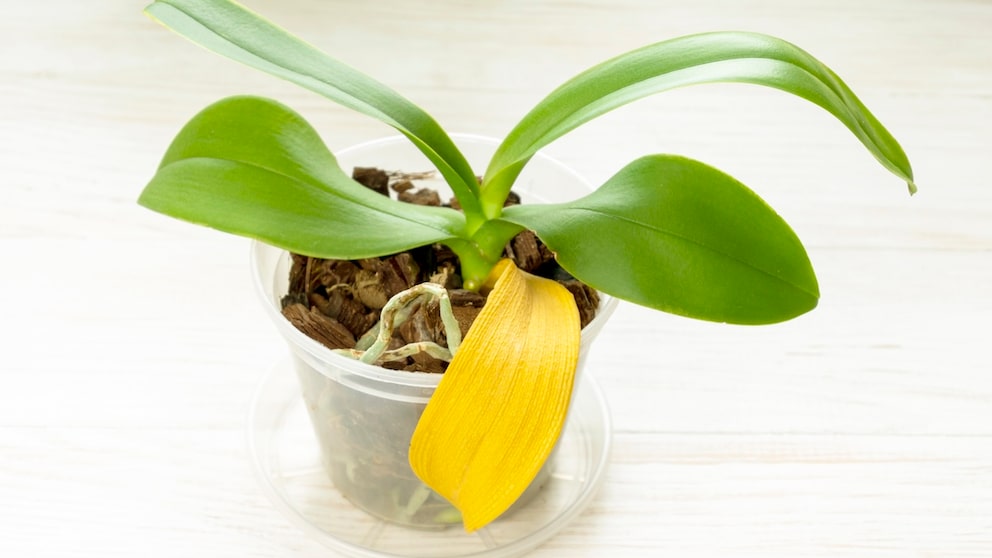
For months, the orchid blooms beautifully and continuously produces new buds. It’s all the more concerning when individual leaves suddenly turn yellow. There can be a variety of reasons behind this. However, not all of them mean the orchid is sick or dying. In some cases, the discoloration is a natural part of the plant’s life cycle.
Not Every Yellow Leaf Is a Cause for Concern
When assessing the situation, it’s important to consider how many leaves are affected, where they are located, and the overall appearance of the orchid. Bernd Treder, president of the German Orchid Society (D.O.G.), explains: “In a natural aging process, only a single, lowest leaf turns yellow. The rest of the plant looks strong and green. The leaf slowly dries up and falls off on its own.”
If more than one leaf changes, the orchid should be examined more closely. “With a care mistake, several leaves turn yellow, limp, or spotty at the same time. The yellowing starts in the middle or on the upper leaves,” says Treder.
The Cause Often Lies in Watering
If multiple discolorations appear, it’s worth first looking at past care habits. Orchids are particularly sensitive to deviations in watering. According to Treder, both too much and too little water can cause yellow leaves: “The most common cause is waterlogging. It leads to root rot, preventing the leaves from absorbing water and turning yellow. Extreme dryness also causes yellowing.”
It may seem contradictory that leaves discolor despite wet substrate. However, the condition of the roots is crucial. If they are damaged by persistent moisture, the orchid can no longer properly absorb the available water.
Also interesting: Orchid has finished blooming? Here’s what to do now
Location Can Also Cause Yellow Leaves
In addition to watering habits, the orchid’s location should be checked. Light conditions are particularly important. “Too much direct sunlight causes sunburn with yellow-brown, dry spots. A place that’s too dark inhibits photosynthesis,” says Treder.
The appearance can thus provide an initial clue to the cause. Limited, dry spots are more indicative of damage from direct sun. If the leaves become generally paler, other causes may also be considered.
The Amount of Fertilizer Must Be Right
In terms of nutrient supply, two opposing care mistakes can lead to a similar result. If yellow leaves are noticed, both a possible deficiency and the amount of fertilizer used so far should be considered.
Treder explains: “A nitrogen deficiency leads to uniformly pale, yellow leaves. Too much fertilizer, on the other hand, burns the roots, which also leads to yellow leaves.” Therefore, more fertilizer is not automatically the right response to a pale orchid. First, it should be clarified what actually caused the discoloration.
4 Mistakes That Cause Yellow Leaves on Geraniums
What to Do When Strawberry Leaves Turn Yellow
What to Do About Yellow Leaves
Before changing the amount of water or fertilizing again, the condition of the plant should be checked. The roots provide an important clue. Treder advises: “Take the orchid out of the pot and check the roots. Cut off rotten parts and adjust the watering habits.”
The expert advises against hasty interventions on the leaf itself: “Do not forcibly tear off the yellow leaf. This creates entry points for fungi and bacteria. You should wait until it falls off on its own.” Similarly, you should not automatically water more frequently when yellowing occurs. “Never immediately increase the water amount with yellow leaves without checking the roots,” warns Treder.
These Warning Signs Require Quick Action
In some cases, there is little time to save the orchid. Therefore, special attention should be paid to the base and center of the plant. Treder warns: “You should act immediately if the stem base, that is, the base, becomes black or mushy. If the leaves turn yellow from the heart of the plant, stem rot is imminent.”
Immediate care measures are then necessary. “Without immediate repotting and drying, the plant will die in a few days,” explains the president of the German Orchid Society.