


June 8, 2024, 4:24 am | Read time: 5 minutes
A split-level design can be architecturally exciting. By creating different levels, the floor plan can be designed in an extremely creative way. Daniela Matsuzaki, an architecture journalist at myHOMEBOOK, explains what lies behind it.
The split-level floor plan is a popular alternative to single-level living. In split-level homes, living rooms or other communal spaces are offset by a quarter floor up or down. This creates varying room depths. Small steps lead from one room to another. Generally, the split-level floor plan also feels like an open layout with different heights.
Overview
History of Split-Level Design
The trend of staggered levels originally comes from the U.S. After World War II, there was a significant baby boom in the U.S. This led to a search for new ways to improve living conditions in the suburbs. The new architectural style made it possible to create more living space on smaller plots.
Although the houses were more compact, they were more affordable, making this construction method extremely attractive. The open and relaxed floor plans were also a welcome change from traditional Craftsman homes.
Also interesting: What to Consider When Building on a Slope
Features of a Split-Level House
In a split-level house, it feels as if there are no walls. The open floor plan, which extends through various areas and levels, makes this type of construction special. The half floors, which usually have no real boundaries, offer an almost panoramic view.
The main levels in a split-level, often consisting of communal spaces like living rooms, kitchens, and dining areas, are usually directly connected. Rooms that require more privacy are more or less out of sight and are either a few levels lower or higher. In a split-level house, there are no individual floors; rather, everything is separated by half staircases.
Unique Floor Plans
Living on different levels allows for creative expression. This can lead to interesting and individual floor plans. It’s not uncommon for there to be plenty of natural light in the house. Floor-to-ceiling windows and skylights allow enough light to enter the house and brighten darker areas.
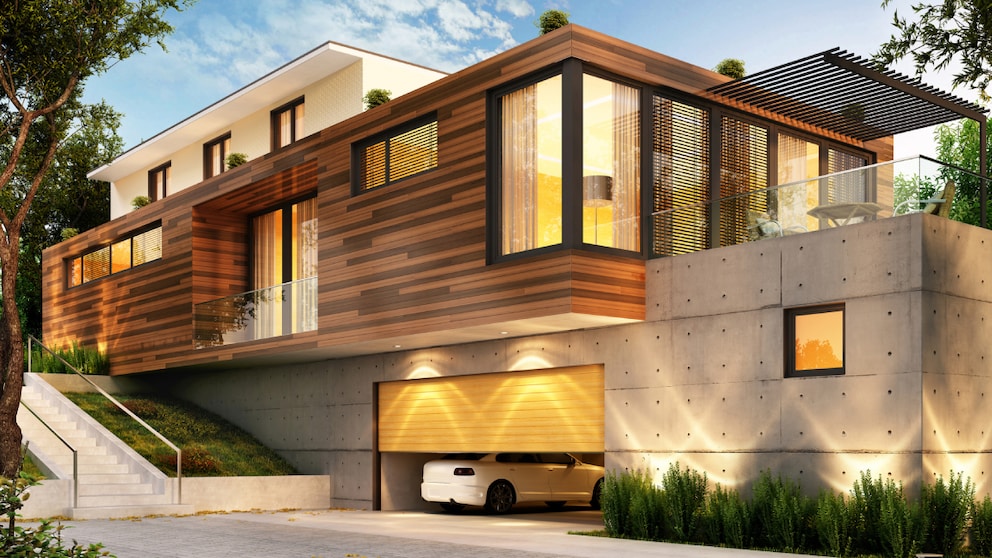
A split-level is also well-suited for a house on a slope, as the floor plan often needs to be terraced due to the steep location. From the outside, this design can be recognized by the different levels and room heights. In some split-level houses, the lower levels often contain a garage with an adjoining half-basement and living room above.
Creating Individual Zones
A split-level house allows for the creation of many private zones, helping one to retreat. Separating living and sleeping areas already provides a certain level of privacy. Additionally, dividing the floor plan into different zones offers space for work, relaxation, and hobbies. With the integration of partitions and custom built-ins, these areas can be better defined.
Partially open fireplaces located between two levels offer a visual appeal and create a subtle separation between areas. Different ceiling heights can also create varied atmospheres. Low ceilings can provide coziness, while high ceilings exude a touch of luxury and make the room appear larger.
Watch Out for Trip Hazards
Since this design involves climbing stairs, the constant up and down can pose a safety risk for some people. There is a potential fall hazard, especially for children and seniors.
Additionally, the split-level house is not particularly wheelchair accessible and can be a burden for people with limited mobility. Therefore, it’s important to consider whether such a floor plan is practical beforehand.
The Sunken Living Room Is Back! The Advantages and Disadvantages of the Sunken Living Room

Why Modern Apartments Often Feel Uncomfortable Today
Split-Level from the Outside
This style often varies in its construction, but the half-story heights have typical features that are easily recognizable from the outside. The irregularity of the building is quite noticeable. There are also individual rectangular or square structures that protrude forward. Large panoramic or double windows are also typical of split-level houses, as are flat roofs and facades equipped with various materials.
Examples of Split-Level
While the original floor plans were already very innovative, the split-level has continued to evolve. Today, there are many modern interpretations of it.
The single-family house in Hamburg Volksdorf by “La‘ket Architects,” for example, is characterized by a “compact split-level organization.” From the outside, a modern cubist design can be seen, which does not differ materially from the facade of the surrounding single-family homes. Traditional clinker bricks were also used for this building. The flush windows allow a view inside, revealing the different levels that provide privacy as they ascend. The entrance is partially underground and accessible via a recessed area.
The Multi-Split Single-Family House by Deolmann Design is another example of modern split-level architecture. The interlocking split floor plan connects all levels with an “open interior,” with integration to the garden throughout. While the building is closed to the street, it opens up at the back. This house received the German Design Award 2024.
Also interesting: The Features of a Hybrid House

Choose Furnishings Wisely in Split-Level Homes
“The split-level house design is interesting and offers plenty of room for creativity. The different levels create lively variety. However, when furnishing, one should not combine too many different styles. This can quickly appear cluttered and chaotic. With minimal and uniform furnishings, one can make the most of a split-level.”