


May 8, 2026, 3:04 pm | Read time: 5 minutes
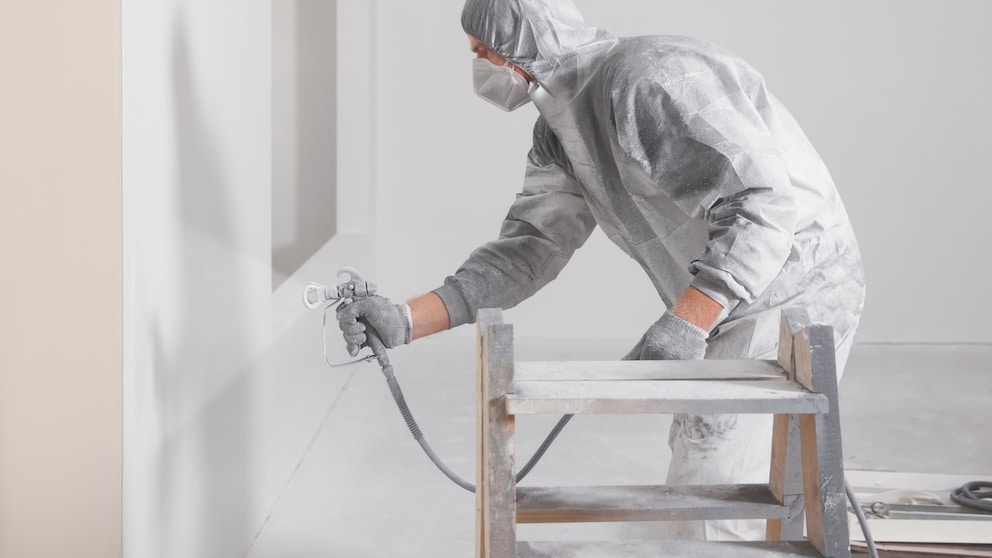
Wall paint can be applied not only with a brush and roller but also by spraying. A spray system allows large areas to be coated quickly and evenly by finely atomizing the paint and applying it to the wall without contact. This way, textures like woodchip wallpaper or plaster remain completely intact. What sounds practical, however, only works under certain conditions and is not suitable for every situation. myHOMEBOOK explains what to consider.
The Advantages of Spraying
The biggest advantage of spraying is speed: With a spray device, walls can be coated much faster than with a roller. The paint distributes evenly, eliminating streaks and overlaps, as well as the typical brush strokes and roller marks. Even hard-to-reach areas, corners, and intricate sections are well covered. However, some practice is required to make these advantages come to fruition.
Spraying Paint Also Has Disadvantages
Those who have only worked with a roller and brush may easily underestimate the amount of preparation involved. What sounds like a perfect alternative also comes with drawbacks. The preparation requires more effort. Additionally, there is the purchase or rental of a device and the subsequent cleaning of the spray equipment.
When painting, it is sufficient to tape off edges, baseboards, and light switches. In contrast, spray mist spreads and can creep into every crevice. Floor covering is mandatory, and furniture, radiators, windowsills, and door frames must be completely covered. Ideally, drafts should also be avoided to prevent the paint particles from spreading further.
Conventional wall paint is too viscous for most spray devices. Depending on the system, about five to ten percent of water is needed. This must be added gradually according to the manufacturer’s instructions for the device. If the paint is too thick, the nozzle of the spray device clogs. If it is too diluted, the paint does not cover properly and may run.
Unlike painting, more attention must be paid to work safety. A mask protects against inhaling the paint mist. Safety goggles prevent paint from coming into contact with the eyes. Gloves are also important.
Once spraying is finished, the equipment must be cleaned immediately, as drying paint clogs nozzles and pumps. This can quickly take half an hour or more.
Finally, spraying consumes slightly more paint due to technical reasons. This is also referred to as “overspray.”
Color Choice and Preparation
When diluted according to instructions, all common interior paints can be sprayed, including classic emulsion paints as well as acrylic, silicate, and lime paints. Special paints for spray systems save the effort of dilution but are more expensive.
The surface should be clean, dry, and free of grease and dust. This is true for classic painting with a roller as well, but it is even more important when spraying. The atomized paint lays a thin layer on the surface, which emphasizes even small imperfections more strongly.

Where “Elephant Skin” Is Useful as Wall Sealant

When Wallpaper Peels: Common Mistakes Behind the Problem
Step by Step to an Even Coat
Once the room is prepared, the painting consists of only a few steps.
- Stir the paint thoroughly, dilute with water if necessary, and fill it into the container.
- Set the device according to the manufacturer’s instructions. The manual provides guidance on how to adjust the nozzle, spray width, and airflow for the respective surface.
- Before starting, it’s better to test spray on a piece of cardboard or wallpaper scraps.
- First, spray corners, edges, and hard-to-reach areas. Then move on to the large surfaces. Hold the spray gun at a right angle to the wall. The distance should be 20 to 30 centimeters. Work in calm, even strokes and slightly overlap each pass.
In general, several thin layers are better than one thick one. Otherwise, drips and runs can form quickly. For textured surfaces like woodchip wallpaper or rough plaster, spray crosswise. Once horizontally and once vertically.
Avoiding Common Beginner Mistakes
There are three typical “surprises” for beginners.
- Paint drips or streaks appear. The distance to the wall was probably too short. Or the handheld device was moved too slowly. Too much paint ended up in the same spot.
- The spraying is intermittent or no paint comes out. The nozzle is clogged. The paint was too thick or not stirred enough.
- The paint ends up in places where it doesn’t belong. The mist should not be underestimated. Better masking next time.
For a renovation or remodeling with large areas, spraying is a time-saving alternative. For smaller areas, working with a roller might be faster because the preparation and cleanup are less demanding.