


June 8, 2026, 11:12 am | Read time: 4 minutes
Hanging wallpaper at least once in a lifetime. Probably everyone has dealt with wallpaper in their DIY career, even if only when painstakingly peeling it off the wall. However, applying it is more challenging. myHOMEBOOK spoke with a master painter about why wallpaper sometimes comes loose and what can be done better next time.
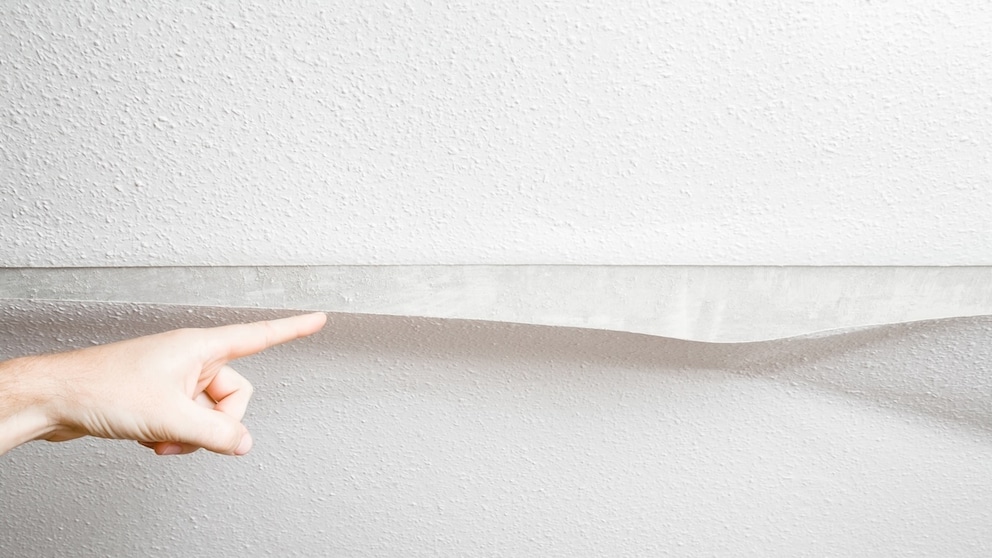
The work is done. Proudly, you look around the room. And then this: The freshly glued wallpaper is coming off the wall in some places. Wallpapering expert Boris Steiner regularly encounters such cases with his clients. He is the managing director at the painting company Steiner & Pawlowski in Krefeld and immediately knows what might have gone wrong. “Either too little or too much paste was applied,” Steiner cites two of the most common causes of poorly adhering wallpaper in a conversation with myHOMEBOOK.
Too Much or Too Little Paste
Even a DIY novice understands too little paste, but too much? “Yes, even too much of a good thing doesn’t always help. Especially older paper wallpapers expand when paste is applied. If the paste is then unevenly distributed, for example, the edges can dry faster than the areas in the middle. As a result, no continuous adhesive surface is created.”
Often, the problem starts when mixing the paste. If it’s too thin, it won’t achieve its full adhesive effect. “That’s why it’s best to always follow the manufacturer’s instructions on the packaging when mixing,” recommends Steiner.
It’s also worth checking the packaging because it usually states which mixture works best for which type of wallpaper. In addition to classic woodchip and paper wallpapers, non-woven wallpapers have become increasingly popular in recent years. “Non-woven wallpapers have the decisive advantage that it’s enough to apply paste to the wall. Wallpapering has become significantly easier since then,” the master painter notes.
Preparing the Surface
The surface can still cause problems when wallpapering. Especially in older buildings from the 1950s to the 1970s, the walls are made of older types of plaster that usually require pre-treatment. Otherwise, achieving a full-surface bond can be problematic.
“Even in new buildings, there can be difficulties if, for example, the surface is made of gypsum plaster. Then fine lime deposits form on the surface. If these are not sanded down beforehand, liquid can hardly penetrate the wall, and the wallpaper won’t hold,” explains wallpapering expert Steiner.

Painting Walls Correctly: 6 Tips to Avoid Streaks
Painting, Wallpapering, Plastering–What Primer Do I Need for Each Purpose?
Beware of Moisture!
When wallpaper is properly glued, it usually adorns walls for eternity. If a wallpaper suddenly comes loose after decades, the room conditions may have changed. “Moisture is always a problem; over time, it acts like a natural wallpaper remover,” emphasizes Boris Steiner.
Sometimes, a new coat of paint is enough to dissolve the adhesive effect, especially if the wallpaper has been painted over multiple times. Specifically, with woodchip wallpaper, at some point, a completely new wallpaper should be considered. “If such a wallpaper has already had its fourth or fifth coat of paint, it not only looks unattractive, but the paint eventually acts like a cardboard layer. This causes tension, which can lead to the wallpaper coming off,” adds the master painter.
Small Wallpapering Tips
To ensure that only firmly glued wallpaper remains on the wall in the future, Steiner has a few tips:
- The surface should be dry, clean, solid, smooth, evenly absorbent, and dust-free
- Distribute paste evenly, not too thick, not too thin, otherwise seams dry too quickly or bubbles form
- The room should not be too warm
- Avoid drafts, or the paste will dry too quickly
Sometimes it’s not necessarily big wallpaper problems; often, it’s just a small corner that doesn’t want to stick anymore. “Simply lift the loose corner slightly, apply some paste underneath, and reattach.” Then, such a small wall mishap is quickly resolved, the master painter knows.
When it comes to mold, the fun stops. A professional should definitely be consulted. The cause is usually not just on the surface but often hidden. “It should be checked whether a simple mold remover is sufficient or if it might be necessary to remove entire plaster areas to treat the surface,” advises Boris Steiner emphatically.