



November 27, 2022, 10:52 am | Read time: 5 minutes
Healthy sleep is important, and in times when awareness of mental and physical well-being, as well as environmental concerns, is steadily growing, it is even more so. A sustainably furnished bedroom requires a certain investment but often proves to be extremely worthwhile in many ways.
Without a doubt, a sustainably furnished bedroom can only positively impact one’s well-being and home health. Being surrounded by environmentally safe items during sleep enhances our sleep quality, relaxation, and regeneration. Moreover, opting for a predominantly natural bedroom setup also benefits the environment. These practical tips will help you take the first steps toward a sustainably furnished bedroom.
1. Sustainable Wall and Floor Design
Especially in the bedroom, where we spend an average of eight hours each night, the ambiance around us should be as healthy as possible. This refers to walls and floors, whose coverings are often full of questionable to dangerous substances. Through emissions, preservatives like formaldehyde, plasticizers, binders, solvents, or heavy metals gradually enter our bodies and can cause allergies, skin irritations, and respiratory issues.
In contrast, wall paints based on ecological materials, such as silicate, lime, or casein paint, are considered much healthier. When it comes to flooring, sustainable coverings are also important. Above all, avoid plastic coverings like PVC floors. Although they may be more cost-effective, they, like conventional wall paint, are full of chemical additives. A good, healthy alternative is a natural wood or cork floor.
Also interesting: 5 Eco-Friendly Wall Paints as Healthy Alternatives to Conventional Coatings
2. Bed Made of Local Wood for a Sustainable Bedroom
No piece of furniture is as close to us as our own bed. Therefore, we should theoretically not have to worry about our sleeping place. However, in practice, the wrong product can contain many undesirable substances. Additionally, models like the popular box spring bed often have numerous metal reinforcements inside. Due to their low-to-the-ground design, moisture, of which we lose 1.5 to 2 liters in the form of sweat during sleep, cannot be released.
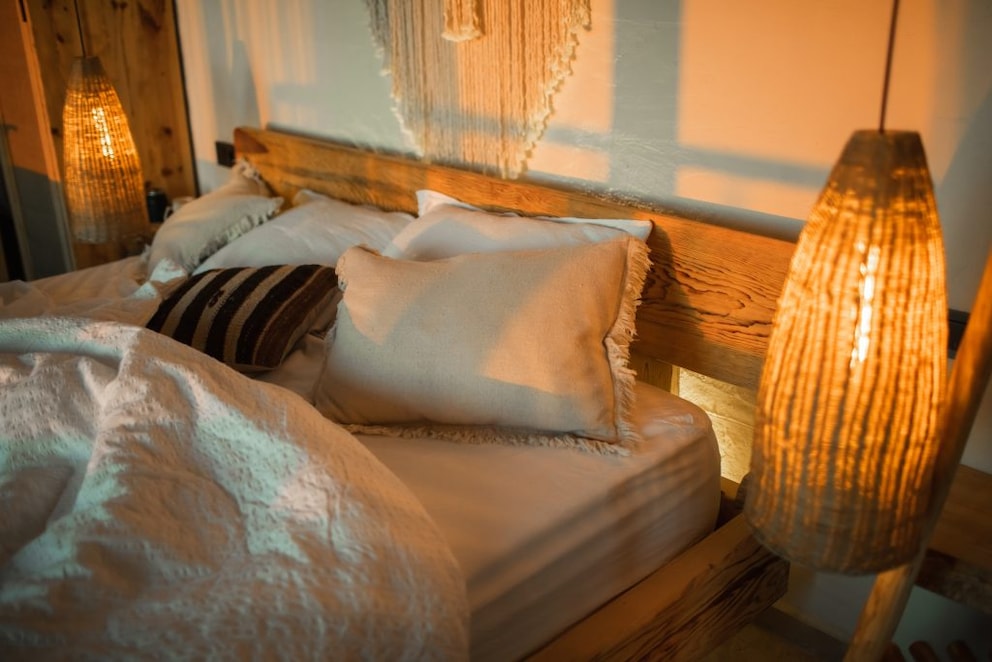
Ideally, choose a model that stands on four legs, providing free space under the slatted frame. The bed should be made of wood, preferably with an FSC seal. In addition to local woods like beech or oak, Swiss pine is particularly healthy and beneficial. Its aromas have calming, anti-inflammatory, and sleep-promoting effects.
3. Choose a Mattress with Natural Filling
Cold foam, innerspring, or box spring are popular models when buying a new mattress. However, none of these qualities are truly healthy and sustainable. Innerspring mattresses are suspected of disrupting the natural Earth’s magnetic field due to their metal components, potentially causing cardiovascular issues. Dust mites often accumulate in the cavities of pocket spring mattresses. The filling of cold foam mattresses is often based on petroleum, as a synthetic product. Box spring beds, on the other hand, do not ensure good moisture transport.
For a sustainably furnished bedroom, mattresses made of coconut fibers are recommended, as they regulate moisture much better. Natural latex also offers a healthy quality, as it provides good thermal insulation, among other benefits.

Firmness, Material, Size–How to Find the Right Mattress

Decorating a Child’s Room According to Feng Shui
4. Natural Furniture for a Sustainable Bedroom
In addition to the bed, ideally, all other furniture in the sustainable bedroom should be made of natural materials. From the wardrobe to the dresser to the nightstand, wood is always recommended. Local woods like beech, birch, pine, or oak not only create a good, pleasant room climate but also do not require long transport routes like tropical woods. To be on the safe side, choose products certified with the FSC seal, ensuring the wood comes from responsibly managed forests.
Alternatively, sustainable bedroom furniture can come from second-hand sources, having already had a previous life. For good mental health, closed furniture is especially suitable. An open view of shelves or clothes racks, which can sometimes appear chaotic, can subconsciously lead to nervousness and unease.
5. No Technology in the Sustainable Bedroom
To keep the bedroom a place of relaxation, it is advisable not to store too many unnecessary items. As a result of the pandemic and due to a lack of space, the home office has quickly moved into the bedroom in many households. Along with it came numerous electronic devices and equipment, as well as the Wi-Fi router. All these technical items have blinking LEDs and emit strong electromagnetic radiation. Ideally, they should be put in standby mode or completely disconnected from the power grid overnight. Smartphones and TVs also do not belong in a sustainably furnished bedroom.

Additionally, something else that does not belong in a sustainably furnished bedroom is overly bright colors and too much decor. Both are distracting and can significantly disturb sleep. Calming colors like white, gray, or blue are effective. Warm, strong tones like red and orange are considered energizing and thus absolutely counterproductive for restful sleep. In terms of decoration, a minimalist approach should be taken. Less is clearly more sleep in this case. Plants can also be included in the sustainable bedroom, but only those suitable for this space, such as air-purifying aloe vera, bromeliad, peace lily, or snake plant.