


August 19, 2026, 4:47 am | Read time: 4 minutes
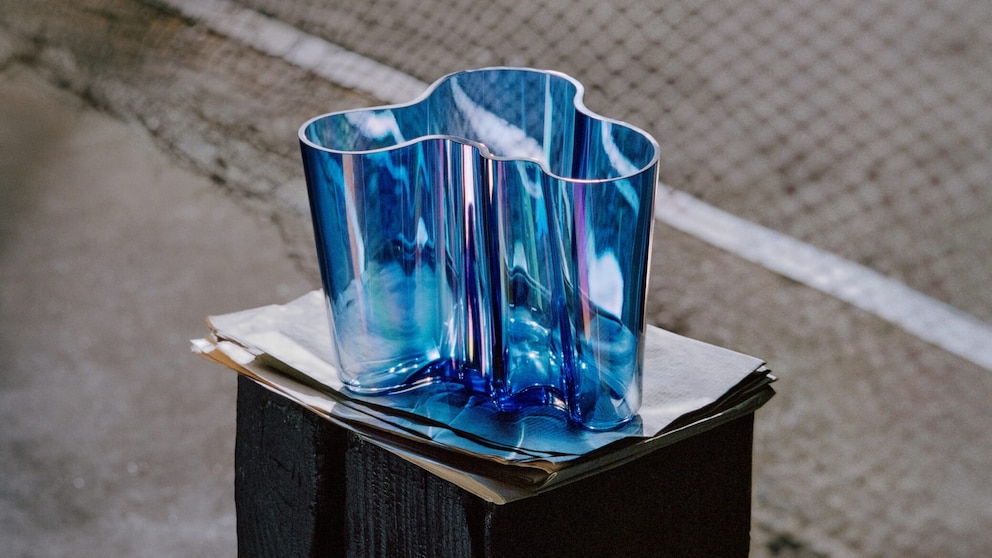
There are design objects that capture the spirit of an era. And then there are those few designs that endure for decades without losing their modernity. The Savoy Vase by Alvar Aalto undoubtedly belongs to the latter category. Since its creation in 1936, it has evolved from a competition entry to one of the world’s most famous glass vases. This year, the iconic form celebrates its 90th birthday and is more relevant than ever.
A Design That Broke with Conventions
The Finnish architect couple Alvar and Aino Aalto participated in the 1936 design competition of the glass manufacturer Karhula-Iittala. Their entry was radically different from anything considered modern glass design at the time. While symmetrical, geometric shapes dominated European taste, the Aaltos presented a series of organically curved glass objects with free-flowing contours.
The competition entry bore the unusual title “Eskimoerindens skinnbyxa”—in English, roughly “The Eskimo Woman’s Leather Pants.” Behind the peculiar name was not a single vase but an entire collection of vessels and bowls of various sizes. The designs won the competition and were subsequently exhibited in the Finnish Pavilion at the 1937 Paris World’s Fair. There, the extraordinary form first caught the attention of an international audience.
Where Does the Famous Silhouette Come From?
Few design objects have been interpreted as often as the curved contour of the Savoy Vase. It is often said that its form was inspired by the thousands of Finnish lakes or the undulating coastal landscape. Others see in it the outline of a fluttering piece of fabric or an abstracted wave motion, which fits the family name Aalto, meaning “wave” in Finnish.
Interestingly, Alvar Aalto himself never clearly explained the idea behind the form. This very ambiguity makes the design so intriguing to this day. Instead of a clear symbolism, Aalto created an organic design language that leaves room for personal associations. It appears natural, lively, and surprisingly modern—even nine decades after its creation.
Why the Vase Is Called “Savoy”
The name known worldwide today only emerged after the vase’s design. Originally, it only had a model number. It wasn’t until it was used on the tables of the newly opened Savoy Restaurant in Helsinki from 1937 that the name “Savoy Vase” became established.
The restaurant itself was designed by Alvar and Aino Aalto and quickly became a meeting place for the Finnish cultural and business elite. The vase was not just decoration but part of a holistic design concept that combined architecture, furniture, lighting, and accessories. The place of use eventually became its commonly used name.

What Makes Arne Jacobsen’s Egg Chair So Special

How the Iconic “Togo” Sofa Revolutionized the Furniture Market
Craftsmanship Makes Each Piece Unique
The production of the vase is still genuine craftsmanship today. Each vase is mouth-blown. The free-flowing contour cannot simply be pressed into a standardized mold but requires a lot of experience from the glassblowers.
This artisanal production ensures that no vase is exactly like another. Small differences in line, material thickness, or color effect are intentionally part of the design’s character.
A Classic That Survives Trends
While many design icons are closely tied to a specific era, the Savoy Vase by Alvar and Aino Aalto seems to defy any fashion. Its secret lies in its versatility. It functions as a flower vase just as naturally as a sculptural object on a sideboard or dining table.
Additionally, it is adaptable. Over the decades, numerous sizes and color variations have appeared: from clear glass to smoky gray and moss green to more vibrant blue or red tones. Yet the characteristic silhouette has always remained unchanged. It has become a trademark of Finnish design and is now one of the most famous designs of the 20th century.