

October 14, 2026, 4:06 am | Read time: 5 minutes
The Flowerpot by &Tradition, with its two opposing hemispheres, distinctive silhouette, and a color palette ranging from subtle to bold, is much more than a light source. It is a piece of design history, a symbol of creative freedom, and proof that good design is not a matter of fleeting trends.
Follow myHOMEBOOK on WhatsApp now
A Design from a Time of Change
The year 1968 was marked by social changes, new ways of living, and a desire to question outdated ideas. Youth culture developed its own forms of expression, the Flower Power movement stood for peace, love, and openness, while enthusiasm for technological innovations and space exploration created new visions of the future. Design, too, increasingly broke away from traditional conventions, seeking a language that was more modern, bold, and experimental.
It was in this environment that the Flowerpot was created. Verner Panton, born in Denmark in 1926, was one of the designers who consciously moved away from the restrained aesthetics of classic Scandinavian modernism. While many of his contemporaries focused on natural materials, muted colors, and a more straightforward design language, he was fascinated by intense colors, unusual materials, geometric shapes, and futuristic space concepts. For Panton, design was not just about function. It should appeal to people emotionally, stimulate their imagination, and make everyday life more vibrant. The Flowerpot embodies this attitude in a special way: It appears uncomplicated and playful, yet is meticulously thought out. Its design reflects the optimism of a time when the future could be reinvented not only technically but also creatively.
Since 2011, the Flowerpot has been part of the portfolio of the Danish design brand &Tradition. Previously, it was produced by Louis Poulsen, among others. With today’s collection, the original idea has grown far beyond the classic pendant lamp. New formats, additional applications, and altered color schemes allow the design to be adapted to modern living and working environments.
Also interesting: Why designer Eero Saarinen eliminated table legs and made design history
From the First Pendant Lamp to a Versatile Collection
Originally, the Flowerpot became known as a pendant lamp. Since its design in 1968, the series has continuously evolved. Today, it includes numerous models that meet different lighting and interior design needs. The characteristic design language of Verner Panton remains intact.

The Flowerpot pendant lamp is available in versions VP1, VP2, VP6, VP7, and VP10. The versions differ in size and are therefore suitable for different living areas such as the dining table, kitchen island, larger rooms, or open living spaces.
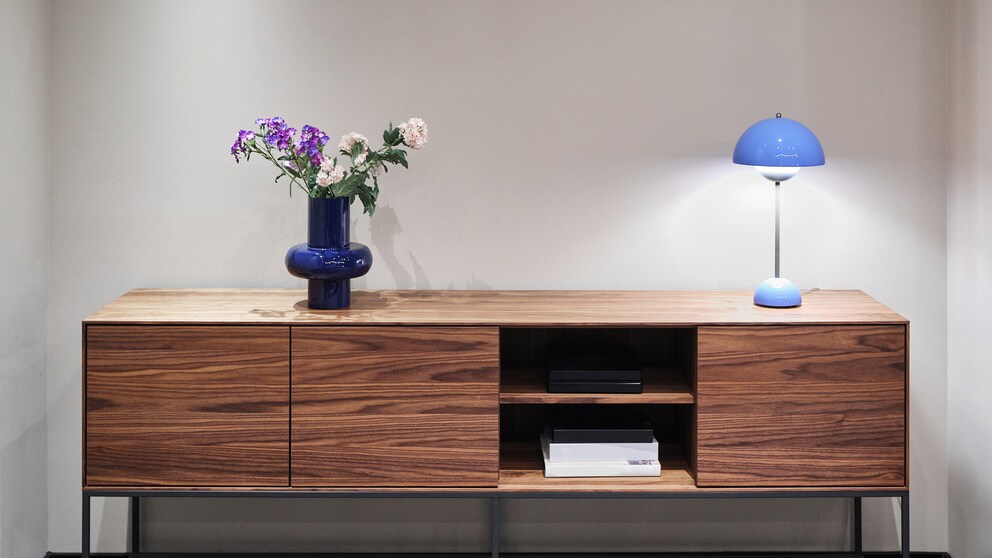
For those who prefer to place the Flowerpot on a dresser, sideboard, or desk, the models VP3, VP4, and VP9 are the best choices. They are suitable both as decorative accent lighting and for creating cozy light islands in the living area.
With the VP8, the characteristic Flowerpot shape also makes its way into wall lighting. It is ideal for hallways, next to the bed, or as an additional light source in a reading nook. Those who like the design but prefer a floor lamp will find the VP12 model appealing.
A special example of the Flowerpot range is the Flowerpot Chandelier, where multiple shades are combined into one installation. This transforms the individual design classic into a composition reminiscent of a modern, geometrically interpreted bouquet.
Two Hemispheres, a Distinctive Form
The design principle of the Flowerpot is remarkably simple: Two facing, hemispherical metal shades form the lamp body. The upper shade is significantly larger than the lower one and partially covers it. Together, they create a harmonious, almost floating composition that resembles an abstract flower or a stylized mushroom.
The name Flowerpot refers to the round, organically shaped form. Indeed, the lamp resembles a flower without replicating it naturalistically. This abstraction is precisely what makes it appealing. Panton translates a familiar association into a modern, geometric form that appears both soft and precise.
However, the construction is not only aesthetically motivated. The lower shade conceals the light source and helps direct the light. The inward-facing surfaces reflect the light, while the open, compact design of the lamp maintains its characteristic expression. The shades are made of molded metal and receive a painted or finished surface depending on the version. The result is a design that relies on few elements and is convincing precisely because of it. There are no superfluous embellishments, no trendy details, and no complicated construction that distracts from the basic idea. The form itself is the design element–and at the same time the hallmark of the entire series.

Tile Trends for 2026

Why the “Panthella” Lamp Has Been Making Design History for Over 50 Years
A Play with Colors and Surfaces
Color plays a central role in the Flowerpot and is one of Verner Panton’s most important design elements. The lamp is now available in numerous variants, from subtle colors like white, black, or beige to bold tones like red, blue, or orange, as well as various metal finishes. Depending on the color choice, it can appear understated or deliberately set accents.
The interplay with different materials and interior styles is particularly exciting. While light colors emphasize the striking shape, bold hues create a stronger focal point. On the occasion of Verner Panton’s 100th birthday in 2026, &Tradition also introduced new color variants, including Steel Blue, Ivory, and Zesty Orange. They draw on the designer’s original color palette and show how the classic can be reimagined with new nuances. The color design is thus much more than a cosmetic addition: It is part of the Flowerpot’s design identity.
A Piece of Design History
The Flowerpot is considered a design classic because it combines a striking form with thoughtful function. Its distinctive silhouette makes it instantly recognizable, while the shades simultaneously ensure targeted light direction. Additionally, the design impresses with its clear, minimalist style that does without unnecessary details. The fact that the lamp was created by Verner Panton in the 1960s and remains popular today underscores its timeless character.