

September 10, 2026, 9:14 am | Read time: 3 minutes
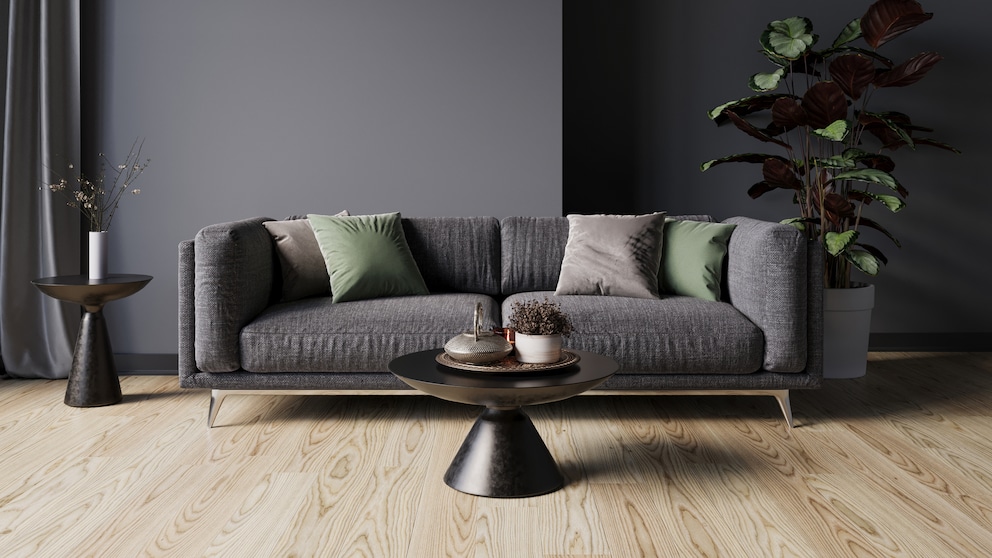
Black kitchens, anthracite-colored sofas, or deep green walls have been trending for years. Many people find such spaces particularly stylish and cozy. Others, however, quickly feel confined or even somewhat oppressed. In fact, the brain reacts sensitively to the environment. What seems important is not so much the color itself but the interplay of light, brightness, and spatial perception.
Follow myHOMEBOOK on WhatsApp now
The Brain Constantly Evaluates a Room’s Brightness
Whether a room is perceived as pleasant, open, or cramped also depends on how much light reaches the eye. A systematic review of light and emotions in indoor spaces shows that people often rate bright rooms as friendlier, more open, and more activating. In contrast, darker environments are more often associated with calm, security, and retreat.
This is precisely why interior designers often use darker colors in living or bedrooms. They can create an intimate atmosphere and make spaces feel cozier. At the same time, researchers point out that dark environments can also be perceived as more closed or smaller.
The Feeling of Safety
Findings from brain research also suggest that light does far more than just illuminate spaces. Scientists at Monash University discovered a direct signaling pathway between the eye and the amygdala, a brain region involved in processing fear.
In the experiments, light reduced the activity of certain nerve cells in this area. The results provide an interesting clue as to why bright environments are often perceived as more pleasant or calming.
From an evolutionary perspective, this would be plausible, as in a bright environment, people can better assess their surroundings. This could unconsciously promote a sense of control and safety.
Daylight Apparently Promotes Well-Being
The connection becomes even clearer with daylight. A comprehensive review from 2024 analyzed 74 scientific studies on the impact of light on well-being. The result was that people tended to report higher well-being when exposed to sufficient light.
For interior design, this means that dark furniture or wall colors are not inherently problematic. They can even be perceived as very homely. It becomes critical when dark surfaces absorb already scarce light sources, making a room appear permanently very dark.

Why Deep Reds Are Taking Over Our Living Spaces

The Best and Worst Paint Colors for the Bedroom
When Dark Rooms Can Feel Unpleasant
Especially small rooms with few windows can appear even darker with dark walls, curtains, or furniture. Some psychologists suspect that dark environments often simultaneously convey coziness and retreat. This can be desirable in a bedroom or reading nook. In work or living areas, however, many people desire more openness and activity.
That’s why interior designers often recommend a middle ground. Dark colors as a style element, combined with sufficient daylight, multiple light sources, and bright accents, seem to be an appropriate combination. This way, the desired elegance is maintained without the room appearing gloomy.
Are Dark Walls Bad, Then?
Research has not yet provided convincing evidence that dark wall colors make people unhappy or even harm the psyche. Rather, the effect of light in the room seems to be decisive. Dark colors can convey coziness, calm, and security. However, if there is not enough light, rooms can quickly appear smaller, more closed, and less inviting.
This means that it’s not the black wall that influences the brain, but the brightness that ultimately reaches the living room.