

October 18, 2022, 10:15 am | Read time: 8 minutes
Connected thermostats promise significant savings on annual heating costs and offer practical additional features. But can the purchase costs be recouped?
This coming winter, many consumers want to keep heating costs as low as possible. Given the drastically increased energy prices, this is a necessity in many households. Programmable and smart thermostats for radiators are said to offer heating cost savings of up to 30 percent. A fact check.

Smart Thermostats: What Are They Exactly?
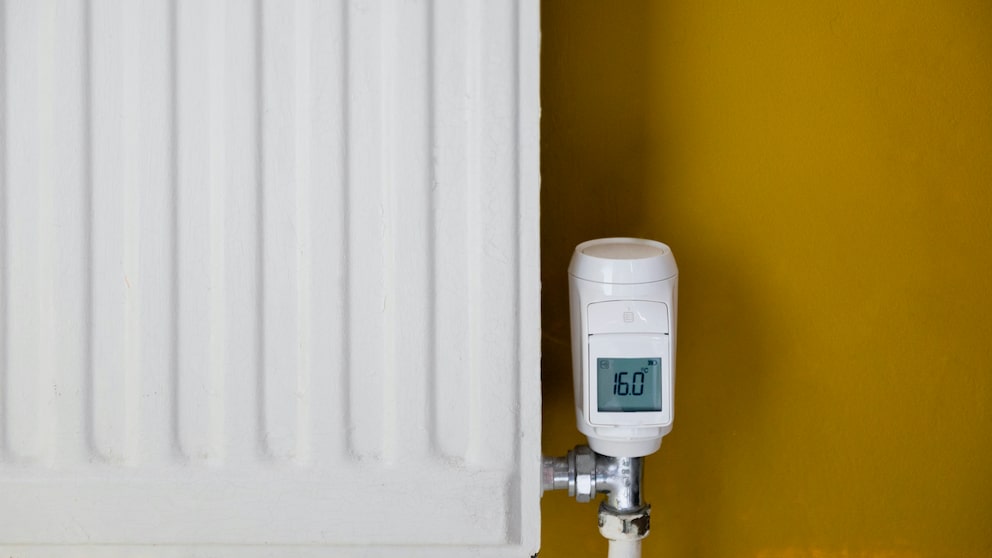
They essentially function like the usual dial regulators, only electronically. The valve on the heater is opened and closed by a small electric motor. A control electronics monitors the temperature and maintains the connection to the control center. Depending on the manufacturer, this can be a standalone box or the internet router. Such a thermostat costs between 40 and 70 euros.
How Can You Program the Thermostat?
With a programmable thermostat, measuring the room temperature and controlling the radiator valve is automated. You can, but don’t need to, manually adjust the temperature each time. Programming when the temperature should be higher or lower on which day is done directly on the device.
For example, you can set normal temperature from Monday to Friday from 2 p.m. to 10 p.m. and on Saturday and Sunday from 8 a.m. to 10 p.m. At all other times, the room is heated less because the residents are in bed or usually not there. If something changes or you feel too cold or too warm in between, you can adjust it.
Related: Smart Thermostats in Test – Which Ones Are Really Worth It?
What Do the Devices Cost?
According to Wolfgang Burchard from the VDMA (German Engineering Federation), simple programmable thermostats are available from 10 to 15 euros. Basic smart thermostats cost from about 40 to 60 euros. But there are extras like window contacts or control centers. According to Stiftung Warentest, a household should budget between approximately 400 and 800 euros for a starter package with six thermostats, four window sensors, and a control center.
Related: Smart Home Association Chief Warns Against Products from the USA and Far East
Can I Really Save Heating Costs with Smart Thermostats?
Some manufacturers promise up to 30 percent savings on heating costs. Matthias Wagnitz is skeptical. The energy and heating technology expert at the ZVSHK industry association says: “How much you can save also depends a lot on how you heated before.” Meaning: Those who have always turned down the heating in the evening and don’t leave it on 5 during the day can save less than people who like to sleep warm and sometimes heat with the window open.
Nico Jurran from “c’t” magazine also says: “If you heat sensibly, you will have great difficulty saving anything with a normal smart home concept.” He goes even further: “The general statement that you save money is total nonsense.”
Living Situation Decisive
This is primarily because there is no single heating system or living situation. As a tenant, you might have central heating, a floor heating system, or district heating. Or there might be underfloor heating or night storage heaters–in which case such devices can almost never be integrated. You might live in a well-insulated or poorly insulated house.
Homeowners can have old boilers with cast-iron radiators, a condensing boiler, low-temperature heating, or even live in a low-energy house with smart heat control. You see: It’s so complex, and there are so many possible individual cases that blanket savings promises are not very credible.
Also interesting: How to Heat Economically Without Freezing
Example Measurement Shows Small Savings
Yes, Stiftung Warentest in 2019. In an example measurement (apartment building, 70 square meters, six heaters, poor insulation), they determined a savings potential of a good eight percent if, for example, the temperature is lowered at night or during absence. After deducting the basic costs, six percent remains. That’s 60 euros with assumed heating costs of 1,000 euros a year, calculates Reiner Metzger from Stiftung Warentest.
Night Setback with Smart Thermostats Not Always a Reason to Buy
Not really. For the example apartment, it’s good, and ZVSHK expert Wagnitz also says: For tenants in a poorly insulated house without influence on the night setback of the heating, there is indeed savings potential. For other living forms, however, the calculation is only partially applicable.
Residents of single-family homes can usually set a night setback directly on the boiler, says Matthias Wagnitz. They could potentially save a bit more with smart systems by giving individual rooms adjusted heating times–for example, if the bathroom is only heated in the morning. But you can’t calculate such things across the board. There is no single savings calculation for all possible living forms.
When Do Smart Thermostats Pay Off?
Possibly never. If you calculate 300 euros for the thermostats for the six radiators in the example apartment, you break even after five years in the best-case scenario. Then there are costs for batteries and–watch out–subscription prices for additional services with some systems. “If you factor all that in, you often can’t save that much,” says Nico Jurran.
Additionally, the thermostat only reduces consumption costs. The basic fees for reading, billing, allocations for stairwells or living space shares, and other fixed costs are unfortunately not affected by the smartest thermostat. And: No winter is like the other.
Do I Even Need Connected Thermostats?
The simple answer is: no. Those who use their dial regulators with discipline can also reduce heating costs. The consumer center of Mecklenburg-Vorpommern recommends about 21 degrees in frequently used living rooms and 18 degrees for bedrooms. The typical dial regulators are set so that level 3 corresponds to about 20 degrees. Each additional mark on the scale corresponds to one degree. It should not be colder than 16 degrees in rooms permanently–otherwise, increased humidity could lead to mold formation.
But: The simple answer is not always the best answer. Because besides possible savings, connected thermostats offer more.
Well-adjusted, they are extremely comfortable. The heating maintains the temperature by itself, turns down in the evening, you can turn it on from afar, and some systems allow complex data evaluations. Together with window contacts, smart circuits can be built–then the heating turns off when airing.
And: “The smart thermostats have the advantage that you can regulate the temperature for each radiator individually,” says Reiner Metzger. This is also practical for centrally controlled heating systems, and everyone can set their desired temperature in each room.
An Investment in Comfort?
Yes, all three experts agree. “It’s often a question of comfort, rarely a question of efficiency,” says Nico Jurran about the benefits of such systems. “Anyone who wants to control their heating by voice command should do so.” Connected solutions also have the advantage that everything can be conveniently set centrally via an app or browser. For example, heating times for the whole year.
If the heating is off, many solutions regularly open and close the valves. So nothing calcifies. Once set up, you hardly have to worry about the heating anymore. And that might not save money, but it might prevent some arguments with roommates. That’s worth a lot too.
Hidden Costs
Nico Jurran recalls “real quality problems” with some tested devices. In the Stiftung Warentest test, Reiner Metzger reports, there were no noticeable issues with the quality and function of the ten models tested. However, Metzger says there is no long-term data on the durability of the devices. For comparison: A normal screw thermostat easily lasts several decades. How long the smart counterparts will last remains to be seen.
Additional costs naturally arise for batteries, and–to be honest–the battery waste should not be forgotten. According to Nico Jurran, there are also possible costs for additional temperature sensors. With them, the imprecise temperature control directly at the thermostat in larger rooms can be better adjusted with extra data from the other end of the room.
Some systems also have monthly costs for using additional comfort functions. And the popular IFTTT (If This Then That) service is now chargeable from the fourth switch.

Digital Thermostat for $10 at Discount Store–But There’s a Catch

Replace Old Thermostats on Heaters to Save Energy
Is There Perhaps a Cheaper Way to a Smart Heating System?
If you don’t want central programming and don’t need app or voice control, you can choose simpler electronic thermostats. They are significantly cheaper with purchase prices of 10 to 30 euros and are not connected, but you can program heating times individually. This way, the basic function of the heating can be automated. Some of the devices can also detect whether ventilation is taking place or not.
“This is the lowest-threshold thing you can do with your heating,” says Reiner Metzger. However, you won’t have the additional comfort of the smart home system.
Connect, Program, or Keep Turning?
In summary: Whether you really save money with connected thermostats is highly questionable according to experts. In some cases, this may be true, and heating costs may actually decrease. In many other cases, the cost aspect is likely not a reason to switch to connected thermostats. Here, the undisputed comfort of such solutions would be an argument for the investment.
Programmable electronic thermostats are definitely the cheaper solution. If you want to avoid purchase costs, installation, and battery replacement, it’s best to continue using the old screw thermostats–with the necessary discipline.
with material from dpa