


August 12, 2026, 3:14 pm | Read time: 4 minutes
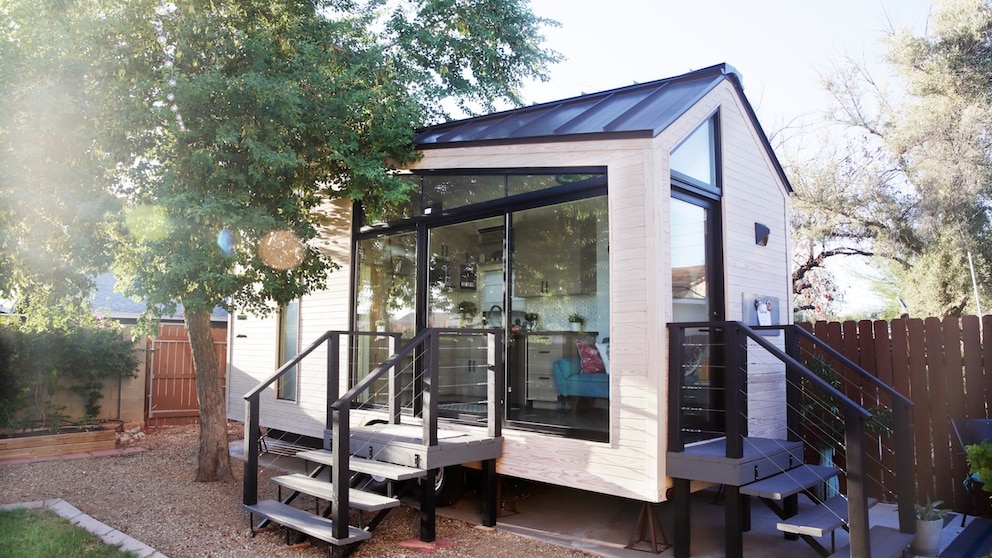
Tiny House refers to a type of living space ranging from 25 to 60 square meters. Why the term is misleading and what the legal situation in Germany looks like, myHOMEBOOK inquired with the Federal Association of Microhouses.
Follow myHOMEBOOK on WhatsApp now
Tiny House Movement from the USA
It starts with the correct terminology. “Authorities are more familiar with the term microhouse, as Tiny House is less common or sounds too American to officials,” explains Aristide Hamann, an architect with the Federal Association of Microhouses, when asked by myHOMEBOOK. In fact, the term Tiny House originates from the USA. There, a genuine Tiny House movement emerged as a result of the financial and real estate crisis in 2007 and 2008. During this time, so-called trailer parks with mobile homes were created. However, comparing them to microhouses in Germany is somewhat misleading.
Legally, a microhouse is a movable, freestanding building, the exact opposite of real estate. It is fully manufactured and then transported as a whole to the desired location. There, the small house can be connected to the necessary utility networks. “Since the house has wheels underneath, it could also be attached to a trailer hitch designed for such weight and driven through Germany,” says the architect from the Federal Association of Microhouses.
Manageable Microhouse Trend
It is still a manageable trend. According to figures from the Tiny House industry, about 75,000 people are interested in such a small, movable, freestanding building. The reasons are varied. Especially older people find their living space too large, want to downsize, and therefore choose a microhouse. Ideally, their previous, larger house then becomes available for their own offspring and family.
For better understanding: A microhouse is not a legal exception. Like any other house, its legal classification depends on its actual use. If it is primarily used for living, it is considered a building and is subject to building and planning laws like any other residential house.
Also interesting: Living in a Tiny House–the pros and cons
The different rules for using tiny houses
What Are the Risks of Building a Garden Shed Without a Permit?
Contact Authorities Early
This brings us back to the original question: Can you simply place a Tiny House in your garden? “Yes, that is generally allowed,” answers Aristide Hamann from the Federal Association of Microhouses, “but it depends on the purpose for which such a house is placed in the garden.” This determines which administrative steps are necessary in advance and which forms are required by local authorities for setting up a microhouse in your own garden.
“Anyone interested in setting up a microhouse on their own property should have the feasibility of the project checked by the municipality early on,” advises the architect, as the entire planning authority lies with the local building office. If the plan is to use the microhouse as a residence, the location should be developed, meaning connections to electricity, water, and sewage should be easily possible. This takes the most time in planning, notes architect Aristide Hamann.
Planning Horizon: Four to Six Months
Once all permits are in place, the biggest hurdle in setting up a microhouse in your own garden is already overcome. “The review period by the building office is a maximum of three months. The construction of the microhouse then takes another two to four months, depending on the size of the house,” Hamann estimates the timeline of a microhouse project. Depending on the number of square meters, a turnkey microhouse costs between 60,000 and 135,000 euros. Those who value special features will pay a bit more in the end.
There are few circumstances that speak against setting up a microhouse in your own garden. Neighbors only play a role if the distance to the adjacent property falls short of the required three meters. “Then you need the neighbor’s consent, which is usually granted,” reports Aristide Hamann from the Federal Association of Microhouses. Otherwise, the usual regulations apply to any new construction project, especially if there is proximity to nature reserves or biotopes. In this case, the locally responsible municipality could refuse permission to set up.