


July 2, 2026, 11:17 am | Read time: 4 minutes
They smell like “mountain lake,” “morning freshness,” or “sea breeze” and promise a radiant shine and hygiene with every flush: Toilet bowl cleaners are considered the undisputed standard solution for easy toilet cleaning. But do these gadgets really deliver on their promises? Or are they hiding unhealthy chemical cocktails?
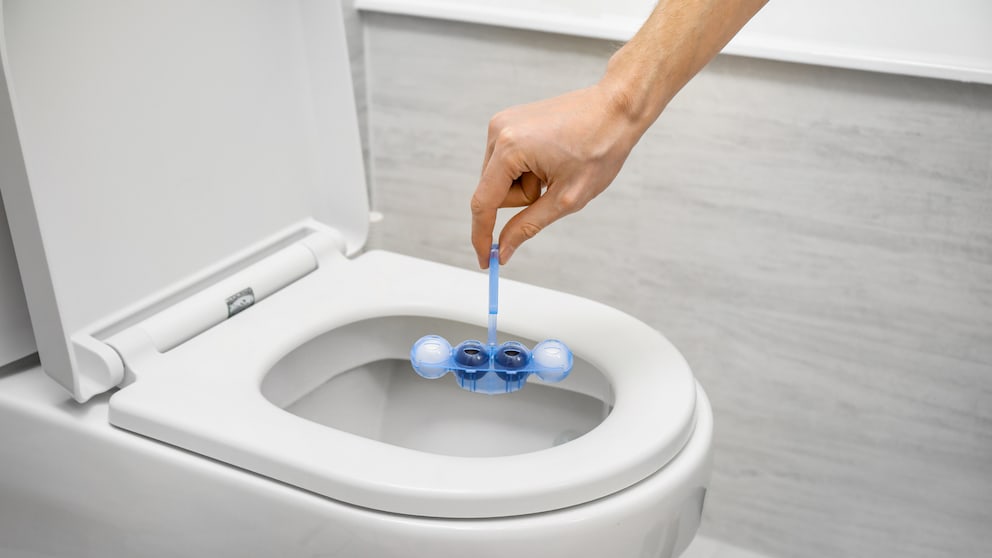
The idea behind toilet bowl cleaners is as simple as it is ingenious. They sit discreetly on the toilet rim and release measured amounts of active ingredients with each flush. These are meant to counteract impurities and keep the toilet bowl consistently clean. Additionally, the strong scent often lingers for hours after use, effectively masking unpleasant odors. No wonder toilet bowl cleaners are so popular. They simulate cleanliness and hygiene, primarily through scent and color effects. But what about their cleaning performance?
Follow myHOMEBOOK on WhatsApp now
Toilet Bowl Cleaners Don’t Replace Manual Cleaning
Microbiologically speaking, toilets are among the most contaminated places in the bathroom. Various studies have shown that ceramic surfaces are the perfect breeding ground for bacterial films. In these so-called biofilms, microorganisms can multiply almost undisturbed. They are even largely resistant to flushing and are usually found in hard-to-reach places, such as under the toilet rim. Although toilet bowl cleaners remove surface dirt with the surfactants they contain, their effectiveness is disputed.
A report from the Environmental Advisory Service in Lucerne critically states: “No toilet bowl cleaner in the world can replace the mechanical cleaning power of a toilet brush. Despite their chemicals, toilet cleaners cannot reach all areas of a toilet.” Additionally, toilet bowl cleaners are often hung in plastic holders that come into contact with water. Since germs can easily thrive here, the holders must also be regularly cleaned for impeccable hygiene.
Also interesting: Toilet clogged? A clever trick with plastic wrap helps
Ingenious or Extremely Harmful?
As described in a brochure by the German Federation for the Environment and Nature Conservation (BUND), the composition of toilet bowl cleaners burdens water bodies and does not replace mechanical cleaning. In the past, one substance was particularly problematic: “Paradichlorobenzene is the ingredient that the industry should actually dispose of as hazardous waste. (…) The chemicals can only briefly affect germs and bacteria before disappearing down the drain. In sewage treatment plants, the chemicals then cause problems.” Because the chlorinated hydrocarbon (PDCB) was classified as highly carcinogenic and irritating, it was banned in the EU about 20 years ago. Although PDCB is no longer a component of toilet bowl cleaners, the current ingredients are not significantly better and pose a threat to water bodies and sewage treatment plants, according to BUND: “Therefore, avoid the unnecessary and environmentally harmful use of chemicals.”
Urine Scale in the Toilet? These 5 Household Remedies Help

How to Achieve Pet-Friendly Cleaning at Home
What Are Toilet Bowl Cleaners Made Of?
A look at the ingredients shows: Modern toilet bowl cleaners have hardly evolved in their composition and still consist of surfactants (over 30% anionic, 5-15% nonionic surfactants) and fragrances. This combination has been criticized for years. Synthetic fragrances often appear on packaging, which are considered ecotoxic to aquatic organisms. For example, the substance Butylphenyl Methylpropional (Lilial) is known to be classified as reproductive toxic. Therefore, the EU has banned it in cosmetics. It is still commonly used in toilet bowl cleaners.
But it’s not just individual fragrances that are critical; surfactants are also problematic. They enter the wastewater with every flush. Today, according to EU regulations, they must be biodegradable. However, their constant use means an additional entry of chemical substances into the water cycle and a burden on the ecosystem. Additionally, surfactants are mostly made from fossil resources like petroleum, whose extraction consumes many resources.
Toilet Bowl Cleaners Have Their Uses, But …
Toilet bowl cleaners certainly have their uses. They provide a fresh scent and a visually clean toilet. However, they do not replace thorough cleaning, as environmental advisors and hygiene experts agree. Modern toilet bowl cleaners are no longer comparable to older products because many problematic ingredients have been replaced. Nevertheless, their composition remains critical when considering a healthy ecosystem and water bodies.
To keep your toilet consistently clean and not harm the environment, you can’t avoid the classic toilet brush. BUND recommends: “The best way to clean the toilet is with a brush and vinegar cleaner, used once or twice a week. For heavy soiling, let the vinegar cleaner work overnight.” Only then can hard-to-reach areas be reliably cleaned. According to the Consumer Center NRW, the use of organic acids like vinegar or citric acid is particularly recommended because they are completely biodegradable and reliably dissolve lime deposits.
If you also value a pleasant scent, you can place ecological alternatives outside the toilet. These air fresheners provide a subtle fragrance experience and prevent unnecessary chemicals from entering the water cycle with every flush.