


December 4, 2022, 10:38 am | Read time: 3 minutes
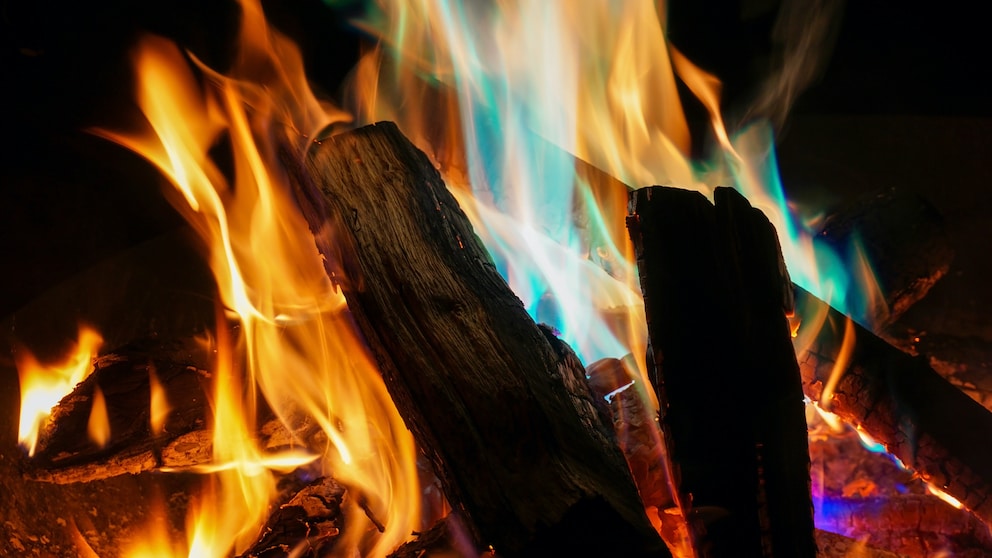
Fire captivates people. It’s not just the dance of the flames that draws us in. The warmth from a fireplace or campfire also creates a special atmosphere. With special powders, you can color fire. How this works and whether it’s even allowed is explained by myHOMEBOOK.
At first, colorful fire sounds very unusual. However, many are already familiar with it in the form of fireworks. With so-called fire colors, you can also make the flames in a fireplace or campfire appear in different colors. You simply add the powder to the fire. It’s important to use it only with solid fuels like wood.
Can you use the powder in a fireplace?
The manufacturers of fire colors state that you can color both campfires and fireplace flames with the salts. Jörg Seelbach from the Federal Association of Chimney Sweeps views this critically. The reason: According to the law, only approved fuels under § 3 Abs. 1 of the 1st BImSchV may be used in fireplaces. “The use of the powder to color the flames is therefore not legally permissible,” says Seelbach.
The differences between baking powder, baking soda, and soda ash

The Difference Between a Fireplace and a Stove
How can you color fire?
Even if you can’t use the powder in a fireplace, the question remains how it’s possible to color fire in different hues. Dr. Karin Schmitz from the German Chemical Society e.V. (GDCh) explains that the coloring of flames is related to the energetic excitation of atoms. “An atom is the smallest unit of a substance and consists, simply put, of a nucleus and electrons orbiting it.” The flame colors are made up of different salts. When you add a metal or metal salt to a hot flame, the electrons absorb the energy of the metal. “They are thus more energetic than they normally are,” says Schmitz.
And further: “However, the electrons do not absorb an arbitrary amount of energy, but only a very specific amount, uniform energy packets.” These energy packets are then released shortly afterward in the form of radiation. “The radiation has a specific wavelength characteristic of each element,” the expert continues. You can’t always see the radiation. However, if the wavelength is in the visible range, we see a colored flame.
Also interesting: That’s why you shouldn’t burn old newspapers in the fireplace
Which substance produces which color?
Depending on the metal or salt, you can produce different flame colors. Schmitz explains: “With calcium and strontium, you can color the flame red. With sodium, the flame becomes intensely yellow. Potassium makes the fire violet, while barium and copper make it green.” The corresponding elements are found in various household items. For example, sodium is found in table salt (sodium chloride) and can also be used to color fire yellow. “Potash (potassium carbonate), sometimes used instead of baking powder for baking, would produce a violet flame,” says the expert.
When using different salts to color a campfire, the expert recommends being cautious in all cases. “For all chemical experiments at home, it’s advisable to wear safety goggles.”