


September 28, 2026, 2:17 pm | Read time: 5 minutes
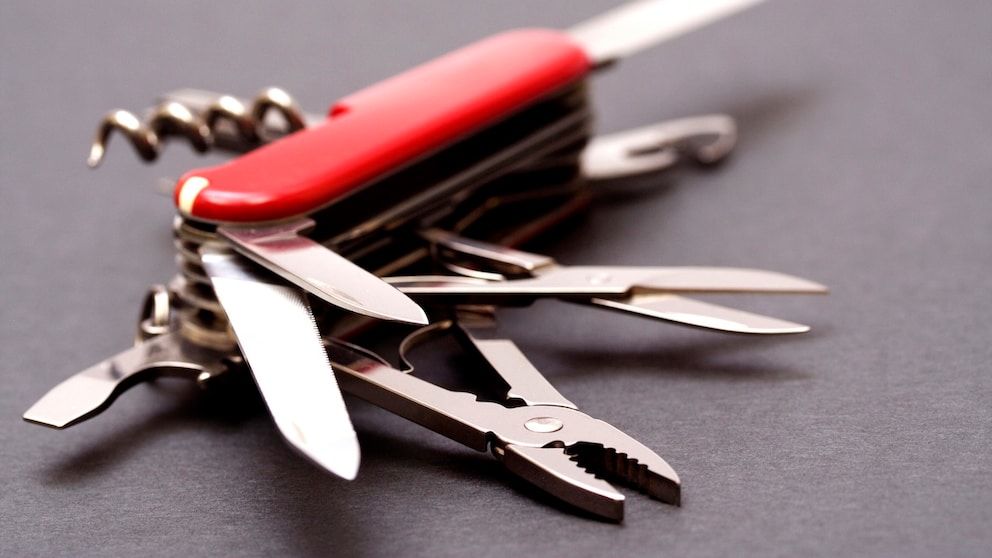
Somewhere in a drawer, it lies. Among batteries, stamps, and a key that no longer fits any door. Red, with a white cross, the blade slightly dull from whittling branches. A pocketknife, gifted by a father, a grandfather, or a travel-loving aunt. Millions of people own such an item. Hardly anyone knows its full story. Why a German detour is part of the Swiss Army Knife’s origin is what this myHOMEBOOK article reveals.
It was invented, unsurprisingly, by a Swiss. However, it didn’t happen without German help. The trail leads to Solingen, the city that has been producing high-quality cutting tools since the Middle Ages.
But first, let’s start from the beginning. The story begins in 1884 in the small Swiss community of Ibach in the canton of Schwyz. There, Karl Elsener opened a workshop for knives and surgical instruments. However, initially, hardly anyone in Switzerland took notice.
Follow myHOMEBOOK on WhatsApp now
New Soldier’s Knife Sought
By the end of 1890, the Swiss military department was looking for a manufacturer for special knives. The new cutting tool for soldiers was to have not only a blade but also a screwdriver for the then-current rifle “Model 1889,” a can opener, and an awl for punching holes in leather. One handle, four tools. The Swiss military urgently needed such a model, specifically 15,000 pieces. The request went directly to a German company in Solingen.
At the time, the military didn’t believe a Swiss knife maker could deliver such a large quantity. But the knife manufacturers in Switzerland heard about it and protested loudly. Among the protesters was Karl Elsener. He rallied the fragmented industry and, in 1891, founded the Swiss Knife Makers Association with 30 colleagues.
After further reports about the protests in the local press, Swiss companies were finally allowed to bid for the military contract. Karl Elsener won the contract and began supplying the soldier’s knives with special functions. Thus, the icon of Swiss identity began with a detour through Solingen.
Also interesting: How to properly sharpen a dull knife in 4 steps
A Spring as a Brilliant Business Idea
But business remained tough for Karl Elsener. In 1892, most of his association colleagues dropped out because the Solingen manufacturers could produce much cheaper. Karl Elsener persevered, writing red numbers year after year.
With a brilliant idea, the Swiss knife manufacturer turned things around. In June 1897, he patented a lighter knife model with a clever twist–a spring held tools on both sides of the handle, instead of just one. This made it easier to open and close the tools. It was the birth of the “Officer’s and Sports Knife,” slimmer and more elegant than the previous, rather bulky army knife.
The Swiss military never bought it. However, officers and private buyers showed great interest in the knife, as it included an additional tool–a corkscrew. More and more people wanted such a knife. Elsener’s company was saved.
Of course, a brand name was still needed. Karl Elsener’s mother’s name was Victoria. The body of the popular knife was made of stainless steel. In French, this is called “inox.” So, in 1909, after his mother’s death, Karl Elsener initially named his company “Victoria.” Later, the name changed to “Victorinox.” The company still exists today and continues to produce Swiss Army Knives. The knife is known worldwide. U.S. soldiers gave it the name “Swiss Army Knife.” The word “Officer’s Knife” was too cumbersome for Americans.
Who Is Behind the Tool Brand Stanley?

The Barcelona Chair and Its Royal History
A Folding Knife in Space
The multifunctional tool remains a bestseller and a popular gift to this day. Since 1968, a model has been part of the permanent collection at the Museum of Modern Art in New York.
The Swiss Army Knife, now a work of art, even made it to space. Since the late 1970s, a “Swiss Army Knife” has been part of the standard equipment for NASA astronauts. It has often proven its worth in space, such as in 1995. At that time, Canadian astronaut Chris Hadfield docked the Space Shuttle with the Russian space station Mir. But the hatch was stuck. Special tools from the Russian engineers didn’t help. So Hadfield turned to his Swiss Army Knife: “We kind of broke into the Mir with it,” he explained after returning to Earth. Later, he wrote in a book about his time as an astronaut: “Never leave the planet without one,” meaning without a pocketknife.
The story of the Swiss Army Knife is almost fully told. One question remains: Can you simply carry it in public?
Weapon or Collector’s Item?
The Swiss Army Knife has become a cult object. Many young people have inherited a model from an older person. But ultimately, it is still a knife. Does that automatically make it a weapon?
To answer the question, a look at the weapons law helps. It states in § 42a, among other things: “It is prohibited to carry knives with a one-handed locking blade (one-hand knives) or fixed knives with a blade length over 12 cm.”
The key word is “locking.” A classic Swiss Army Knife holds its blade only with spring force. Nothing can be locked. Light pressure is enough to fold it. Thus, the original generally does not fall under the ban, even if some models can be opened with one hand. However, on flights, it is not allowed in carry-on luggage but belongs in the suitcase.
Legally, the Swiss Army Knife is considered a utility knife and is thus purely a tool. This is exactly what Karl Elsener designed the Swiss Army Knife for, as a combination of a can opener and screwdriver for rifles, not as a weapon.