


September 10, 2026, 1:31 pm | Read time: 4 minutes
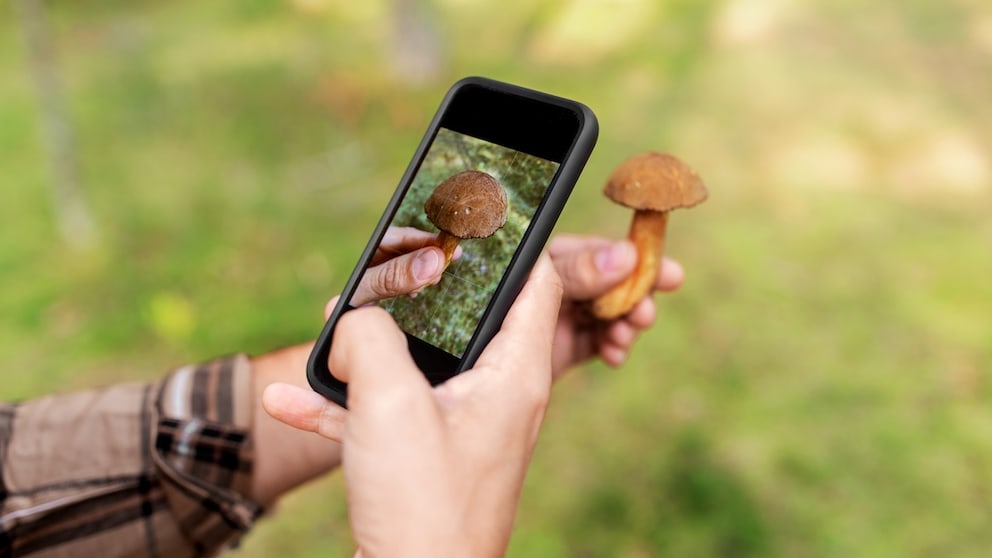
Adventurous forest walks, dodging spider webs, and ultimately hoping for a well-filled mushroom pan are part of fall for many. Nowadays, many use AI-supported apps for this. These promise to reliably identify found mushrooms via photo. What sounds practical, however, carries risks. Can artificial intelligence really distinguish whether a mushroom is edible or poisonous? And how reliable are these digital helpers when even small mistakes can have serious consequences? A mushroom expert explains what AI can achieve in mushroom picking and where its limits lie.
AI Apps Can Ease the Entry
In principle, mushroom expert Gerhard Schuster from the German Society for Mycology views AI-supported identification apps positively. Similar applications for plants or bird calls have already shown how much knowledge can be conveyed with their help in a low-threshold way.
“Basically, I think AI-supported mushroom identification apps are a great thing,” he says. Instead of laboriously searching through identification books, existing curiosity can be satisfied much more easily. Additionally, quicker success experiences can make it easier to get started with mushroom identification.
Also interesting: Properly drying and preserving mushrooms
Some Apps Are Surprisingly Accurate
According to the expert, there are significant differences between the individual applications, but some programs are now surprisingly powerful in image recognition. “There is already a certain range in quality, but some apps are quite astonishingly good at identification,” he explains.
The biggest advantage lies mainly in speed. While traditional identification books often require systematically ruling out various features, apps provide a suggestion within seconds. Another advantage, according to Schuster, is the weight: “Besides, the apps are not a burden when hiking in the forest.” And a smartphone is almost always with you, the expert adds.
Why the Technology Can Still Be Dangerous
Besides the advantages, the mushroom expert also sees a crucial drawback. “The weakness is the supposed simplicity and suggested safety in identifications,” he warns. He explains the potential consequences: “The risk of poisoning is high because with an app, you often approach species that you would have left aside before. The threshold is lowered by the suggested safety.”
Relying on an app’s assessment could make one more willing to take or even consume unknown mushrooms. This is where the expert sees a significant risk.
What AI Cannot Recognize in Photos
Another problem: For the safe identification of many mushroom species, a photo alone is often not enough. Experienced mushroom hunters also pay attention to features that an app currently cannot capture. “No app is yet able to recognize the often identification-relevant smell,” says the expert. The texture of a mushroom also plays an important role. Some species have a characteristic surface or consistency.
“Russulas, for example, feel waxy like a candle. As far as I know, no app can recognize that yet.” Smell, feel, and other subtleties can therefore provide crucial clues that are lost in a purely image-based analysis.
Related: What lies behind the mysterious mushroom rings in the lawn
Never Eat Mushrooms Based Solely on an App
For consumers, the expert has a clear recommendation: Apps are excellent for identifying unknown finds out of interest or learning more about mushrooms. However, they should never be the sole basis for a consumption decision.
“Never eat mushrooms based solely on an app’s identification,” he emphasizes. “A mushroom poisoning is often no fun at all.” Since no one in Germany relies on wild mushrooms to get full, there is no reason to take a risk in identification. For the curious, the applications are still valuable. “For identifying unknown mushrooms out of curiosity, apps are really great.”
Which Poisonous Look-Alikes to Know When Mushroom Foraging
What Can Fyta’s Smart Plant Sensors Do?
Could AI Solve the Problem in the Future?
In the long term, the expert does not rule out that new technologies could make mushroom identification significantly safer. Devices that directly analyze a mushroom’s biological characteristics are conceivable.
“Maybe an app will soon be developed that works with a sensor capable of performing a quick gene sequencing,” he says. “You poke the sensor into the mushroom, and you get the species identified.” However, until such technologies are actually available and reliable, a significant risk remains. “But it’s not there yet, so the risk remains far too high for now.”
Would the Expert Trust an AI Judgment Himself?
The answer is clear: No. Although Schuster has been collecting and identifying mushrooms for many years, he would not rely solely on an app for a new species. “Before I try a new species, I have to be completely sure of my identification, and I wouldn’t be with just an app.”
His experience shows what ultimately matters in mushroom picking: To safely recognize an edible mushroom, one should thoroughly engage with its characteristics, smell it, touch it, and know possible look-alikes. An AI can help with this, but it does not yet replace this knowledge.