



November 25, 2026, 12:17 pm | Read time: 7 minutes
The holiday season is approaching, and with it, the question of the Christmas tree. The selection is vast, as artificial trees are becoming increasingly popular alongside real firs. Which Christmas tree is truly the most eco-friendly? myHOMEBOOK consulted experts.
Follow myHOMEBOOK on WhatsApp now
For many, Christmas without a tree is unimaginable. According to a representative survey by myHOMEBOOK in 2021, the real Christmas tree is the most popular. It smells wonderful and looks great. However, a real tree must be disposed of at the end of the holiday season, which is not exactly sustainable. It’s different with artificial Christmas trees. These can be used again next year. But how sustainable is an artificial Christmas tree made of plastic really?
Overview
Many Christmas Trees Are Contaminated with Insecticides
Many of the Christmas trees sold here come from German plantations. There, trees of the same species often stand together, making them more susceptible to certain pests. Therefore, plant protection products are sometimes used over several years. Depending on the tree species, desired size, and growing conditions, it usually takes about eight to twelve years before a Christmas tree can be cut down. The products are intended to protect the trees from pests and ensure even growth. However, their use can also affect beneficial insects and burden soils and waters. Studies repeatedly detect pesticide residues on Christmas trees. Whether and to what extent these substances evaporate in the living room or are absorbed by humans has not yet been sufficiently investigated.
Also interesting: Why many decorate the Christmas tree only on Christmas Eve
Pros and Cons of an Artificial Christmas Tree
An artificial Christmas tree usually only needs to be purchased once and lasts for several years. This means lower costs and less effort, not least because such a tree doesn’t shed needles. Additionally, allergy sufferers and those with insect phobias handle an artificial fir better. The tree requires little maintenance and doesn’t need watering. TÜV-certified artificial firs are also flame-retardant.
But how environmentally friendly is a tree made of plastic? Basically, plastic is bad for nature. The PVC or polyethylene contained in the artificial Christmas tree is not biodegradable. Nevertheless, an artificial tree can be more eco-friendly if used for many years. However, it is not possible to say exactly how long. Depending on the material, weight, origin, transport, and disposal, studies come to different conclusions.
A Canadian study from 2009 found that a Chinese-made artificial Christmas tree causes about 48 kilograms of CO₂ equivalents during production, transport, and disposal. For a natural tree, it was about 3.1 kilograms of CO₂ equivalents under the study’s assumptions. However, these values cannot be universally applied to every Christmas tree. The British Carbon Trust also points out that the carbon footprint depends on factors such as material, weight, transport, and usage duration.
Therefore, it is crucial to use an existing artificial tree for as long as possible. There are currently no reliable, representative figures on how many years artificial trees are used on average in Germany. If the tree is to look as natural as possible, it can also be relatively expensive.
Environmental Impact of the Real Fir
The Classic
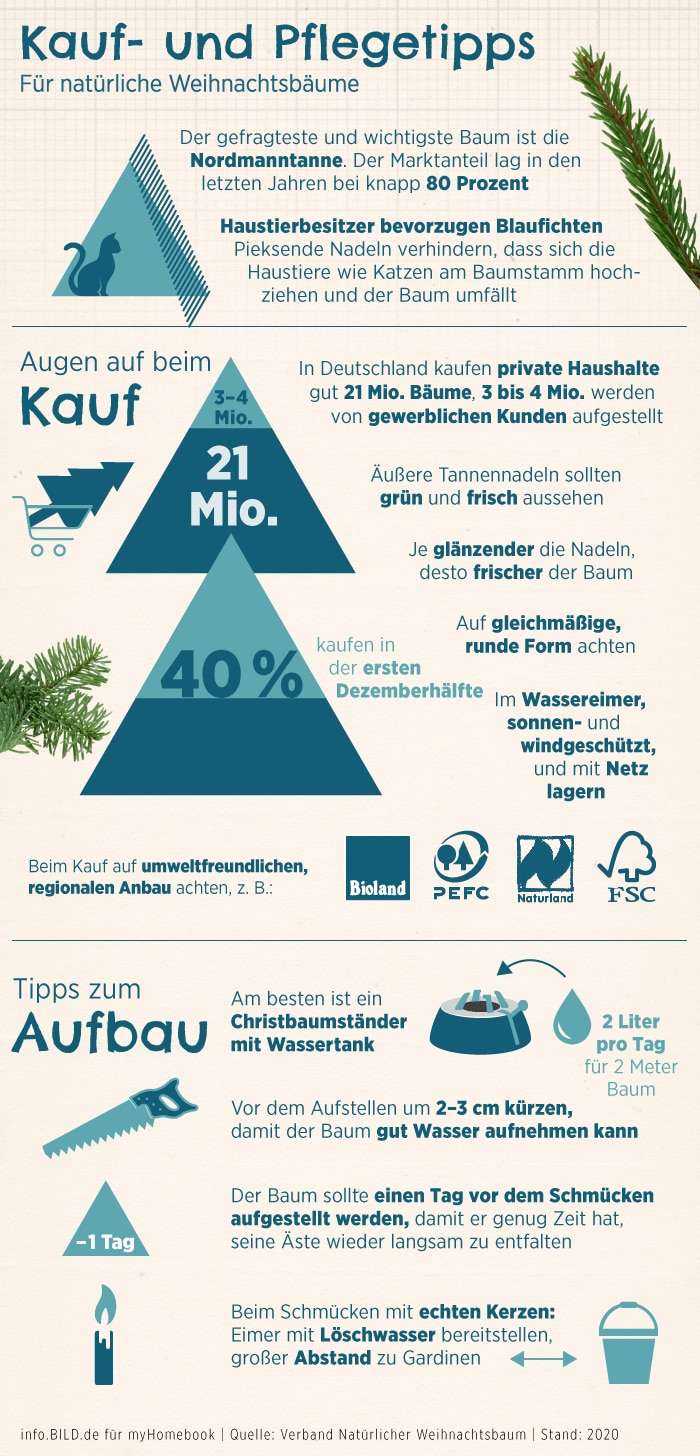
The Nordmann fir remains the most popular Christmas tree in Germany. Forest expert Jana Ballenthien knows its advantages: “Because it’s so beautifully green and soft and doesn’t shed needles.” Behind it are blue spruce, red spruce, and other species. “The real Christmas tree outperforms its artificial competitors by far,” says Denny Ohnesorge, managing director of the German Wood Industry Association (HDH). According to the association, naturally grown trees are generally climate-neutral. “During growth, they process climate-damaging CO₂ from the atmosphere. When the tree is later utilized, less CO₂ is released than was previously stored,” is the argument. After the holiday, the trees are mostly composted or used for energy production.
A natural tree has a comparatively good carbon footprint, especially if it comes from the region, is grown without chemical-synthetic pesticides, and is properly disposed of after the holiday. Transport also plays an important role: long car trips just to buy the tree can significantly worsen its carbon footprint. The German Nature Conservation Association (Nabu) recommends buying spruces, pines, and silver firs from thinning operations or from special forestry sites such as under high-voltage lines. These usually untreated trees would have to be felled anyway.
The environmental organization Robin Wood points out that most of the Christmas trees sold in Germany come from plantations that are fertilized and sprayed with pesticides, with corresponding burdens on soils, waters, and animals. Studies by BUND also regularly detect pesticide residues on Christmas trees. Whether and to what extent these substances evaporate in the living room or can be absorbed by humans is, according to ROBIN WOOD, not yet investigated. Consumers must therefore weigh whether they want to take this potential risk.
The Organic Fir
If you don’t plan to use your artificial Christmas tree forever, you should opt for a natural product from the region. Even better with an organic label. What has caught on more quickly with food takes longer with Christmas trees, says Ballenthien. According to ROBIN WOOD, it is not possible to reliably determine how large the share of organically produced Christmas trees actually is, as reliable sales figures are lacking. The environmental organization currently estimates the share at around one percent.
Once you’ve found a seller with organic trees, you must expect different prices depending on the region. In rural areas, the trees tend to be somewhat cheaper, while in larger cities, they are a bit more expensive, explains Jana Ballenthien. The Federal Environment Agency recommends the following labels as trustworthy: Bio, Bioland, Naturland, Demeter, or FSC. The key is that no chemicals may be used–neither in fertilization nor in pest control, explains Jana Ballenthien.
The Tree with Roots
Could it be even more environmentally friendly? Yes, if the tree would survive the Christmas season. The idea of buying a tree with roots instead of a cut Christmas tree sounds theoretically sustainable and good. The problem: In practice, many trees do not survive a second holiday. Trees that are dug up with their roots shortly before Christmas and pressed into a pot would survive the upcoming holiday, “but not a second one,” warns Jana Ballenthien. It is different, according to him, with Christmas trees that have been grown in a pot from the beginning and have been repotted into larger containers over the years.
But even these trees suffer, according to the ROBIN WOOD expert, because they are naturally in hibernation in December. “And when they come into the warm house, they are awakened from hibernation and lose their frost protection,” warns the expert. Later, after two weeks in the warm living room, the trees could easily freeze outside. An exception: The tree with roots is rented from a local nursery, garden center, or forestry and returned there.
Interested parties should also note that large trees with large roots often need to be watered because otherwise, they quickly suffer from drought damage. Additionally, a 1.5-meter-high Christmas tree requires a pot containing about 50 kilograms of soil.

Real Christmas Tree or Artificial Fir: Which Is Better for the Environment?

Are Christmas Trees More Expensive This Year?
Where to Put the Fir After Christmas?
A pesticide-free organic fir tree can be easily disposed of on the compost after the holiday. Before doing so, the tree should be stripped of Christmas decorations and tinsel. You can also skip lacquer and glitter sprays, as toxins are not good for the compost heap. Otherwise, most municipalities offer a collection service. For this, the undecorated fir tree should be placed outside the door on the respective day.
How About a DIY Christmas Tree?

If you build your own Christmas tree, you don’t have to worry about disposal or potential pesticide contamination. The possibilities are almost limitless. Whether a free-standing tree or one-dimensional on the wall, anything is possible. The good thing is, you can redesign or expand it every year.