


September 23, 2026, 10:53 am | Read time: 3 minutes
Anyone who collects mushrooms should definitely be familiar with the death cap mushroom. It is one of the most poisonous mushroom species in Germany. The Federal Institute for Risk Assessment (BfR) estimates that the mushroom is responsible for at least 80 percent of all fatal mushroom poisonings in Germany.
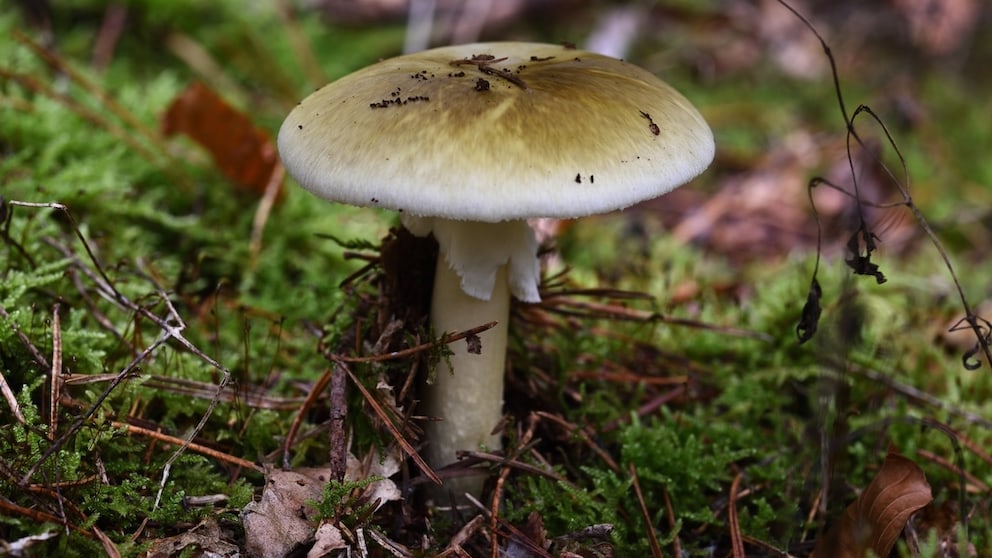
The name of the death cap mushroom can be misleading. “What is particularly insidious about the death cap is that it can appear in a purely white variant, which is not very rare,” says geologist Gerhard Schuster from the German Mycological Society. myHOMEBOOK explains which characteristics are really crucial for identification.
What makes the death cap mushroom so dangerous
The poisoning process occurs in three phases, writes the German Mycological Society (DGfM). “Relatively slowly, 4–6–24 hours after consumption, there is uncontrollable vomiting, cholera-like diarrhea, accompanied by severe abdominal pain,” it states. This phase is followed by a “deceptive recovery” lasting about two to four days. “After that, the effects of the severely damaged liver come to the forefront. Jaundice, liver swelling, and the consequences of liver damage-related blood clotting disorders with stomach and intestinal bleeding,” writes the DGfM.
Related: Which poisonous look-alikes you should know when collecting mushrooms
If poisoning is not treated at all or too late, according to the DGfM, death can occur within three to ten days. Heating is also not a solution. One of the toxins in the death cap mushroom is amatoxins. These are heat-stable, writes the DGfM. Even cooking the mushrooms does not eliminate their toxic effect.
Is it really the most poisonous mushroom in Central Europe?
The DGfM confirms the assumption that the death cap mushroom is the most poisonous mushroom in Central Europe: “Most fatal mushroom poisonings in Central Europe are due to the death cap mushroom. Consuming just 50 grams of a mushroom fruiting body can be fatal. The liver-toxic amatoxins it contains cause multiple organ failure without medical treatment.” In the Anglo-American world, the death cap mushroom is even called “deathcap,” which means “death cap.”
Why the Green Death Cap Mushroom Is So Dangerous
Which Poisonous Look-Alikes to Know When Mushroom Foraging
Please do not confuse champignons with the death cap mushroom!
The death cap mushroom can be confused with the meadow mushroom. An important distinguishing feature is the gills. In champignons, the gills are colored. In young mushrooms, they are gray-pink, in older ones, dark brown. In the death cap mushroom, however, the gills are white, writes the Nature Conservation Association of Lower Saxony. There is a particularly dangerous similarity in young mushrooms. Schuster from the DGfM recommends: “Anyone who completely avoids mushrooms with gills and only collects boletes is already safe from deadly poisonous mushrooms.”
If poisoning is suspected, one should immediately go to a hospital. Contacting a poison control center is also recommended. Ideally, some mushrooms are left over, so it can be quickly determined what type of poisoning it is.
These features help identify the death cap mushroom
According to the German Mycological Society, the mushroom has a greenish color that can fade towards the edge. Its cap is initially hemispherical but flattens over time, reaching a diameter of up to twelve centimeters. The stem can be up to ten centimeters long and about two centimeters thick. It is also characterized by its smell, reminiscent of artificial honey or a sweet invert sugar cream.